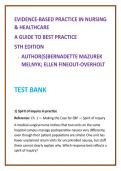
EVIDENCE-BASED PRACTICE IN NURSING
& HEALTHCARE
A GUIDE TO BEST PRACTICE
5TH EDITION
• AUTHOR(S)BERNADETTE MAZUREK
MELNYK; ELLEN FINEOUT-OVERHOLT
TEST BANK
1) Spirit of inquiry in practice
Reference: Ch. 1 — Making the Case for EBP — Spirit of Inquiry
A medical-surgical nurse notices that two units on the same
hospital campus manage postoperative nausea very differently,
even though their patient populations are similar. One unit has
fewer unplanned return visits for uncontrolled nausea, but staff
there cannot clearly explain why. Which response best reflects a
spirit of inquiry?
,A. Continue the current unit routine because local practice is
already established
B. Ask what evidence explains the difference and whether the
better outcome can be replicated
C. Wait until administration mandates a formal practice change
D. Survey staff opinions to determine which unit feels more
confident
Correct Answer: B
Rationale — Correct: A spirit of inquiry begins with questioning
variation in practice and asking whether outcomes differ
because of evidence-based methods. The nurse is not simply
collecting opinions; the nurse is identifying a practice gap that
could justify EBP exploration and eventual change.
Rationale — Incorrect A: Tradition alone is not evidence.
Maintaining routine without questioning outcome variation
misses the first step in EBP.
Rationale — Incorrect C: EBP begins with nurse-initiated
questioning, not only top-down mandates.
Rationale — Incorrect D: Staff confidence may matter, but it
does not answer whether the practice is supported by
evidence.
Teaching Point: Curiosity starts with noticing outcome variation,
then asking why it exists.
Citation: Melnyk, B. M., & Fineout-Overholt, E. (2023).
Evidence-Based Practice in Nursing & Healthcare (5th ed.). Ch.
1.
,2) Identifying a practice gap
Reference: Ch. 1 — Making the Case for EBP — Practice Gap
Identification
A unit manager wants to improve oral care for ventilated
patients. Staff report that “we already do oral care,” but the
infection rate remains higher than benchmark data. Which
finding most strongly indicates a practice gap?
A. Staff are familiar with the oral care policy
B. The unit has higher ventilator-associated infection rates than
comparable units
C. Nurses prefer different oral care tools
D. The policy is several pages long and difficult to read
Correct Answer: B
Rationale — Correct: A practice gap exists when outcomes are
not meeting expected standards or benchmarks. Higher
infection rates suggest the current approach may not be
effective enough and should be examined against best
evidence.
Rationale — Incorrect A: Familiarity with policy does not prove
effectiveness.
Rationale — Incorrect C: Preference alone is not evidence of a
quality problem.
Rationale — Incorrect D: A long policy may affect usability, but
it does not by itself establish an outcome gap.
, Teaching Point: A practice gap is usually revealed by poor or
inconsistent outcomes, not by opinions alone.
Citation: Melnyk, B. M., & Fineout-Overholt, E. (2023).
Evidence-Based Practice in Nursing & Healthcare (5th ed.). Ch.
1.
3) Best first EBP move
Reference: Ch. 1 — Making the Case for EBP — Getting Started
A nurse hears that several patients are dissatisfied with
nighttime interruptions on a telemetry unit. The nurse believes
the issue may be related to clustered care, but no one has
reviewed the data. What is the best first step?
A. Implement clustered care immediately across the unit
B. Gather baseline data and define the problem clearly
C. Choose a new workflow based on staff preference
D. Wait for a randomized trial before taking any action
Correct Answer: B
Rationale — Correct: Early EBP work requires defining the
problem and understanding baseline performance before
selecting an intervention. This avoids premature action and
helps determine whether change is truly needed.
Rationale — Incorrect A: Acting before clarifying the problem
can lead to ineffective or poorly targeted change.
Rationale — Incorrect C: Preference is not sufficient to justify
system-wide practice change.
& HEALTHCARE
A GUIDE TO BEST PRACTICE
5TH EDITION
• AUTHOR(S)BERNADETTE MAZUREK
MELNYK; ELLEN FINEOUT-OVERHOLT
TEST BANK
1) Spirit of inquiry in practice
Reference: Ch. 1 — Making the Case for EBP — Spirit of Inquiry
A medical-surgical nurse notices that two units on the same
hospital campus manage postoperative nausea very differently,
even though their patient populations are similar. One unit has
fewer unplanned return visits for uncontrolled nausea, but staff
there cannot clearly explain why. Which response best reflects a
spirit of inquiry?
,A. Continue the current unit routine because local practice is
already established
B. Ask what evidence explains the difference and whether the
better outcome can be replicated
C. Wait until administration mandates a formal practice change
D. Survey staff opinions to determine which unit feels more
confident
Correct Answer: B
Rationale — Correct: A spirit of inquiry begins with questioning
variation in practice and asking whether outcomes differ
because of evidence-based methods. The nurse is not simply
collecting opinions; the nurse is identifying a practice gap that
could justify EBP exploration and eventual change.
Rationale — Incorrect A: Tradition alone is not evidence.
Maintaining routine without questioning outcome variation
misses the first step in EBP.
Rationale — Incorrect C: EBP begins with nurse-initiated
questioning, not only top-down mandates.
Rationale — Incorrect D: Staff confidence may matter, but it
does not answer whether the practice is supported by
evidence.
Teaching Point: Curiosity starts with noticing outcome variation,
then asking why it exists.
Citation: Melnyk, B. M., & Fineout-Overholt, E. (2023).
Evidence-Based Practice in Nursing & Healthcare (5th ed.). Ch.
1.
,2) Identifying a practice gap
Reference: Ch. 1 — Making the Case for EBP — Practice Gap
Identification
A unit manager wants to improve oral care for ventilated
patients. Staff report that “we already do oral care,” but the
infection rate remains higher than benchmark data. Which
finding most strongly indicates a practice gap?
A. Staff are familiar with the oral care policy
B. The unit has higher ventilator-associated infection rates than
comparable units
C. Nurses prefer different oral care tools
D. The policy is several pages long and difficult to read
Correct Answer: B
Rationale — Correct: A practice gap exists when outcomes are
not meeting expected standards or benchmarks. Higher
infection rates suggest the current approach may not be
effective enough and should be examined against best
evidence.
Rationale — Incorrect A: Familiarity with policy does not prove
effectiveness.
Rationale — Incorrect C: Preference alone is not evidence of a
quality problem.
Rationale — Incorrect D: A long policy may affect usability, but
it does not by itself establish an outcome gap.
, Teaching Point: A practice gap is usually revealed by poor or
inconsistent outcomes, not by opinions alone.
Citation: Melnyk, B. M., & Fineout-Overholt, E. (2023).
Evidence-Based Practice in Nursing & Healthcare (5th ed.). Ch.
1.
3) Best first EBP move
Reference: Ch. 1 — Making the Case for EBP — Getting Started
A nurse hears that several patients are dissatisfied with
nighttime interruptions on a telemetry unit. The nurse believes
the issue may be related to clustered care, but no one has
reviewed the data. What is the best first step?
A. Implement clustered care immediately across the unit
B. Gather baseline data and define the problem clearly
C. Choose a new workflow based on staff preference
D. Wait for a randomized trial before taking any action
Correct Answer: B
Rationale — Correct: Early EBP work requires defining the
problem and understanding baseline performance before
selecting an intervention. This avoids premature action and
helps determine whether change is truly needed.
Rationale — Incorrect A: Acting before clarifying the problem
can lead to ineffective or poorly targeted change.
Rationale — Incorrect C: Preference is not sufficient to justify
system-wide practice change.