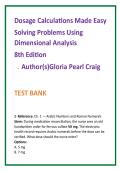
Dosage Calculations Made Easy
Solving Problems Using
Dimensional Analysis
8th Edition
• Author(s)Gloria Pearl Craig
TEST BANK
1) Arabic Numbers and Roman Numerals
Reference: Ch. 1 — Arabic Numbers and Roman Numerals
Stem:
The provider prescribes morphine sulfate XIV mg PO. The
tablets available are 2 mg each. How many tablets should the
nurse administer?
Options:
A. 6 tablets
,B. 7 tablets
C. 8 tablets
D. 14 tablets
Correct Answer: B. 7 tablets
Rationale:
Correct answer: XIV = 14 mg. Dimensional analysis:
14 mg×1 tablet2 mg=7 tablets14 \text{ mg} \times \frac{1 \text{
tablet}}{2 \text{ mg}} = 7 \text{ tablets}14 mg×2 mg1 tablet
=7 tablets. The mg units cancel, leaving tablets.
A: 6 tablets reflects an undercount or rounding error.
C: 8 tablets overestimates the dose and is unsafe.
D: 14 tablets ignores the tablet strength entirely.
Teaching Point: Roman numerals must be converted before
dose calculation.
Citation: Craig, G. P. (n.d.). Dosage Calculations Made Easy:
Solving Problems Using Dimensional Analysis (8th ed., Ch. 1).
2) Arabic Numbers and Roman Numerals
Reference: Ch. 1 — Arabic Numbers and Roman Numerals
Stem:
The provider orders cefadroxil XLV mg PO. The suspension
available is 15 mg/mL. How many milliliters should the nurse
administer?
,Options:
A. 2 mL
B. 3 mL
C. 4 mL
D. 6 mL
Correct Answer: B. 3 mL
Rationale:
Correct answer: XLV = 45 mg. Dimensional analysis:
45 mg×1 mL15 mg=3 mL45 \text{ mg} \times \frac{1 \text{
mL}}{15 \text{ mg}} = 3 \text{ mL}45 mg×15 mg1 mL=3 mL.
Units cancel correctly to mL.
A: 2 mL is too low and suggests a division or numeral
conversion error.
C: 4 mL overestimates the dose.
D: 6 mL doubles the correct amount and is unsafe.
Teaching Point: Convert Roman numerals first, then calculate
the dose.
Citation: Craig, G. P. (n.d.). Dosage Calculations Made Easy:
Solving Problems Using Dimensional Analysis (8th ed., Ch. 1).
3) Multiplying Fractions
Reference: Ch. 1 — Multiplying Fractions
, Stem:
A client is prescribed 2/3 tablet of a medication that contains
3/4 mg per tablet. How many milligrams will the client receive?
Options:
A. 1/4 mg
B. 1/2 mg
C. 3/4 mg
D. 5/6 mg
Correct Answer: B. 1/2 mg
Rationale:
Correct answer: 23×34=612=12\frac{2}{3} \times \frac{3}{4} =
\frac{6}{12} = \frac{1}{2}32×43=126=21. The common factors
cancel, leaving 1/2 mg.
A: 1/4 mg is too low and may reflect multiplying only the
denominators.
C: 3/4 mg ignores the fraction of the tablet ordered.
D: 5/6 mg is not the product of the given fractions.
Teaching Point: Multiply straight across, then simplify before
finalizing the dose.
Citation: Craig, G. P. (n.d.). Dosage Calculations Made Easy:
Solving Problems Using Dimensional Analysis (8th ed., Ch. 1).
4) Multiplying Fractions
Reference: Ch. 1 — Multiplying Fractions
Solving Problems Using
Dimensional Analysis
8th Edition
• Author(s)Gloria Pearl Craig
TEST BANK
1) Arabic Numbers and Roman Numerals
Reference: Ch. 1 — Arabic Numbers and Roman Numerals
Stem:
The provider prescribes morphine sulfate XIV mg PO. The
tablets available are 2 mg each. How many tablets should the
nurse administer?
Options:
A. 6 tablets
,B. 7 tablets
C. 8 tablets
D. 14 tablets
Correct Answer: B. 7 tablets
Rationale:
Correct answer: XIV = 14 mg. Dimensional analysis:
14 mg×1 tablet2 mg=7 tablets14 \text{ mg} \times \frac{1 \text{
tablet}}{2 \text{ mg}} = 7 \text{ tablets}14 mg×2 mg1 tablet
=7 tablets. The mg units cancel, leaving tablets.
A: 6 tablets reflects an undercount or rounding error.
C: 8 tablets overestimates the dose and is unsafe.
D: 14 tablets ignores the tablet strength entirely.
Teaching Point: Roman numerals must be converted before
dose calculation.
Citation: Craig, G. P. (n.d.). Dosage Calculations Made Easy:
Solving Problems Using Dimensional Analysis (8th ed., Ch. 1).
2) Arabic Numbers and Roman Numerals
Reference: Ch. 1 — Arabic Numbers and Roman Numerals
Stem:
The provider orders cefadroxil XLV mg PO. The suspension
available is 15 mg/mL. How many milliliters should the nurse
administer?
,Options:
A. 2 mL
B. 3 mL
C. 4 mL
D. 6 mL
Correct Answer: B. 3 mL
Rationale:
Correct answer: XLV = 45 mg. Dimensional analysis:
45 mg×1 mL15 mg=3 mL45 \text{ mg} \times \frac{1 \text{
mL}}{15 \text{ mg}} = 3 \text{ mL}45 mg×15 mg1 mL=3 mL.
Units cancel correctly to mL.
A: 2 mL is too low and suggests a division or numeral
conversion error.
C: 4 mL overestimates the dose.
D: 6 mL doubles the correct amount and is unsafe.
Teaching Point: Convert Roman numerals first, then calculate
the dose.
Citation: Craig, G. P. (n.d.). Dosage Calculations Made Easy:
Solving Problems Using Dimensional Analysis (8th ed., Ch. 1).
3) Multiplying Fractions
Reference: Ch. 1 — Multiplying Fractions
, Stem:
A client is prescribed 2/3 tablet of a medication that contains
3/4 mg per tablet. How many milligrams will the client receive?
Options:
A. 1/4 mg
B. 1/2 mg
C. 3/4 mg
D. 5/6 mg
Correct Answer: B. 1/2 mg
Rationale:
Correct answer: 23×34=612=12\frac{2}{3} \times \frac{3}{4} =
\frac{6}{12} = \frac{1}{2}32×43=126=21. The common factors
cancel, leaving 1/2 mg.
A: 1/4 mg is too low and may reflect multiplying only the
denominators.
C: 3/4 mg ignores the fraction of the tablet ordered.
D: 5/6 mg is not the product of the given fractions.
Teaching Point: Multiply straight across, then simplify before
finalizing the dose.
Citation: Craig, G. P. (n.d.). Dosage Calculations Made Easy:
Solving Problems Using Dimensional Analysis (8th ed., Ch. 1).
4) Multiplying Fractions
Reference: Ch. 1 — Multiplying Fractions