
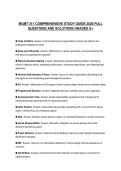
MGMT 311 COMPREHENSIVE STUDY GUIDE 2026 FULL
QUESTIONS AND SOLUTIONS GRADED A+
● Code of Ethics. Answer: Formal statement of organization's values and ethical rules
employees expected to follow
● Deep-Level Diversity. Answer: Differences in values, personality, and work preferences
that become progressively important
● Rational Decision Making. Answer: Systematic process defining problem, identifying
criteria, weighing criteria, developing alternatives, evaluating alternatives, and selecting best
alternative
● General Administrative Theory. Answer: Focus on entire organization describing what
managers do and constituting good management practice
● EU. Answer: Abbreviation for European Union creating single market across member states
● Programmed Decision. Answer: Repetitive decision handled using routine approach
● Socioeconomic View. Answer: Social responsibility perspective that management's
responsibility goes beyond profits to improving society
● Open System. Answer: Organization dynamically interacting with its environment taking
inputs, transforming, and releasing outputs
● Risk. Answer: Situation where decision maker can estimate likelihood of certain outcomes
● Social Responsibility. Answer: Business's obligation to pursue policies and make
decisions benefiting society
● Power Distance. Answer: National culture attribute measuring extent people accept power
distributed unequally
● IMF. Answer: Acronym for International Monetary Fund providing financial assistance to
countries
● World Bank. Answer: International financial institution providing loans to countries for
capital projects
, ● Nonprogrammed Decision. Answer: Unique and nonrecurring decision requiring
custom-made solution
● North American Free Trade Agreement. Answer: Agreement among US, Canada, and
Mexico eliminating trade barriers
● Efficiency. Answer: Getting most output from least inputs characterized as doing things
right
● Born Global. Answer: International company intending to go global from inception
● Human Skills. Answer: Ability to work well with other people individually and in groups
● Rights View. Answer: Ethical perspective respecting and protecting individual liberties and
privileges
● Management Science. Answer: Application of mathematical models and statistical
methods to management problems
● Interpersonal Roles. Answer: Managerial activities involving people including figurehead,
leader, and liaison functions
● Integrative Social Contracts Theory. Answer: Ethical perspective based on empirical and
normative factors combining economic and social contracts
● Corporate Social Responsibility. Answer: Business's intentional actions having positive
social impact beyond economic interests
● Organizing. Answer: Management function arranging and structuring work to accomplish
organizational goals
● Achievement Culture. Answer: National culture emphasizing assertiveness and
materialism
● Controlling. Answer: Management function monitoring performance, comparing with goals,
and correcting deviations
● Bounded Rationality. Answer: Decision making accepting good enough solutions rather
than optimal solutions
● Maximin Choice. Answer: Pessimistic choice maximizing minimum possible payoff
QUESTIONS AND SOLUTIONS GRADED A+
● Code of Ethics. Answer: Formal statement of organization's values and ethical rules
employees expected to follow
● Deep-Level Diversity. Answer: Differences in values, personality, and work preferences
that become progressively important
● Rational Decision Making. Answer: Systematic process defining problem, identifying
criteria, weighing criteria, developing alternatives, evaluating alternatives, and selecting best
alternative
● General Administrative Theory. Answer: Focus on entire organization describing what
managers do and constituting good management practice
● EU. Answer: Abbreviation for European Union creating single market across member states
● Programmed Decision. Answer: Repetitive decision handled using routine approach
● Socioeconomic View. Answer: Social responsibility perspective that management's
responsibility goes beyond profits to improving society
● Open System. Answer: Organization dynamically interacting with its environment taking
inputs, transforming, and releasing outputs
● Risk. Answer: Situation where decision maker can estimate likelihood of certain outcomes
● Social Responsibility. Answer: Business's obligation to pursue policies and make
decisions benefiting society
● Power Distance. Answer: National culture attribute measuring extent people accept power
distributed unequally
● IMF. Answer: Acronym for International Monetary Fund providing financial assistance to
countries
● World Bank. Answer: International financial institution providing loans to countries for
capital projects
, ● Nonprogrammed Decision. Answer: Unique and nonrecurring decision requiring
custom-made solution
● North American Free Trade Agreement. Answer: Agreement among US, Canada, and
Mexico eliminating trade barriers
● Efficiency. Answer: Getting most output from least inputs characterized as doing things
right
● Born Global. Answer: International company intending to go global from inception
● Human Skills. Answer: Ability to work well with other people individually and in groups
● Rights View. Answer: Ethical perspective respecting and protecting individual liberties and
privileges
● Management Science. Answer: Application of mathematical models and statistical
methods to management problems
● Interpersonal Roles. Answer: Managerial activities involving people including figurehead,
leader, and liaison functions
● Integrative Social Contracts Theory. Answer: Ethical perspective based on empirical and
normative factors combining economic and social contracts
● Corporate Social Responsibility. Answer: Business's intentional actions having positive
social impact beyond economic interests
● Organizing. Answer: Management function arranging and structuring work to accomplish
organizational goals
● Achievement Culture. Answer: National culture emphasizing assertiveness and
materialism
● Controlling. Answer: Management function monitoring performance, comparing with goals,
and correcting deviations
● Bounded Rationality. Answer: Decision making accepting good enough solutions rather
than optimal solutions
● Maximin Choice. Answer: Pessimistic choice maximizing minimum possible payoff


