

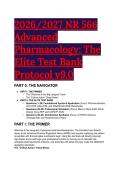
2026/2027 NR 566
Advanced
Pharmacology: The
Elite Test Bank
Protocol v9.0
PART 0: THE NAVIGATOR
● PART I: THE PRIMER
○ The "Welcome to the Big Leagues" Hook
○ The "Critical Action" Cheat Sheet
● PART II: THE ELITE TEST BANK
○ Questions 1–28: Foundational Syntax & Application (Focus: Pharmacokinetics,
AHA 2025, ADA 2026, and GINA/GOLD 2026 Hard-Decks)
○ Questions 29–58: Professional Simulation (Focus: Beers Criteria 2026, Renal
Dosing, Doxy-PEP, and USPSTF 2026)
○ Questions 59–88: Grandmaster Synthesis (Focus: CYP450 Collisions,
Teratogenicity, and Polypharmacy Crises)
PART I: THE PRIMER
Welcome to the vanguard of advanced pharmacotherapeutics. The transition from didactic
theory to the Advanced Practice Registered Nurse (APRN) role requires replacing rote pattern
recognition with first-principles mechanistic logic. Using this test bank will directly intercept
high-stakes errors and forge your professional intuition by forcing you to calculate risk,
anticipate pharmacokinetic collisions, and prescribe with lethal accuracy under the 2026/2027
regulatory standards.
The "Critical Action" Cheat Sheet:
,Domain 2026/2027 Clinical Redline Source Logic
AHA 2025 HTN Stage 1 (130-139/80-89)
requires medication ONLY if
10-year PREVENT risk is
≥7.5%.
ADA 2026 T1DM GLP-1 RAs are now explicitly
approved for obesity
management in Type 1
Diabetes.
Renal eGFR <30 Metformin is strictly
contraindicated.
GINA 2026 Asthma SABA monotherapy is obsolete.
Initiate SMART
(ICS-formoterol) therapy.
USPSTF 2026 Biennial screening
mammography universally
mandated starting at age 40.
CDC Doxy-PEP 200mg Doxycycline within 72
hrs of condomless sex for
high-risk MSM/TGW.
PART II: THE ELITE TEST BANK
Questions 1–28: Foundational Syntax & Application
Q1: A 48-year-old male presents with an average blood pressure of 134/84 mm Hg. His 10-year
PREVENT cardiovascular risk score is 8.2%. After 3 months of lifestyle modifications, his BP
remains unchanged. Under the 2025 AHA/ACC Guidelines, what is the MOST APPROPRIATE
INITIAL action? A) Continue lifestyle modifications for 6 months. B) Initiate monotherapy with a
thiazide diuretic or calcium channel blocker. C) Start dual-therapy with an ACE inhibitor and a
calcium channel blocker. D) Order a renal Doppler ultrasound.
● The Answer: B (Initiate monotherapy with a thiazide diuretic or calcium channel blocker.)
● Distractor Analysis:
○ A is incorrect: PREVENT ≥7.5% in Stage 1 HTN mandates medication.
○ C is incorrect: Dual-therapy is reserved for Stage 2 (≥140/90).
○ D is incorrect: Secondary screening is for resistant HTN.
The Mentor's Analysis: The AHA 2025 guidelines retired the Pooled Cohort Equations. Stage
1 HTN (130-139/80-89) plus a PREVENT score ≥7.5% triggers immediate pharmacotherapy.
Professional Intuition: Do not wait for target organ damage; strike when the kinetic risk meets
the static pressure.
Q2: A 34-year-old client with Type 1 Diabetes Mellitus (T1DM) and a BMI of 36 kg/m² struggles
with intense hunger and weight gain despite adherence to basal-bolus insulin. According to the
2026 ADA Standards, which pharmacologic addition is MOST APPROPRIATE? A) Initiate a
GLP-1 Receptor Agonist. B) Discontinue basal insulin and transition to a GLP-1 RA. C)
Prescribe Phentermine-Topiramate. D) Add Metformin 1000 mg twice daily.
● The Answer: A (Initiate a GLP-1 Receptor Agonist.)
● Distractor Analysis:
, ○ B is incorrect: Stopping basal insulin in T1DM causes Diabetic Ketoacidosis.
○ C is incorrect: GLP-1 RAs are the preferred evidence-based adjunct for obesity in
T1DM.
○ D is incorrect: Metformin targets T2DM insulin resistance, not T1DM obesity.
The Mentor's Analysis: The 2026 ADA update formally introduces GLP-1 RAs as treatment for
obesity in T1DM. Professional Intuition: Treating obesity directly lowers total daily insulin
requirements, mitigating cardiovascular risk.
Q3: A 19-year-old male with moderate persistent asthma relies on an albuterol MDI twice
weekly for nighttime awakenings. According to 2026 GINA guidelines, which pharmacotherapy
modification is IMMEDIATELY required? A) Increase albuterol frequency to every 4 hours. B)
Initiate a low-dose ICS-formoterol inhaler for maintenance and relief. C) Add a Long-Acting
Muscarinic Antagonist (LAMA). D) Initiate an oral systemic corticosteroid burst.
● The Answer: B (Initiate a low-dose ICS-formoterol inhaler for maintenance and relief.)
● Distractor Analysis:
○ A is incorrect: SABA overreliance causes beta-receptor downregulation and
exacerbation risk.
○ C is incorrect: LAMAs are Step 5 add-ons.
○ D is incorrect: SABA monotherapy is obsolete; root inflammation must be
addressed.
The Mentor's Analysis: GINA 2026 mandates Track 1 "SMART" therapy. Using a rapid-onset
LABA (formoterol) with an ICS treats bronchospasm and underlying inflammation
simultaneously. Professional Intuition: SABA monotherapy is clinical malpractice under
modern standards.
Q4: A 68-year-old male with COPD, currently on a LAMA, required oral prednisone for an
exacerbation two months ago. Under the GOLD 2026 strategy, what is the MOST
APPROPRIATE action? A) No change required. B) Escalate to LAMA + LABA combination
therapy. C) Initiate ICS monotherapy. D) Prescribe a prophylactic macrolide.
● The Answer: B (Escalate to LAMA + LABA combination therapy.)
● Distractor Analysis:
○ A is incorrect: Even one moderate exacerbation mandates therapy escalation.
○ C is incorrect: ICS monotherapy in COPD increases pneumonia risk.
○ D is incorrect: Macrolides are last-resort interventions.
The Mentor's Analysis: GOLD 2026 establishes that a single moderate exacerbation indicates
thermodynamic failure. Professional Intuition: Do not wait for hospitalization; an exacerbation
means baseline therapy has failed.
Q5: A 58-year-old male presents with an asymptomatic blood pressure of 188/112 mm Hg.
Neurologic exam is intact. According to AHA 2025 guidelines, how should this be managed? A)
Document as "Hypertensive Emergency" and administer IV labetalol. B) Administer sublingual
nifedipine. C) Document as "Markedly Elevated BP" and modify his outpatient regimen. D)
Document as "Hypertensive Urgency" and admit.
● The Answer: C (Document as "Markedly Elevated BP" and modify his outpatient
regimen.)
● Distractor Analysis:
○ A is incorrect: Emergency requires acute target organ damage.
○ B is incorrect: Sublingual nifedipine causes unpredictable, catastrophic BP drops.
○ D is incorrect: The term "Urgency" is retired; admission is discouraged for
asymptomatic patients.
The Mentor's Analysis: Rapidly dropping BP in an asymptomatic patient causes cerebral
Advanced
Pharmacology: The
Elite Test Bank
Protocol v9.0
PART 0: THE NAVIGATOR
● PART I: THE PRIMER
○ The "Welcome to the Big Leagues" Hook
○ The "Critical Action" Cheat Sheet
● PART II: THE ELITE TEST BANK
○ Questions 1–28: Foundational Syntax & Application (Focus: Pharmacokinetics,
AHA 2025, ADA 2026, and GINA/GOLD 2026 Hard-Decks)
○ Questions 29–58: Professional Simulation (Focus: Beers Criteria 2026, Renal
Dosing, Doxy-PEP, and USPSTF 2026)
○ Questions 59–88: Grandmaster Synthesis (Focus: CYP450 Collisions,
Teratogenicity, and Polypharmacy Crises)
PART I: THE PRIMER
Welcome to the vanguard of advanced pharmacotherapeutics. The transition from didactic
theory to the Advanced Practice Registered Nurse (APRN) role requires replacing rote pattern
recognition with first-principles mechanistic logic. Using this test bank will directly intercept
high-stakes errors and forge your professional intuition by forcing you to calculate risk,
anticipate pharmacokinetic collisions, and prescribe with lethal accuracy under the 2026/2027
regulatory standards.
The "Critical Action" Cheat Sheet:
,Domain 2026/2027 Clinical Redline Source Logic
AHA 2025 HTN Stage 1 (130-139/80-89)
requires medication ONLY if
10-year PREVENT risk is
≥7.5%.
ADA 2026 T1DM GLP-1 RAs are now explicitly
approved for obesity
management in Type 1
Diabetes.
Renal eGFR <30 Metformin is strictly
contraindicated.
GINA 2026 Asthma SABA monotherapy is obsolete.
Initiate SMART
(ICS-formoterol) therapy.
USPSTF 2026 Biennial screening
mammography universally
mandated starting at age 40.
CDC Doxy-PEP 200mg Doxycycline within 72
hrs of condomless sex for
high-risk MSM/TGW.
PART II: THE ELITE TEST BANK
Questions 1–28: Foundational Syntax & Application
Q1: A 48-year-old male presents with an average blood pressure of 134/84 mm Hg. His 10-year
PREVENT cardiovascular risk score is 8.2%. After 3 months of lifestyle modifications, his BP
remains unchanged. Under the 2025 AHA/ACC Guidelines, what is the MOST APPROPRIATE
INITIAL action? A) Continue lifestyle modifications for 6 months. B) Initiate monotherapy with a
thiazide diuretic or calcium channel blocker. C) Start dual-therapy with an ACE inhibitor and a
calcium channel blocker. D) Order a renal Doppler ultrasound.
● The Answer: B (Initiate monotherapy with a thiazide diuretic or calcium channel blocker.)
● Distractor Analysis:
○ A is incorrect: PREVENT ≥7.5% in Stage 1 HTN mandates medication.
○ C is incorrect: Dual-therapy is reserved for Stage 2 (≥140/90).
○ D is incorrect: Secondary screening is for resistant HTN.
The Mentor's Analysis: The AHA 2025 guidelines retired the Pooled Cohort Equations. Stage
1 HTN (130-139/80-89) plus a PREVENT score ≥7.5% triggers immediate pharmacotherapy.
Professional Intuition: Do not wait for target organ damage; strike when the kinetic risk meets
the static pressure.
Q2: A 34-year-old client with Type 1 Diabetes Mellitus (T1DM) and a BMI of 36 kg/m² struggles
with intense hunger and weight gain despite adherence to basal-bolus insulin. According to the
2026 ADA Standards, which pharmacologic addition is MOST APPROPRIATE? A) Initiate a
GLP-1 Receptor Agonist. B) Discontinue basal insulin and transition to a GLP-1 RA. C)
Prescribe Phentermine-Topiramate. D) Add Metformin 1000 mg twice daily.
● The Answer: A (Initiate a GLP-1 Receptor Agonist.)
● Distractor Analysis:
, ○ B is incorrect: Stopping basal insulin in T1DM causes Diabetic Ketoacidosis.
○ C is incorrect: GLP-1 RAs are the preferred evidence-based adjunct for obesity in
T1DM.
○ D is incorrect: Metformin targets T2DM insulin resistance, not T1DM obesity.
The Mentor's Analysis: The 2026 ADA update formally introduces GLP-1 RAs as treatment for
obesity in T1DM. Professional Intuition: Treating obesity directly lowers total daily insulin
requirements, mitigating cardiovascular risk.
Q3: A 19-year-old male with moderate persistent asthma relies on an albuterol MDI twice
weekly for nighttime awakenings. According to 2026 GINA guidelines, which pharmacotherapy
modification is IMMEDIATELY required? A) Increase albuterol frequency to every 4 hours. B)
Initiate a low-dose ICS-formoterol inhaler for maintenance and relief. C) Add a Long-Acting
Muscarinic Antagonist (LAMA). D) Initiate an oral systemic corticosteroid burst.
● The Answer: B (Initiate a low-dose ICS-formoterol inhaler for maintenance and relief.)
● Distractor Analysis:
○ A is incorrect: SABA overreliance causes beta-receptor downregulation and
exacerbation risk.
○ C is incorrect: LAMAs are Step 5 add-ons.
○ D is incorrect: SABA monotherapy is obsolete; root inflammation must be
addressed.
The Mentor's Analysis: GINA 2026 mandates Track 1 "SMART" therapy. Using a rapid-onset
LABA (formoterol) with an ICS treats bronchospasm and underlying inflammation
simultaneously. Professional Intuition: SABA monotherapy is clinical malpractice under
modern standards.
Q4: A 68-year-old male with COPD, currently on a LAMA, required oral prednisone for an
exacerbation two months ago. Under the GOLD 2026 strategy, what is the MOST
APPROPRIATE action? A) No change required. B) Escalate to LAMA + LABA combination
therapy. C) Initiate ICS monotherapy. D) Prescribe a prophylactic macrolide.
● The Answer: B (Escalate to LAMA + LABA combination therapy.)
● Distractor Analysis:
○ A is incorrect: Even one moderate exacerbation mandates therapy escalation.
○ C is incorrect: ICS monotherapy in COPD increases pneumonia risk.
○ D is incorrect: Macrolides are last-resort interventions.
The Mentor's Analysis: GOLD 2026 establishes that a single moderate exacerbation indicates
thermodynamic failure. Professional Intuition: Do not wait for hospitalization; an exacerbation
means baseline therapy has failed.
Q5: A 58-year-old male presents with an asymptomatic blood pressure of 188/112 mm Hg.
Neurologic exam is intact. According to AHA 2025 guidelines, how should this be managed? A)
Document as "Hypertensive Emergency" and administer IV labetalol. B) Administer sublingual
nifedipine. C) Document as "Markedly Elevated BP" and modify his outpatient regimen. D)
Document as "Hypertensive Urgency" and admit.
● The Answer: C (Document as "Markedly Elevated BP" and modify his outpatient
regimen.)
● Distractor Analysis:
○ A is incorrect: Emergency requires acute target organ damage.
○ B is incorrect: Sublingual nifedipine causes unpredictable, catastrophic BP drops.
○ D is incorrect: The term "Urgency" is retired; admission is discouraged for
asymptomatic patients.
The Mentor's Analysis: Rapidly dropping BP in an asymptomatic patient causes cerebral


