

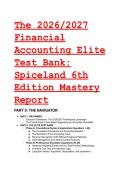
The 2026/2027
Financial
Accounting Elite
Test Bank:
Spiceland 6th
Edition Mastery
Report
PART 0: THE NAVIGATOR
● PART I: THE PRIMER
○ Executive Orientation: The 2026/2027 Professional Landscape
○ The Critical Action Cheat Sheet: Regulatory and Formulaic Guardrails
● PART II: THE ELITE TEST BANK
○ Phase A: Foundational Syntax & Application (Questions 1–28)
■ The Conceptual Framework and Accounting Equation
■ The Mechanics of the Accounting Cycle
■ Revenue Recognition (ASC 606) and Expense Matching
■ Cash Management and Internal Control Protocols
○ Phase B: Professional Simulation (Questions 29–58)
■ Advanced Adjusting Entries and the "Solid Footing" Methodology
■ Inventory Cost Flow and Valuation Logic
■ Long-term Assets: Acquisition, Depreciation, and Impairment
, ■ Current and Long-term Liabilities: The Cost of Debt
■ Stockholders' Equity: Capital Structure and Distributions
○ Phase C: Grandmaster Synthesis (Questions 59–88)
■ ASU 2024-03: Implementation of Disaggregated Income Statement Expenses
(DISE)
■ SEC Climate and Sustainability Reporting (1% Thresholds and GHG Scopes)
■ Accounting for Generative AI and Internal-Use Software (ASU 2025-06)
■ The Statement of Cash Flows: Synthesis of Indirect Adjustments
■ Advanced Financial Statement Analysis and Ratio Interpretation
PART I: THE PRIMER
Executive Orientation: The 2026/2027 Professional Landscape
The transition from academic financial accounting to high-stakes professional practice requires
a profound shift from mechanical entry to strategic interpretation. In the 2026/2027 environment,
the practitioner is no longer a mere recorder of history but a navigator of economic reality. This
document is engineered to bridge the gap between Spiceland's foundational 6th Edition
concepts and the rigorous standards required at elite institutions like UT Austin.
The accounting profession is currently navigating an era defined by two converging forces:
radical transparency and technological acceleration. The Financial Accounting Standards Board
(FASB) has moved decisively toward disaggregation—breaking down traditional "black box"
expense captions into natural categories to provide investors with a granular view of cost
structures. Simultaneously, the Securities and Exchange Commission (SEC) has integrated
climate-related financial metrics directly into the audited notes, mandating 1% materiality
thresholds for severe weather event impacts.
For the professional student, this means mastery of the "Solid Footing" accounting cycle is
merely the entry fee. The true value lies in understanding the "why" behind the "how." Whether it
is the assume-static-condition expedient for CECL credit losses or the capitalization of coding
costs for generative AI software, the 2027 practitioner must apply judgment where algorithms
cannot. This test bank serves as a high-performance training ground, designed to intercept the
cognitive traps that lead to audit failures and misstated earnings.
The Critical Action Cheat Sheet: Regulatory and Formulaic Guardrails
The following data represents the core parameters within which the modern financial reporter
operates. These metrics and rules are the "hard deck" of the profession.
Category Standard / Formula Professional Implications
(2026/2027)
Fundamental Identity Assets = Liabilities + Equity The Balance Sheet Equation
(BSE) is the immutable
foundation of all double-entry
systems.
Expense Disclosure ASU 2024-03 (DISE) Mandates tabular footnotes for
natural categories
(Compensation, Depreciation,
etc.) in functional captions.
, Category Standard / Formula Professional Implications
(2026/2027)
Sustainability 1% Threshold (SEC S-X) Severe weather impacts
exceeding 1% of pretax income
must be disclosed in audited
notes.
Receivables Risk ASU 2025-05 (CECL) Allows a practical expedient
assuming current conditions
remain static for short-term
receivables.
Asset Performance ROE = \frac{Net\ Income}{Avg.\ The primary measure of how
Equity} efficiently management
generates wealth for
shareholders.
Liquidity Barrier Current\ Ratio = \frac{Current\ A ratio < 1.0 serves as a
Assets}{Current\ Liab} "solvency amber alert" for
short-term creditors.
AI Software Costs ASU 2025-06 Capitalize development once
management commits and
project completion is
"probable".
PART II: THE ELITE TEST BANK
Phase A: Foundational Syntax & Application (Questions 1–28)
Q1: A corporation issues 10,000 shares of \$1 par value common stock for \$25 per share on
January 1, 2026. Under the ACCOUNTING EQUATION framework, what is the IMMEDIATE
impact on the company's financial position? A) Assets increase by \$10,000; Equity increases
by \$10,000. B) Assets increase by \$250,000; Equity increases by \$250,000. C) Assets
increase by \$250,000; Liabilities increase by \$240,000. D) Cash increases by \$250,000; Net
Income increases by \$250,000.
● The Answer: B (Assets increase by \$250,000; Equity increases by \$250,000.)
● Distractor Analysis:
○ A is incorrect: This only accounts for the par value, ignoring the additional paid-in
capital which is a component of total equity.
○ C is incorrect: Issuing stock is an equity transaction, not a liability; the company
does not "owe" the \$250,000 to shareholders in the form of a debt.
○ D is incorrect: While cash increases, stock issuance is a financing activity and does
not flow through the income statement; it has no impact on net income.
The Mentor's Analysis: The fundamental balance sheet equation (A = L + E) is the ultimate
reality check. Beginners often confuse "Par Value" with "Market Value." In 2026/2027, the
market value represents the actual economic inflow. The practitioner must visualize the
transaction as an expansion of the firm's resources. Professional Intuition: Always track the
total cash inflow first; the split between Common Stock and Additional Paid-in Capital is merely
a legal sub-categorization within the equity umbrella.
Q2: A practitioner is evaluating the RELEVANCE of financial information under the FASB
Conceptual Framework. Which of the following components MUST be present for information to
Financial
Accounting Elite
Test Bank:
Spiceland 6th
Edition Mastery
Report
PART 0: THE NAVIGATOR
● PART I: THE PRIMER
○ Executive Orientation: The 2026/2027 Professional Landscape
○ The Critical Action Cheat Sheet: Regulatory and Formulaic Guardrails
● PART II: THE ELITE TEST BANK
○ Phase A: Foundational Syntax & Application (Questions 1–28)
■ The Conceptual Framework and Accounting Equation
■ The Mechanics of the Accounting Cycle
■ Revenue Recognition (ASC 606) and Expense Matching
■ Cash Management and Internal Control Protocols
○ Phase B: Professional Simulation (Questions 29–58)
■ Advanced Adjusting Entries and the "Solid Footing" Methodology
■ Inventory Cost Flow and Valuation Logic
■ Long-term Assets: Acquisition, Depreciation, and Impairment
, ■ Current and Long-term Liabilities: The Cost of Debt
■ Stockholders' Equity: Capital Structure and Distributions
○ Phase C: Grandmaster Synthesis (Questions 59–88)
■ ASU 2024-03: Implementation of Disaggregated Income Statement Expenses
(DISE)
■ SEC Climate and Sustainability Reporting (1% Thresholds and GHG Scopes)
■ Accounting for Generative AI and Internal-Use Software (ASU 2025-06)
■ The Statement of Cash Flows: Synthesis of Indirect Adjustments
■ Advanced Financial Statement Analysis and Ratio Interpretation
PART I: THE PRIMER
Executive Orientation: The 2026/2027 Professional Landscape
The transition from academic financial accounting to high-stakes professional practice requires
a profound shift from mechanical entry to strategic interpretation. In the 2026/2027 environment,
the practitioner is no longer a mere recorder of history but a navigator of economic reality. This
document is engineered to bridge the gap between Spiceland's foundational 6th Edition
concepts and the rigorous standards required at elite institutions like UT Austin.
The accounting profession is currently navigating an era defined by two converging forces:
radical transparency and technological acceleration. The Financial Accounting Standards Board
(FASB) has moved decisively toward disaggregation—breaking down traditional "black box"
expense captions into natural categories to provide investors with a granular view of cost
structures. Simultaneously, the Securities and Exchange Commission (SEC) has integrated
climate-related financial metrics directly into the audited notes, mandating 1% materiality
thresholds for severe weather event impacts.
For the professional student, this means mastery of the "Solid Footing" accounting cycle is
merely the entry fee. The true value lies in understanding the "why" behind the "how." Whether it
is the assume-static-condition expedient for CECL credit losses or the capitalization of coding
costs for generative AI software, the 2027 practitioner must apply judgment where algorithms
cannot. This test bank serves as a high-performance training ground, designed to intercept the
cognitive traps that lead to audit failures and misstated earnings.
The Critical Action Cheat Sheet: Regulatory and Formulaic Guardrails
The following data represents the core parameters within which the modern financial reporter
operates. These metrics and rules are the "hard deck" of the profession.
Category Standard / Formula Professional Implications
(2026/2027)
Fundamental Identity Assets = Liabilities + Equity The Balance Sheet Equation
(BSE) is the immutable
foundation of all double-entry
systems.
Expense Disclosure ASU 2024-03 (DISE) Mandates tabular footnotes for
natural categories
(Compensation, Depreciation,
etc.) in functional captions.
, Category Standard / Formula Professional Implications
(2026/2027)
Sustainability 1% Threshold (SEC S-X) Severe weather impacts
exceeding 1% of pretax income
must be disclosed in audited
notes.
Receivables Risk ASU 2025-05 (CECL) Allows a practical expedient
assuming current conditions
remain static for short-term
receivables.
Asset Performance ROE = \frac{Net\ Income}{Avg.\ The primary measure of how
Equity} efficiently management
generates wealth for
shareholders.
Liquidity Barrier Current\ Ratio = \frac{Current\ A ratio < 1.0 serves as a
Assets}{Current\ Liab} "solvency amber alert" for
short-term creditors.
AI Software Costs ASU 2025-06 Capitalize development once
management commits and
project completion is
"probable".
PART II: THE ELITE TEST BANK
Phase A: Foundational Syntax & Application (Questions 1–28)
Q1: A corporation issues 10,000 shares of \$1 par value common stock for \$25 per share on
January 1, 2026. Under the ACCOUNTING EQUATION framework, what is the IMMEDIATE
impact on the company's financial position? A) Assets increase by \$10,000; Equity increases
by \$10,000. B) Assets increase by \$250,000; Equity increases by \$250,000. C) Assets
increase by \$250,000; Liabilities increase by \$240,000. D) Cash increases by \$250,000; Net
Income increases by \$250,000.
● The Answer: B (Assets increase by \$250,000; Equity increases by \$250,000.)
● Distractor Analysis:
○ A is incorrect: This only accounts for the par value, ignoring the additional paid-in
capital which is a component of total equity.
○ C is incorrect: Issuing stock is an equity transaction, not a liability; the company
does not "owe" the \$250,000 to shareholders in the form of a debt.
○ D is incorrect: While cash increases, stock issuance is a financing activity and does
not flow through the income statement; it has no impact on net income.
The Mentor's Analysis: The fundamental balance sheet equation (A = L + E) is the ultimate
reality check. Beginners often confuse "Par Value" with "Market Value." In 2026/2027, the
market value represents the actual economic inflow. The practitioner must visualize the
transaction as an expansion of the firm's resources. Professional Intuition: Always track the
total cash inflow first; the split between Common Stock and Additional Paid-in Capital is merely
a legal sub-categorization within the equity umbrella.
Q2: A practitioner is evaluating the RELEVANCE of financial information under the FASB
Conceptual Framework. Which of the following components MUST be present for information to


