Written by students who passed Immediately available after payment Read online or as PDF Wrong document? Swap it for free 4.6 TrustPilot
logo-home
Exam (elaborations)

NURS 660 Psychopharmacology & Advanced Mental Health Exam 1 2026/2027 | Maryville Actual Questions with Verified Answers & Detailed Rationales | Grade A Study Guide.

Rating
-
Sold
-
Pages
43
Grade
A+
Uploaded on
26-03-2026
Written in
2025/2026

INSTANT PDF DOWNLOAD—This comprehensive study guide is specifically designed for Maryville University graduate nursing students (PMHNP) preparing for NURS 660 Psychopharmacology and Advanced Mental Health Exam 1 for the 2026/2027 academic year. Based on verified exam materials from top-selling student resources, this resource contains expertly verified practice questions and 100% correct answers with detailed rationales to help you master core concepts and achieve a top score (Grade A+) . This comprehensive guide covers all major topics tested on NURS 660 Exam 1 : Neuroanatomy & Brain Function : Functions of the hypothalamus (pituitary control, body temp, hunger/thirst, sexual behavior, circadian rhythm) ; lobes of the brain—frontal (concentration, planning, inhibition, emotion) , parietal (sensory processing, touch, pain, temperature) , temporal (short-term memory, equilibrium, emotion) , occipital (visual perception) ; cerebellum (coordination, balance, posture) ; brainstem (life-sustaining functions, circadian rhythm) ; limbic system (emotion regulation, survival behaviors) ; hippocampus (long-term memory, spatial navigation) ; thalamus (relay motor/sensory signals, consciousness, sleep) ; Broca's area (speech production) ; Wernicke's area (speech comprehension) . Psychiatric Assessment & Communication Techniques : Goal of psychiatric assessment (efficient data collection, elicit emotion, establish therapeutic relationship, rule out differential diagnoses, develop treatment plan) ; definition of psychiatric interview (skill of encouraging disclosure of personal information for professional purpose) ; importance of knowing patient's age (plan environment, ask questions appropriately, stage of development) ; communication techniques—theming (identifying patterns), recognizing (acknowledging feelings), validating (confirming understanding), sequencing (clarifying chronological events) . Cranial Nerve Assessment : CN I (olfactory)—test each nostril separately with familiar scent ; CN II (optic)—visual acuity (Snellen chart, Rosenbaum for near vision), color vision, visual fields by confrontation, funduscopic exam (red reflex, optic disc, macula) ; CN III, IV, VI (oculomotor, trochlear, abducens)—six cardinal fields of gaze, accommodation (pupils constrict as gaze shifts from distance to near) , nystagmus screening ; CN V (trigeminal)—corneal reflex, facial sensation (forehead, cheek, chin bilaterally), cold sensation with tuning fork . Eye Examination & Pathologies : Ophthalmoscopic technique (examine patient's right eye with your right eye, left eye with left eye) ; visualize macula by asking patient to look directly into the light ; anisocoria (unequal pupils that still react to light) ; unilateral exophthalmos (possible retro-orbital tumor) ; glaucoma (loss of vision in outer half of each eye, regular screening for early detection) ; age-related macular degeneration (AMD) , diabetic retinopathy, cataracts ; legal blindness (20/200 or worse) ; conjunctival cobblestone appearance (allergic or infectious conjunctivitis) . Mental Status Examination (MSE) : Components—appearance, behavior, speech, mood, affect, thought process, thought content, cognition, insight/judgment ; orientation (person, place, time) ; short-term memory (recall 3 objects after 2-5 minutes) ; long-term memory (questions about past events) ; attention/concentration (spell a 5-letter word forward and backward) ; math (serial 7s) ; word finding (name items in category) ; naming objects (pen, watch) . Ear, Nose, Throat & Neurological Assessment : Weber test (tuning fork on top of head—sound heard equally in both ears is normal) ; Rinne test (air conduction bone conduction, 2:1 ratio is normal) ; otitis externa (swimmer's ear: meatus inflamed, tender, weeping, extreme pain) ; transillumination for sinus pain ; tonsil grading (3+ = tonsils touch uvula) ; normal aging changes (decreased taste, presbyopia, decreased night vision) ; cocaine abuse signs (chronic sniffling, nasal congestion, nosebleeds, mucosal scabs, septum perforation) . Red Flags & Emergencies : Worst headache of my life (subarachnoid hemorrhage—refer to ED) ; acute onset severe headache, unrelenting headache, new-onset headache 50 years, headache with stiff neck/fever, headache with altered mental status, headache after head trauma ; retinal detachment (curtain feeling, floaters, flashes) ; uneven pupils with headache (neurological emergency) . Lifespan & Developmental Considerations : Erikson's stages across the lifespan ; Piaget's four stages of cognitive development (sensorimotor, preoperational, concrete operational, formal operational) ; therapeutic boundaries with children exposed to trauma (handshake or no contact, share a joke, use age-appropriate language) ; interviewing elementary school-aged children (build rapport, be flexible, use familiar topics, positive reinforcement) . Sample Questions Include : "What is the function of the hypothalamus?" → Controls basic biological needs including pituitary hormone release, body temperature, hunger/thirst, sexual behavior, circadian rhythm, and emotional responses "What is the correct technique to test accommodation?" → Pupils should constrict as the gaze shifts from across the room to an object 6 inches away "What is the correct ophthalmoscopic examination technique?" → Examine the patient's right eye with your right eye and the patient's left eye with your left eye "What is the normal finding for a Weber test?" → The patient hears the tone equally in both ears "What is the most important differential to rule out in postmenopausal bleeding?" → Endometrial cancer "What is the gold standard for endometrial cancer diagnosis?" → Dilation and curettage (D&C) All questions include complete rationales based on current evidence-based practice, psychopharmacology standards, and Maryville University curriculum requirements. DOCUMENT ACCESS: This study guide is available as an instant digital download (PDF) immediately upon purchase. Fully text-searchable, printable, and accessible anytime through your user account. 100% satisfaction guarantee. Trusted by thousands of Maryville graduate nursing students for NURS 660 exam preparation and mastering psychopharmacology competencies .

Show more Read less
Institution
NURS 660/ NURS660
Module
NURS 660/ NURS660

Content preview

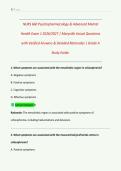
1|Page


NURS 660 Psychopharmacology & Advanced Mental

Health Exam 1 2026/2027 | Maryville Actual Questions

with Verified Answers & Detailed Rationales | Grade A

Study Guide.


1. What symptoms are associated with the mesolimbic region in schizophrenia?

A. Negative symptoms

B. Positive symptoms

C. Cognitive symptoms

D. Affective symptoms

Correct Answer: B

Rationale: The mesolimbic region is associated with positive symptoms of

schizophrenia, including hallucinations and delusions.


2. What symptoms are associated with the mesocortical/prefrontal cortex in

schizophrenia?

A. Positive symptoms

,2|Page


B. Negative symptoms

C. Cognitive symptoms

D. Affective symptoms

Correct Answer: B

Rationale: The mesocortical/prefrontal cortex is associated with negative symptoms of

schizophrenia.


3. What symptoms are associated with the dorsolateral prefrontal cortex in

schizophrenia when hypoactive?

A. Positive symptoms

B. Negative symptoms

C. Cognitive symptoms (planning ahead and controlling impulses)

D. Affective symptoms

Correct Answer: C

Rationale: Hypoactivity in the dorsolateral prefrontal cortex is associated with cognitive

symptoms, including impaired planning and impulse control.


4. What is the function of the amygdala?

A. Impulse control

,3|Page


B. Memory, emotion, fear, and aggression

C. Planning and decision-making

D. Reward and addiction

Correct Answer: B

Rationale: The amygdala is a limbic system structure involved in memory, emotion, fear,

and aggression.


5. What is the function of the ventromedial prefrontal cortex?

A. Impulse control

B. Memory and emotion

C. Controlling emotional responses from the amygdala and decision-making (affective

symptoms)

D. Reward and addiction

Correct Answer: C

Rationale: The ventromedial prefrontal cortex controls emotional responses from the

amygdala and is involved in decision-making, relating to affective symptoms.


6. What is the function of the orbitofrontal cortex?

A. Memory and emotion

, 4|Page


B. Impulse control

C. Reward and addiction

D. Positive symptoms

Correct Answer: B

Rationale: The orbitofrontal cortex, part of the prefrontal cortex, is involved in impulse

control.


7. List the positive symptoms of schizophrenia. (Select all that apply.)

A. Hallucinations and delusions

B. Disorganized thoughts

C. Distortions and exaggerations in language and communication

D. Disorganized speech and behavior

E. Catatonic behavior

Correct Answer: A, B, C, D, E

Rationale: Positive symptoms include hallucinations, delusions, disorganized thoughts,

disorganized speech and behavior, and catatonic behavior.


8. What are the negative symptoms of schizophrenia (5 A's)? (Select all that apply.)

A. Affective flattening

Written for

Institution
NURS 660/ NURS660
Module
NURS 660/ NURS660

Document information

Uploaded on
March 26, 2026
Number of pages
43
Written in
2025/2026
Type
Exam (elaborations)
Contains
Questions & answers

Subjects

$12.49
Get access to the full document:

Wrong document? Swap it for free Within 14 days of purchase and before downloading, you can choose a different document. You can simply spend the amount again.
Written by students who passed
Immediately available after payment
Read online or as PDF


Also available in package deal

Thumbnail
Package deal
MARYVILLE NURS 660 ALL EXAMS QUESTIONS WITH CORRECT VERIFIED SOLUTIONS 100% GUARANTEED PASS PACKAGE DEAL
-
4 13 2024
$ 62.90 More info

Get to know the seller

Seller avatar
Reputation scores are based on the amount of documents a seller has sold for a fee and the reviews they have received for those documents. There are three levels: Bronze, Silver and Gold. The better the reputation, the more your can rely on the quality of the sellers work.
ExamitorMagnus Massachusetts Institute Of Technology
View profile
Follow You need to be logged in order to follow users or courses
Sold
117
Member since
2 year
Number of followers
7
Documents
1756
Last sold
1 week ago
Top Score

I am a professional writer with knowledge across diverse academic fields. I provide quality work and I guarantee superb, timely and original content. I know the pain of getting a shoddy work, and I would never wish this on any client! I guarantee a topnotch paper, with a fast High-score turnaround. I provide quality work guaranteed to give you an exemplary grade. Furthermore, I am a tutor of Research paper, Dissertation, proposal, management studies, economics, educational studies, sociology and psychology, marketing, Geography, History, Management, English, Literature, Education. Medical studies, Health Care studies and Nursing, Biology, Economics among other subjects.

Read more Read less
3.5

22 reviews

5
8
4
3
3
6
2
2
1
3

Why students choose Stuvia

Created by fellow students, verified by reviews

Quality you can trust: written by students who passed their exams and reviewed by others who've used these revision notes.

Didn't get what you expected? Choose another document

No problem! You can straightaway pick a different document that better suits what you're after.

Pay as you like, start learning straight away

No subscription, no commitments. Pay the way you're used to via credit card and download your PDF document instantly.

Student with book image

“Bought, downloaded, and smashed it. It really can be that simple.”

Alisha Student

Working on your references?

Create accurate citations in APA, MLA and Harvard with our free citation generator.

Working on your references?

Frequently asked questions