

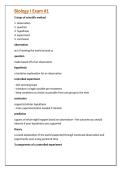
Biology I Exam #1
5 steps of scientific method
1. observation
2. question
3. hypothesis
4. experiment
5. conclusion
observation
act of viewing the world around us
question
made based off of an observation
hypothesis
a tentative explanation for an observation
controlled experiment
- test several groups
- introduce a single variable per treatment
- keep conditions as similar as possible from one group to the next
conclusion
supports/refutes hypothesis
- more experimentation needed if refuted
prediction
a guess of what might happen based on observation-- the outcome you would
observe if your hypothesis was supported
theory
a sound explanation of the world supported through continued observation and
experiments over a long period of time
3 components of a controlled experiment
,1. variable
2. test group
3. control group
variable
feature of an experiment that is changed from one treatment to the next
test group
exposed to variable in an experiment
control group
not exposed to the variable in an experiment
importance of test group & control group
they allow researchers to determine whether the variable in an experiment has
an effect
independent variable
manipulation performed on the test group
(ex. hours of tutoring)
which axis is the independent variable found on a graph?
x-axis
dependent variable
effect that is being measured
(ex. test score)
which axis is the dependent variable found on a graph?
y-axis
theory of evolution
set of hypotheses that provide a powerful explanation for both biological
observations & the diversity of life
, why do we learn that the theory of evolution is the single most important
theory in all of biology?
there's lots of evidence from asking/testing good scientific questions
(ex. anatomy, fossil record, biogeography, molecular biology)
7 ways living organisms are different from non-living organisms
1. organization - complex organization
2. response - ability to change in response to the environment
3. reproduction - ability to reproduce
4. evolution - capacity to evolve
5. metabolism - chemical rxns that sustain life
6. homeostasis - maintenance of stable internal environment
7. growth - regulated growth/cell division
1st law of thermodynamics
energy can neither be created nor destroyed; it can only be transformed from one
form into another
how does the 1st law of thermodynamics apply to living organisms?
- living organisms transform energy from sunlight --> chemical energy
- cells convert energy by expending it & giving off heat as a by product
2nd law of thermodynamics
the amount of entropy in the universe is constantly increasing
entropy
amount of disorder in a system
disorder
# of states that a system can take on
how does temperature affect entropy?
higher temp --> molecules move faster --> more entropy
how does the 2nd law of thermodynamics apply to living organisms?
5 steps of scientific method
1. observation
2. question
3. hypothesis
4. experiment
5. conclusion
observation
act of viewing the world around us
question
made based off of an observation
hypothesis
a tentative explanation for an observation
controlled experiment
- test several groups
- introduce a single variable per treatment
- keep conditions as similar as possible from one group to the next
conclusion
supports/refutes hypothesis
- more experimentation needed if refuted
prediction
a guess of what might happen based on observation-- the outcome you would
observe if your hypothesis was supported
theory
a sound explanation of the world supported through continued observation and
experiments over a long period of time
3 components of a controlled experiment
,1. variable
2. test group
3. control group
variable
feature of an experiment that is changed from one treatment to the next
test group
exposed to variable in an experiment
control group
not exposed to the variable in an experiment
importance of test group & control group
they allow researchers to determine whether the variable in an experiment has
an effect
independent variable
manipulation performed on the test group
(ex. hours of tutoring)
which axis is the independent variable found on a graph?
x-axis
dependent variable
effect that is being measured
(ex. test score)
which axis is the dependent variable found on a graph?
y-axis
theory of evolution
set of hypotheses that provide a powerful explanation for both biological
observations & the diversity of life
, why do we learn that the theory of evolution is the single most important
theory in all of biology?
there's lots of evidence from asking/testing good scientific questions
(ex. anatomy, fossil record, biogeography, molecular biology)
7 ways living organisms are different from non-living organisms
1. organization - complex organization
2. response - ability to change in response to the environment
3. reproduction - ability to reproduce
4. evolution - capacity to evolve
5. metabolism - chemical rxns that sustain life
6. homeostasis - maintenance of stable internal environment
7. growth - regulated growth/cell division
1st law of thermodynamics
energy can neither be created nor destroyed; it can only be transformed from one
form into another
how does the 1st law of thermodynamics apply to living organisms?
- living organisms transform energy from sunlight --> chemical energy
- cells convert energy by expending it & giving off heat as a by product
2nd law of thermodynamics
the amount of entropy in the universe is constantly increasing
entropy
amount of disorder in a system
disorder
# of states that a system can take on
how does temperature affect entropy?
higher temp --> molecules move faster --> more entropy
how does the 2nd law of thermodynamics apply to living organisms?


