

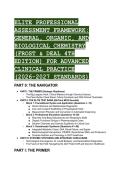
ELITE PROFESSIONAL
ASSESSMENT FRAMEWORK:
GENERAL, ORGANIC, AND
BIOLOGICAL CHEMISTRY
(FROST & DEAL 4TH
EDITION) FOR ADVANCED
CLINICAL PRACTICE
(2026-2027 STANDARDS)
PART 0: THE NAVIGATOR
● PART I: THE PRIMER (Strategic Readiness)
○ The Big Leagues Hook: Clinical Mastery through Chemical Literacy
○ The Panic Button Cheat Sheet: Critical Constants and 2026 Clinical Thresholds
● PART II: THE ELITE TEST BANK (66-Point MCQ Gauntlet)
○ Block 1: Foundational Syntax and Application (Questions 1–15)
■ Atomic Structure and Radioisotope Diagnostics
■ Ionic and Covalent Scaffolding in Physiological Fluids
■ Measurement Precision and Conversion in Automated Dispensing
○ Block 2: Professional Simulation (Questions 16–40)
■ Real-time Acid-Base Disturbances and Respiratory Shifts
■ Organic Functional Groups in Pharmacological Onset
■ Solution Chemistry and Osmotic Equilibrium in Critical Care
○ Block 3: Grandmaster Synthesis (Questions 41–66)
■ Integrated Metabolic Crises: DKA, Renal Failure, and Sepsis
■ Biotechnological Interventions: CRISPR, Recombinant DNA, and Proteomics
■ Complex Nutrition and Toxicology in 2027 Healthcare
● PART III: SYSTEMIC SYNTHESIS AND STRATEGIC CONCLUSION
○ Technological Convergence: AI, Liquid Biopsies, and Decentralized Diagnostics
○ The Future of the Field: Navigating the 2027 Patent Cliff and Genomic Healthcare
PART I: THE PRIMER
,Mastering General, Organic, and Biological (GOB) chemistry is the difference between a
technician who follows orders and a practitioner who anticipates physiological collapse. In the
2026 healthcare landscape, where AI manages routine data, the elite professional must
possess the chemical intuition to validate algorithmic outputs and intervene in complex
metabolic crises.
The Panic Button Cheat Sheet
● Bicarbonate Buffer Equilibrium: \text{CO}_2 + \text{H}_2\text{O} \rightleftharpoons
\text{H}_2\text{CO}_3 \rightleftharpoons \text{H}^+ + \text{HCO}_3^-. The primary defense
against \text{pH} volatility.
● The pKa Threshold: When \text{pH} = \text{pKa}, the drug is 50\% ionized. Only
uncharged forms cross lipid membranes effectively.
● Anion Gap (AG): \text{AG} = [\text{Na}^+] - ([\text{Cl}^-] + [\text{HCO}_3^-]). Normal
Range: 12 \pm 4 \text{ mEq/L}. Elevations indicate unmeasured acids
(MUDPILES/GOLDMARK).
● Ideal Gas Law (Modified for 2026 Respiratory Support): PV = nRT. Essential for
calculating oxygen cylinder duration and ventilator pressure settings.
● Half-Life Calculation (N_t = N_0(0.5)^{t/h}): Decisive for timing diagnostic scans and
managing radiation safety protocols.
PART II: THE ELITE TEST BANK (The Core Product)
Q1: A 64-year-old patient is scheduled for a cardiac stress test utilizing Technetium-99m. The
practitioner notes that the isotope has a half-life of 6 hours. If the initial dose is 200 \text{ mCi},
what is the MOST ACCURATE amount of radioactivity remaining in the patient after 24 hours?
A) 100 \text{ mCi} B) 50 \text{ mCi} C) 12.5 \text{ mCi} D) 6.25 \text{ mCi}
● The Answer: C (12.5 \text{ mCi})
● Distractor Analysis:
○ A is incorrect: This represents only one half-life (6 hours).
○ B is incorrect: This represents two half-lives (12 hours).
○ D is incorrect: This represents five half-lives (30 hours). 24 hours equals exactly
four half-lives (24/6 = 4). The calculation follows: 200 \rightarrow 100 \rightarrow 50
\rightarrow 25 \rightarrow 12.5.
The Mentor's Analysis: Radioactivity is not a linear decay; it is exponential. For the 2026
practitioner, understanding the "Hard Deck" of half-lives is critical for both patient safety and the
scheduling of sequential diagnostic tests. Technetium-99m is the clinical gold standard because
it allows for high-resolution imaging with a decay rate that minimizes long-term ionizing
exposure. Professional Intuition: Always count the half-life intervals before reaching for the
calculator.
Q2: During a pre-operative assessment, a patient exhibits high anxiety, leading to hyperpnea.
The practitioner identifies that the patient’s arterial P\text{CO}_2 has dropped from 40 \text{
mmHg} to 25 \text{ mmHg}. Which chemical shift in the bicarbonate buffer system is
IMMEDIATELY occurring? A) The equilibrium shifts toward the production of more \text{CO}_2
and \text{H}_2\text{O}, consuming \text{H}^+ ions. B) The equilibrium shifts toward the
production of \text{H}^+ and \text{HCO}_3^-, lowering the blood \text{pH}. C) Bicarbonate ions
are rapidly excreted by the kidneys to raise the P\text{CO}_2. D) The hemoglobin molecule
increases its affinity for oxygen, causing tissue acidosis.
● The Answer: A (The equilibrium shifts toward the production of more \text{CO}_2 and
, \text{H}_2\text{O}, consuming \text{H}^+ ions.)
● Distractor Analysis:
○ B is incorrect: This shift occurs during hypoventilation (retaining \text{CO}_2).
○ C is incorrect: Renal compensation is a slow process taking hours to days; it is not
an immediate shift.
○ D is incorrect: While the Bohr effect is relevant, it describes the inverse relationship
between \text{CO}_2 and O_2 affinity, not the buffer shift itself.
The Mentor's Analysis: Le Châtelier’s Principle is the "invisible hand" of respiratory physiology.
When P\text{CO}_2 is removed through hyperventilation, the system "pulls" the reaction to the
left to compensate, which inevitably uses up \text{H}^+ protons, causing respiratory alkalosis.
Clinical Pearl: Alkalemia is the result of the system's attempt to restore equilibrium at the
expense of \text{pH} stability.
Q3: A neonatal nurse is preparing to administer a surfactant replacement therapy to a
premature infant with Respiratory Distress Syndrome (RDS). Based on the 4th edition
curriculum, which molecular property of surfactants is MOST critical for lung function? A) Their
ability to increase the surface tension of water in the alveoli. B) Their role as a protein catalyst
that speeds up the absorption of oxygen. C) Their amphipathic nature, which reduces surface
tension and prevents alveolar collapse. D) Their high water solubility, which allows them to
dissolve in the blood.
● The Answer: C (Their amphipathic nature, which reduces surface tension and prevents
alveolar collapse.)
● Distractor Analysis:
○ A is incorrect: Surfactants decrease surface tension; increasing it would cause lung
collapse.
○ B is incorrect: Surfactants are lipids (phospholipids), not enzymes or protein
catalysts.
○ D is incorrect: Surfactants must remain at the air-water interface in the lungs, not
dissolve into the systemic circulation.
The Mentor's Analysis: The "Integrated Approach" of Frost and Deal emphasizes that
molecular structure dictates biological function. The dual nature (hydrophilic head/hydrophobic
tail) of phospholipids allows them to wedge between water molecules, breaking the hydrogen
bonding that would otherwise snap the alveoli shut. Professional Intuition: Without this
chemical "wedge," the work of breathing becomes thermodynamically impossible.
Q4: In 2027, decentralized diagnostic platforms utilize liquid biopsies to monitor circulating
tumor DNA (ctDNA). Which chemical characteristic of nucleic acids allows for their extraction
from a complex matrix like human plasma? A) The highly positive charge of the nitrogenous
bases at physiological \text{pH}. B) The hydrophobic nature of the deoxyribose sugars. C) The
negatively charged phosphate backbone, which allows for electrostatic binding to positively
charged surfaces. D) The ability of DNA to act as a strong base in an aqueous solution.
● The Answer: C (The negatively charged phosphate backbone, which allows for
electrostatic binding to positively charged surfaces.)
● Distractor Analysis:
○ A is incorrect: Nitrogenous bases are relatively neutral at physiological \text{pH};
the charge is on the phosphate.
○ B is incorrect: Sugars are polar and hydrophilic, but the backbone charge is the
primary feature for extraction.
○ D is incorrect: DNA stands for Deoxyribonucleic Acid; it is not a base.
The Mentor's Analysis: Precision medicine in 2027 rests on our ability to manipulate the
ASSESSMENT FRAMEWORK:
GENERAL, ORGANIC, AND
BIOLOGICAL CHEMISTRY
(FROST & DEAL 4TH
EDITION) FOR ADVANCED
CLINICAL PRACTICE
(2026-2027 STANDARDS)
PART 0: THE NAVIGATOR
● PART I: THE PRIMER (Strategic Readiness)
○ The Big Leagues Hook: Clinical Mastery through Chemical Literacy
○ The Panic Button Cheat Sheet: Critical Constants and 2026 Clinical Thresholds
● PART II: THE ELITE TEST BANK (66-Point MCQ Gauntlet)
○ Block 1: Foundational Syntax and Application (Questions 1–15)
■ Atomic Structure and Radioisotope Diagnostics
■ Ionic and Covalent Scaffolding in Physiological Fluids
■ Measurement Precision and Conversion in Automated Dispensing
○ Block 2: Professional Simulation (Questions 16–40)
■ Real-time Acid-Base Disturbances and Respiratory Shifts
■ Organic Functional Groups in Pharmacological Onset
■ Solution Chemistry and Osmotic Equilibrium in Critical Care
○ Block 3: Grandmaster Synthesis (Questions 41–66)
■ Integrated Metabolic Crises: DKA, Renal Failure, and Sepsis
■ Biotechnological Interventions: CRISPR, Recombinant DNA, and Proteomics
■ Complex Nutrition and Toxicology in 2027 Healthcare
● PART III: SYSTEMIC SYNTHESIS AND STRATEGIC CONCLUSION
○ Technological Convergence: AI, Liquid Biopsies, and Decentralized Diagnostics
○ The Future of the Field: Navigating the 2027 Patent Cliff and Genomic Healthcare
PART I: THE PRIMER
,Mastering General, Organic, and Biological (GOB) chemistry is the difference between a
technician who follows orders and a practitioner who anticipates physiological collapse. In the
2026 healthcare landscape, where AI manages routine data, the elite professional must
possess the chemical intuition to validate algorithmic outputs and intervene in complex
metabolic crises.
The Panic Button Cheat Sheet
● Bicarbonate Buffer Equilibrium: \text{CO}_2 + \text{H}_2\text{O} \rightleftharpoons
\text{H}_2\text{CO}_3 \rightleftharpoons \text{H}^+ + \text{HCO}_3^-. The primary defense
against \text{pH} volatility.
● The pKa Threshold: When \text{pH} = \text{pKa}, the drug is 50\% ionized. Only
uncharged forms cross lipid membranes effectively.
● Anion Gap (AG): \text{AG} = [\text{Na}^+] - ([\text{Cl}^-] + [\text{HCO}_3^-]). Normal
Range: 12 \pm 4 \text{ mEq/L}. Elevations indicate unmeasured acids
(MUDPILES/GOLDMARK).
● Ideal Gas Law (Modified for 2026 Respiratory Support): PV = nRT. Essential for
calculating oxygen cylinder duration and ventilator pressure settings.
● Half-Life Calculation (N_t = N_0(0.5)^{t/h}): Decisive for timing diagnostic scans and
managing radiation safety protocols.
PART II: THE ELITE TEST BANK (The Core Product)
Q1: A 64-year-old patient is scheduled for a cardiac stress test utilizing Technetium-99m. The
practitioner notes that the isotope has a half-life of 6 hours. If the initial dose is 200 \text{ mCi},
what is the MOST ACCURATE amount of radioactivity remaining in the patient after 24 hours?
A) 100 \text{ mCi} B) 50 \text{ mCi} C) 12.5 \text{ mCi} D) 6.25 \text{ mCi}
● The Answer: C (12.5 \text{ mCi})
● Distractor Analysis:
○ A is incorrect: This represents only one half-life (6 hours).
○ B is incorrect: This represents two half-lives (12 hours).
○ D is incorrect: This represents five half-lives (30 hours). 24 hours equals exactly
four half-lives (24/6 = 4). The calculation follows: 200 \rightarrow 100 \rightarrow 50
\rightarrow 25 \rightarrow 12.5.
The Mentor's Analysis: Radioactivity is not a linear decay; it is exponential. For the 2026
practitioner, understanding the "Hard Deck" of half-lives is critical for both patient safety and the
scheduling of sequential diagnostic tests. Technetium-99m is the clinical gold standard because
it allows for high-resolution imaging with a decay rate that minimizes long-term ionizing
exposure. Professional Intuition: Always count the half-life intervals before reaching for the
calculator.
Q2: During a pre-operative assessment, a patient exhibits high anxiety, leading to hyperpnea.
The practitioner identifies that the patient’s arterial P\text{CO}_2 has dropped from 40 \text{
mmHg} to 25 \text{ mmHg}. Which chemical shift in the bicarbonate buffer system is
IMMEDIATELY occurring? A) The equilibrium shifts toward the production of more \text{CO}_2
and \text{H}_2\text{O}, consuming \text{H}^+ ions. B) The equilibrium shifts toward the
production of \text{H}^+ and \text{HCO}_3^-, lowering the blood \text{pH}. C) Bicarbonate ions
are rapidly excreted by the kidneys to raise the P\text{CO}_2. D) The hemoglobin molecule
increases its affinity for oxygen, causing tissue acidosis.
● The Answer: A (The equilibrium shifts toward the production of more \text{CO}_2 and
, \text{H}_2\text{O}, consuming \text{H}^+ ions.)
● Distractor Analysis:
○ B is incorrect: This shift occurs during hypoventilation (retaining \text{CO}_2).
○ C is incorrect: Renal compensation is a slow process taking hours to days; it is not
an immediate shift.
○ D is incorrect: While the Bohr effect is relevant, it describes the inverse relationship
between \text{CO}_2 and O_2 affinity, not the buffer shift itself.
The Mentor's Analysis: Le Châtelier’s Principle is the "invisible hand" of respiratory physiology.
When P\text{CO}_2 is removed through hyperventilation, the system "pulls" the reaction to the
left to compensate, which inevitably uses up \text{H}^+ protons, causing respiratory alkalosis.
Clinical Pearl: Alkalemia is the result of the system's attempt to restore equilibrium at the
expense of \text{pH} stability.
Q3: A neonatal nurse is preparing to administer a surfactant replacement therapy to a
premature infant with Respiratory Distress Syndrome (RDS). Based on the 4th edition
curriculum, which molecular property of surfactants is MOST critical for lung function? A) Their
ability to increase the surface tension of water in the alveoli. B) Their role as a protein catalyst
that speeds up the absorption of oxygen. C) Their amphipathic nature, which reduces surface
tension and prevents alveolar collapse. D) Their high water solubility, which allows them to
dissolve in the blood.
● The Answer: C (Their amphipathic nature, which reduces surface tension and prevents
alveolar collapse.)
● Distractor Analysis:
○ A is incorrect: Surfactants decrease surface tension; increasing it would cause lung
collapse.
○ B is incorrect: Surfactants are lipids (phospholipids), not enzymes or protein
catalysts.
○ D is incorrect: Surfactants must remain at the air-water interface in the lungs, not
dissolve into the systemic circulation.
The Mentor's Analysis: The "Integrated Approach" of Frost and Deal emphasizes that
molecular structure dictates biological function. The dual nature (hydrophilic head/hydrophobic
tail) of phospholipids allows them to wedge between water molecules, breaking the hydrogen
bonding that would otherwise snap the alveoli shut. Professional Intuition: Without this
chemical "wedge," the work of breathing becomes thermodynamically impossible.
Q4: In 2027, decentralized diagnostic platforms utilize liquid biopsies to monitor circulating
tumor DNA (ctDNA). Which chemical characteristic of nucleic acids allows for their extraction
from a complex matrix like human plasma? A) The highly positive charge of the nitrogenous
bases at physiological \text{pH}. B) The hydrophobic nature of the deoxyribose sugars. C) The
negatively charged phosphate backbone, which allows for electrostatic binding to positively
charged surfaces. D) The ability of DNA to act as a strong base in an aqueous solution.
● The Answer: C (The negatively charged phosphate backbone, which allows for
electrostatic binding to positively charged surfaces.)
● Distractor Analysis:
○ A is incorrect: Nitrogenous bases are relatively neutral at physiological \text{pH};
the charge is on the phosphate.
○ B is incorrect: Sugars are polar and hydrophilic, but the backbone charge is the
primary feature for extraction.
○ D is incorrect: DNA stands for Deoxyribonucleic Acid; it is not a base.
The Mentor's Analysis: Precision medicine in 2027 rests on our ability to manipulate the


