
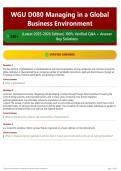
WGU D080 Managing in a Global
Business Environment
(Latest 2025-2026 Edition) 100% Verified Q&A + Answer
550+
Key Solutions
VERIFIED ANSWERS
Question 1
The key element of globalization is interdependence and interconnectedness among companies and countries around the
globe. Globalism is characterized by an increasing number of worldwide connections, rapid and discontinuous change, an
increasing number of diverse participants, and growing complexity.
Correct Answer
What is globalization?
Question 2
economic: developed economies integrating with developing countries through foreign direct investment, lowering the
costs of doing business, reducing trade barriers, and, in many cases, increasing cross-border migration.
political: globalization may ultimately reduce the importance of nation-states.
cultural: The spread of culture has added to processes such as commodity exchange and colonization, which have a more
extended history of carrying cultural meaning around the globe. The circulation of cultures enables individuals to partake in
extended social relations that cross national and regional borders.
Correct Answer
What are the economic, political, and cultural effects of globalization?
Question 3
any nonprofit, voluntary citizens' groups that are organized on a local, national, or international level
Correct Answer
What is nongovernmental organization and how does it impact government public policy across national boundaries?
Trusted by thousands of students and professionals worldwide Page 1 of 84
,Question 4
International business encompasses a full range of cross-border exchanges of goods, services, or resources across two or
more nations. These exchanges can go beyond the exchange of money for physical goods to include international transfers
of other resources such as people; intellectual property such as patents, copyrights, brand trademarks, and data; and
contractual assets or liabilities. Such assets or liabilities include the right to use some foreign asset, provide some future
service to overseas customers, or execute a complex financial instrument. The entities involved in international business
range from large multinational firms with thousands of employees doing business in many countries to a small one-person
company acting as an importer or exporter. This broader definition of international business also encompasses for-profit,
border-crossing transactions as well as transactions motivated by nonfinancial gains.
Correct Answer
What are the features of international business?
Question 5
- Exporting
- franchising
- joint ventures
- home-owned affiliates
- fully global ventures
Correct Answer
What are the different forms of international business? Explain each form.
Question 6
market entry
2. product specialization
3. value chain disaggregation
4. value chain reengineering
5. creation of new markets
Correct Answer
What are the 5 stages of entering a global market? Explain each stage
Question 7
market, cost, competition, government
Correct Answer
What are the 4 drivers of globalization? Explain
Question 8
unsaturated demand for new products, lower labor costs, less expensive natural resources, and other inputs to products.
Correct Answer
What are the benefits and costs of global expansion from MNCs' perspective?
Trusted by thousands of students and professionals worldwide Page 2 of 84
,Question 9
0: the first stage of globalism and is pushed forward by nationalism and religion.
2.0: the second stage of globalization and is characterized by advances in methods of transportation.
3.0: the third stage of globalization and is characterized by advancements across the board, especially technology and
communication.
Correct Answer
What are the characteristics of each stage of globalization?
Question 10
Ethical issues, governmental policies, and economic restrictions are all likely when a company moves into an unfamiliar
global space. A multinational company may also face infrastructural and technological challenges in a developing country.
Correct Answer
What are the criticisms of globalization?
Question 11
There are more than 13 major types of government, each of which consists of multiple variations. At one end of the
extremes of political ideologies is anarchism, which contends that individuals should control political activities, and public
government is both unnecessary and unwanted. At the other extreme is totalitarianism, which contends that every aspect of
an individual's life should be controlled and dictated by a strong central government.
Totalitarianism
Authoritarian
Monarchy
Democracy
Oligarchy
Dictatorship
Correct Answer
What are different types of governments? Explain
Question 12
Local policies, rules, and regulations can have a significant effect on the success rate of a business. Depending on how long
a company expects to operate in a country and how easy it is for business to enter and exit, a firm may also assess the
country's political risk and stability.
Correct Answer
What impacts does a political system have on international trade and business?
Question 13
- Industrialized nations have economies characterized by a healthy climate for private enterprise (business) and by a
consumer orientation, meaning the business climate focuses on meeting consumers' long-term wants and needs.
- Less-developed nations, also known as least-developed countries (LDCs), have extensive poverty, low per capita income
and standards of living, low literacy rates, and minimal technology.
- Developing nations are those that make the transition from economies based on agricultural and raw materials production
to industrialized economies.
Correct Answer
What are the features of industrialized, less-developed, and developing nations?
Trusted by thousands of students and professionals worldwide Page 3 of 84
, Question 14
- Traditional economies are found in rural countries where the primary occupation is farming.
- In a command economy found in a communist country, most of the economic system is controlled by a centralized power.
- In a planned economy found in a socialist country, the factors of production are used for the common good.
- In an open economy, a democratic method is used to determine how to use the factors of production.
- A market economy is a decentralized economy in which firms and households determine how resources are allocated
based on how best to satisfy their needs.
- A mixed economy has less government intervention than a command economy. Supply and demand control the economy,
and ideally, the government steps in when needed.
Correct Answer
What are different economic systems and how to differentiate them?
Question 15
- Communisim is a system in which all property is publicly owned and the government controls global trade
- Social ownership, central control of the means of production, and a cooperative approach toward management of the
economy are hallmarks of socialism.
- Capitalism is generally considered to be an economic system based on private ownership of the means of production and
on the creation of goods or services for profit by privately owned business enterprises.
Correct Answer
What is communism, socialism, and capitalism?
Question 16
- civil law system is an inquisitorial system where the investigating judge investigates the facts of the case. It is the most
widespread legal system in the world.
- Common law is based on traditions and precedence and can be traced to the English monarchy. In common law systems,
judges interpret the law, and judicial rulings can set precedent.
- Religious law is also known as theocratic law and is based on religious guidelines.
Correct Answer
Explain and differentiate common, civil, and theocratic legal systems.
Question 17
- The IMF helps maintain liquidity of global funding by providing a straight-forward method for nations to borrow and loan
to each other through a mechanism called the special drawing right.
- The World Bank's priorities are to help build sustainable economic growth, invest in people, and build resilience for shocks
and threats.
- WTO reviews the trade policies of all nations to ensure that each country is treated fairly and equally under the most
favored nation requirement.
- Criticisms are similar: a lack of transparency; neglect for considering the environment when making decisions; and policies
in favor of more affluent, developed countries at the expense of poorer nations
Correct Answer
Identify and differentiate the IMF, the World Bank, and the WTO's major functions and conditionality. Explain criticisms of
each international organization.
Trusted by thousands of students and professionals worldwide Page 4 of 84
Business Environment
(Latest 2025-2026 Edition) 100% Verified Q&A + Answer
550+
Key Solutions
VERIFIED ANSWERS
Question 1
The key element of globalization is interdependence and interconnectedness among companies and countries around the
globe. Globalism is characterized by an increasing number of worldwide connections, rapid and discontinuous change, an
increasing number of diverse participants, and growing complexity.
Correct Answer
What is globalization?
Question 2
economic: developed economies integrating with developing countries through foreign direct investment, lowering the
costs of doing business, reducing trade barriers, and, in many cases, increasing cross-border migration.
political: globalization may ultimately reduce the importance of nation-states.
cultural: The spread of culture has added to processes such as commodity exchange and colonization, which have a more
extended history of carrying cultural meaning around the globe. The circulation of cultures enables individuals to partake in
extended social relations that cross national and regional borders.
Correct Answer
What are the economic, political, and cultural effects of globalization?
Question 3
any nonprofit, voluntary citizens' groups that are organized on a local, national, or international level
Correct Answer
What is nongovernmental organization and how does it impact government public policy across national boundaries?
Trusted by thousands of students and professionals worldwide Page 1 of 84
,Question 4
International business encompasses a full range of cross-border exchanges of goods, services, or resources across two or
more nations. These exchanges can go beyond the exchange of money for physical goods to include international transfers
of other resources such as people; intellectual property such as patents, copyrights, brand trademarks, and data; and
contractual assets or liabilities. Such assets or liabilities include the right to use some foreign asset, provide some future
service to overseas customers, or execute a complex financial instrument. The entities involved in international business
range from large multinational firms with thousands of employees doing business in many countries to a small one-person
company acting as an importer or exporter. This broader definition of international business also encompasses for-profit,
border-crossing transactions as well as transactions motivated by nonfinancial gains.
Correct Answer
What are the features of international business?
Question 5
- Exporting
- franchising
- joint ventures
- home-owned affiliates
- fully global ventures
Correct Answer
What are the different forms of international business? Explain each form.
Question 6
market entry
2. product specialization
3. value chain disaggregation
4. value chain reengineering
5. creation of new markets
Correct Answer
What are the 5 stages of entering a global market? Explain each stage
Question 7
market, cost, competition, government
Correct Answer
What are the 4 drivers of globalization? Explain
Question 8
unsaturated demand for new products, lower labor costs, less expensive natural resources, and other inputs to products.
Correct Answer
What are the benefits and costs of global expansion from MNCs' perspective?
Trusted by thousands of students and professionals worldwide Page 2 of 84
,Question 9
0: the first stage of globalism and is pushed forward by nationalism and religion.
2.0: the second stage of globalization and is characterized by advances in methods of transportation.
3.0: the third stage of globalization and is characterized by advancements across the board, especially technology and
communication.
Correct Answer
What are the characteristics of each stage of globalization?
Question 10
Ethical issues, governmental policies, and economic restrictions are all likely when a company moves into an unfamiliar
global space. A multinational company may also face infrastructural and technological challenges in a developing country.
Correct Answer
What are the criticisms of globalization?
Question 11
There are more than 13 major types of government, each of which consists of multiple variations. At one end of the
extremes of political ideologies is anarchism, which contends that individuals should control political activities, and public
government is both unnecessary and unwanted. At the other extreme is totalitarianism, which contends that every aspect of
an individual's life should be controlled and dictated by a strong central government.
Totalitarianism
Authoritarian
Monarchy
Democracy
Oligarchy
Dictatorship
Correct Answer
What are different types of governments? Explain
Question 12
Local policies, rules, and regulations can have a significant effect on the success rate of a business. Depending on how long
a company expects to operate in a country and how easy it is for business to enter and exit, a firm may also assess the
country's political risk and stability.
Correct Answer
What impacts does a political system have on international trade and business?
Question 13
- Industrialized nations have economies characterized by a healthy climate for private enterprise (business) and by a
consumer orientation, meaning the business climate focuses on meeting consumers' long-term wants and needs.
- Less-developed nations, also known as least-developed countries (LDCs), have extensive poverty, low per capita income
and standards of living, low literacy rates, and minimal technology.
- Developing nations are those that make the transition from economies based on agricultural and raw materials production
to industrialized economies.
Correct Answer
What are the features of industrialized, less-developed, and developing nations?
Trusted by thousands of students and professionals worldwide Page 3 of 84
, Question 14
- Traditional economies are found in rural countries where the primary occupation is farming.
- In a command economy found in a communist country, most of the economic system is controlled by a centralized power.
- In a planned economy found in a socialist country, the factors of production are used for the common good.
- In an open economy, a democratic method is used to determine how to use the factors of production.
- A market economy is a decentralized economy in which firms and households determine how resources are allocated
based on how best to satisfy their needs.
- A mixed economy has less government intervention than a command economy. Supply and demand control the economy,
and ideally, the government steps in when needed.
Correct Answer
What are different economic systems and how to differentiate them?
Question 15
- Communisim is a system in which all property is publicly owned and the government controls global trade
- Social ownership, central control of the means of production, and a cooperative approach toward management of the
economy are hallmarks of socialism.
- Capitalism is generally considered to be an economic system based on private ownership of the means of production and
on the creation of goods or services for profit by privately owned business enterprises.
Correct Answer
What is communism, socialism, and capitalism?
Question 16
- civil law system is an inquisitorial system where the investigating judge investigates the facts of the case. It is the most
widespread legal system in the world.
- Common law is based on traditions and precedence and can be traced to the English monarchy. In common law systems,
judges interpret the law, and judicial rulings can set precedent.
- Religious law is also known as theocratic law and is based on religious guidelines.
Correct Answer
Explain and differentiate common, civil, and theocratic legal systems.
Question 17
- The IMF helps maintain liquidity of global funding by providing a straight-forward method for nations to borrow and loan
to each other through a mechanism called the special drawing right.
- The World Bank's priorities are to help build sustainable economic growth, invest in people, and build resilience for shocks
and threats.
- WTO reviews the trade policies of all nations to ensure that each country is treated fairly and equally under the most
favored nation requirement.
- Criticisms are similar: a lack of transparency; neglect for considering the environment when making decisions; and policies
in favor of more affluent, developed countries at the expense of poorer nations
Correct Answer
Identify and differentiate the IMF, the World Bank, and the WTO's major functions and conditionality. Explain criticisms of
each international organization.
Trusted by thousands of students and professionals worldwide Page 4 of 84


