
Organic Chemistry Reactions &
Mechanisms
(Latest 2025-2026 Edition) 100% Verified Q&A + Answer
150+
Key Solutions
VERIFIED ANSWERS
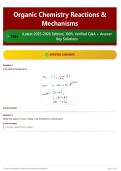
Question 1
Free Radical Halogenation
Correct Answer
Question 2
What free radical is most is likely to be formed from bromination?
Correct Answer
A tertiary radical (Most stable)
Trusted by thousands of students and professionals worldwide Page 1 of 41
,Question 3
Combustion
Correct Answer
Question 4
Pyrolysis (Cracking)
Correct Answer
Question 5
What are nucleophiles?
Correct Answer
Electron-rich species that are attracted to a positively polarized atom (i.e. a carbonyl carbon)
Question 6
What is a better nucleophile I or F?
Correct Answer
Flourine
Question 7
What is a better leaving group I or F?
Correct Answer
Iodine
Trusted by thousands of students and professionals worldwide Page 2 of 41
,Question 8
Sn1 Reaction
Correct Answer
Question 9
What doesn't a nucleophile play a role in the rate of an Sn1 reaction?
Correct Answer
It is not involved in the rate-determining step...the formation of the carbocation.
Question 10
What factors will help carbocation formation and therefore increase the rate of an Sn1 reaction?
Correct Answer
1. Highly substituted carbons.
2. Polar solvents (Surround and isolate the carbocation)
3. Good leaving groups (Weak bases)
Question 11
Sn2 Reaction
Correct Answer
Trusted by thousands of students and professionals worldwide Page 3 of 41
, Question 12
Why is a Sn2 reaction bimolecular?
Correct Answer
Its rate-determining step is dependent on TWO species; both the substrate and the nucleophile.
Question 13
What are the best conditions for an Sn2 reaction?
Correct Answer
You must have a strong nucleophile for the backside attack (thats what she said) with no steric hindrance.
Question 14
With respect to optical activity, what do your end products of Sn1 and Sn2 reactions become?
Correct Answer
Sn1 = racemic mixture (nucleophile can attack from either the top or the bottom of the planar carbocation), therefore loss
of optical activity.
Sn2 = inversion of configuration and remains optically active.
Question 15
What role does tosylate usually play in reactions?
Correct Answer
It usually acts as a good leaving group and a good protecting group.
Question 16
Catalytic Hydrogenation
Correct Answer
Trusted by thousands of students and professionals worldwide Page 4 of 41
Mechanisms
(Latest 2025-2026 Edition) 100% Verified Q&A + Answer
150+
Key Solutions
VERIFIED ANSWERS
Question 1
Free Radical Halogenation
Correct Answer
Question 2
What free radical is most is likely to be formed from bromination?
Correct Answer
A tertiary radical (Most stable)
Trusted by thousands of students and professionals worldwide Page 1 of 41
,Question 3
Combustion
Correct Answer
Question 4
Pyrolysis (Cracking)
Correct Answer
Question 5
What are nucleophiles?
Correct Answer
Electron-rich species that are attracted to a positively polarized atom (i.e. a carbonyl carbon)
Question 6
What is a better nucleophile I or F?
Correct Answer
Flourine
Question 7
What is a better leaving group I or F?
Correct Answer
Iodine
Trusted by thousands of students and professionals worldwide Page 2 of 41
,Question 8
Sn1 Reaction
Correct Answer
Question 9
What doesn't a nucleophile play a role in the rate of an Sn1 reaction?
Correct Answer
It is not involved in the rate-determining step...the formation of the carbocation.
Question 10
What factors will help carbocation formation and therefore increase the rate of an Sn1 reaction?
Correct Answer
1. Highly substituted carbons.
2. Polar solvents (Surround and isolate the carbocation)
3. Good leaving groups (Weak bases)
Question 11
Sn2 Reaction
Correct Answer
Trusted by thousands of students and professionals worldwide Page 3 of 41
, Question 12
Why is a Sn2 reaction bimolecular?
Correct Answer
Its rate-determining step is dependent on TWO species; both the substrate and the nucleophile.
Question 13
What are the best conditions for an Sn2 reaction?
Correct Answer
You must have a strong nucleophile for the backside attack (thats what she said) with no steric hindrance.
Question 14
With respect to optical activity, what do your end products of Sn1 and Sn2 reactions become?
Correct Answer
Sn1 = racemic mixture (nucleophile can attack from either the top or the bottom of the planar carbocation), therefore loss
of optical activity.
Sn2 = inversion of configuration and remains optically active.
Question 15
What role does tosylate usually play in reactions?
Correct Answer
It usually acts as a good leaving group and a good protecting group.
Question 16
Catalytic Hydrogenation
Correct Answer
Trusted by thousands of students and professionals worldwide Page 4 of 41


