ESTUDYR
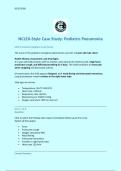
NCLEX-Style Case Study: Pediatric Pneumonia
Client Scenario (Applies to all items)
The nurse in the pediatric emergency department cares for a 5-year-old male client.
Health History, Assessment, and Vital Signs:
A 5-year-old child presents with his mother, who reports the child has had a high fever,
productive cough, and difficulty breathing for 3 days. The child complains of chest pain
when coughing and decreased activity.
On assessment, the child appears fatigued, with nasal flaring and intercostal retractions.
Lung auscultation reveals crackles in the right lower lobe.
Vital signs on arrival:
Temperature: 39.2°C (102.6°F)
Heart rate: 132/min
Respiratory rate: 36/min
Blood pressure: 94/60 mmHg
Oxygen saturation: 90% on room air
Item 1 of 6
Question:
Click to select the findings that require immediate follow-up by the nurse.
(Select all that apply)
Fever
Productive cough
Oxygen saturation 90%
Nasal flaring
Intercostal retractions
Crackles in right lower lobe
Heart rate 132/min
Correct Answers:
, ESTUDYR
Oxygen saturation 90%
Nasal flaring
Intercostal retractions
Heart rate 132/min
Rationale:
Low oxygen saturation and signs of increased work of breathing indicate respiratory distress
and hypoxia, requiring immediate intervention.
Fever, cough, and crackles are expected findings in pneumonia but are not the most urgent
compared to oxygenation issues.
Item 2 of 6
Question:
For each finding, indicate whether it is most consistent with pneumonia, asthma, or
bronchiolitis.
Finding Pneumonia Asthma Bronchiolitis
Fever ☐ ☐ ☐
Productive cough ☐ ☐ ☐
Crackles ☐ ☐ ☐
Expiratory wheezing ☐ ☐ ☐
Intercostal retractions ☐ ☐ ☐
Correct Answers:
Fever → Pneumonia, Bronchiolitis
Productive cough → Pneumonia
Crackles → Pneumonia
Expiratory wheezing → Asthma, Bronchiolitis
Intercostal retractions → Pneumonia, Asthma, Bronchiolitis
Rationale:
Pneumonia is characterized by infection of lung tissue, leading to fever, productive cough,
and crackles.
Asthma and bronchiolitis are more associated with wheezing and airway obstruction.
Retractions can occur in any condition causing respiratory distress.
NCLEX-Style Case Study: Pediatric Pneumonia
Client Scenario (Applies to all items)
The nurse in the pediatric emergency department cares for a 5-year-old male client.
Health History, Assessment, and Vital Signs:
A 5-year-old child presents with his mother, who reports the child has had a high fever,
productive cough, and difficulty breathing for 3 days. The child complains of chest pain
when coughing and decreased activity.
On assessment, the child appears fatigued, with nasal flaring and intercostal retractions.
Lung auscultation reveals crackles in the right lower lobe.
Vital signs on arrival:
Temperature: 39.2°C (102.6°F)
Heart rate: 132/min
Respiratory rate: 36/min
Blood pressure: 94/60 mmHg
Oxygen saturation: 90% on room air
Item 1 of 6
Question:
Click to select the findings that require immediate follow-up by the nurse.
(Select all that apply)
Fever
Productive cough
Oxygen saturation 90%
Nasal flaring
Intercostal retractions
Crackles in right lower lobe
Heart rate 132/min
Correct Answers:
, ESTUDYR
Oxygen saturation 90%
Nasal flaring
Intercostal retractions
Heart rate 132/min
Rationale:
Low oxygen saturation and signs of increased work of breathing indicate respiratory distress
and hypoxia, requiring immediate intervention.
Fever, cough, and crackles are expected findings in pneumonia but are not the most urgent
compared to oxygenation issues.
Item 2 of 6
Question:
For each finding, indicate whether it is most consistent with pneumonia, asthma, or
bronchiolitis.
Finding Pneumonia Asthma Bronchiolitis
Fever ☐ ☐ ☐
Productive cough ☐ ☐ ☐
Crackles ☐ ☐ ☐
Expiratory wheezing ☐ ☐ ☐
Intercostal retractions ☐ ☐ ☐
Correct Answers:
Fever → Pneumonia, Bronchiolitis
Productive cough → Pneumonia
Crackles → Pneumonia
Expiratory wheezing → Asthma, Bronchiolitis
Intercostal retractions → Pneumonia, Asthma, Bronchiolitis
Rationale:
Pneumonia is characterized by infection of lung tissue, leading to fever, productive cough,
and crackles.
Asthma and bronchiolitis are more associated with wheezing and airway obstruction.
Retractions can occur in any condition causing respiratory distress.