

1
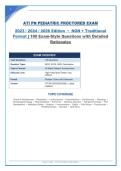
ATI PN PEDIATRIC PROCTORED EXAM
/ 2026 Edition • NGN + Traditional
Format | 180 Exam-Style Questions with Detailed
Rationales
EXAM OVERVIEW
Total Questions 180 Questions
Question Types MCQ, SATA, NGN, Calculations
Topics Covered All Major Pediatric Nursing Areas
Difficulty Level High-Yield, Most-Tested, Very
Difficult
Format Multiple Choice with Rationales
Version ATI PN 2023/2024/2026 + Latest
Updates
TOPIC COVERAGE
Growth & Development • Respiratory • Cardiovascular • Gastrointestinal • Genitourinary • Neurology •
Hematology/Oncology • Musculoskeletal • Endocrine • Infectious Diseases • Allergy/Immunology • Pain
Management • Medication Safety • Nutrition • Immunizations • Safety • Child Abuse • Psychosocial •
Fluid/Electrolytes • Neonatal • NGN Items
Page 1 of 67 | ATI PN Pediatric 2026 Edition
,2
TOPIC INDEX
TOPIC AREA # OF QUESTIONS
Growth & Development 5
Respiratory 7
Cardiovascular 4
GI 5
GU 4
Neurology 5
Hematology 4
Oncology 4
Musculoskeletal 4
Endocrine 4
Infectious Disease 5
Allergy 1
Pain Management 2
Medication Safety 3
Nutrition 2
Immunizations 3
Safety 3
Child Abuse 2
Psychosocial 2
Fluid & Electrolytes 2
Neonatal 3
NGN 5
Burns 2
Congenital Heart Disease 2
Cerebral Palsy 1
Down Syndrome (Trisomy 21) 1
Failure to Thrive (FTT) 1
Autism Spectrum Disorder 1
ADHD 1
Lead Poisoning 1
Fragile X Syndrome 1
Dehydration 1
Acute Otitis Media 1
Strabismus 1
Page 2 of 67 | ATI PN Pediatric 2026 Edition
,3
Wilms Tumor (Nephroblastoma) 1
Neuroblastoma 1
Thalassemia 2
Idiopathic Thrombocytopenic Purpura (ITP) 1
Juvenile Idiopathic Arthritis (JIA) 1
Cleft Lip/Palate 1
Tracheoesophageal Fistula (TEF) 1
Omphalocele vs Gastroschisis 1
Croup 1
Congenital Hypothyroidism 1
Cryptorchidism (Undescended Testis) 1
Phimosis 1
Enuresis 1
Adolescent Health 3
Pediatric Assessment Triangle (PAT) 1
Pediatric Vital Signs 1
Respiratory Distress 1
Status Epilepticus 1
Febrile Seizure 1
Drowning/Near-Drowning 1
Epipen 1
Cleft Lip Repair 1
Foreign Body Aspiration 1
Eczema (Atopic Dermatitis) 1
Impetigo 1
Head Lice (Pediculosis Capitis) 1
Scabies 1
Ringworm (Tinea Capitis) 1
Osteomyelitis 1
Septic Arthritis 1
Legg-Calvé-Perthes Disease 1
Slipped Capital Femoral Epiphysis (SCFE) 1
Club Foot (Talipes Equinovarus) 1
Meningocele vs. Myelomeningocele 1
Hydrocephalus 1
Muscular Dystrophy (Duchenne) 1
Page 3 of 67 | ATI PN Pediatric 2026 Edition
,4
Phenylketonuria (PKU) 1
Galactosemia 1
Reye Syndrome 1
Tonsillectomy 1
Cleft Palate Repair 1
Gastroesophageal Reflux Disease (GERD) 1
Necrotizing Enterocolitis (NEC) 1
Retinopathy of Prematurity (ROP) 1
Patent Ductus Arteriosus (PDA) 1
Inborn Errors of Metabolism 1
Respiratory Acidosis 1
Pediatric CPR 1
Shock 1
Hemolytic Uremic Syndrome (HUS) 1
Hypocalcemia 1
Congenital Adrenal Hyperplasia (CAH) 1
Intussusception 1
Pyloric Stenosis 1
Umbilical Hernia 1
Idiopathic Scoliosis 1
Osgood-Schlatter Disease 1
Growing Pains 1
Foreign Body 1
Hirschsprung Disease 1
Biliary Atresia 1
Short Bowel Syndrome 1
Immune Thrombocytopenia (ITP) 1
Cystic Fibrosis 1
Transposition of the Great Arteries 1
Pediatric Trauma 1
Pediatric Burns 1
Encopresis 1
Pyelonephritis 1
Vesicoureteral Reflux (VUR) 1
Hemophilia 1
Sickle Cell Disease 1
Page 4 of 67 | ATI PN Pediatric 2026 Edition
,5
HIV 1
Immune Deficiency 1
Pediatric Palliative Care 1
Cultural Competence 1
Type 2 Diabetes 1
Growth Hormone Deficiency 1
Precocious Puberty 1
Adolescent Confidentiality 1
Attention-Deficit/Hyperactivity Disorder (ADHD) 1
Oppositional Defiant Disorder (ODD) 1
Therapeutic Communication 1
Anticipatory Guidance 1
Page 5 of 67 | ATI PN Pediatric 2026 Edition
, 6
Q1 | ☑ SATA | Topic: Growth & Development
A nurse is assessing a 2-year-old child during a well-child visit. Which of the following
findings should the nurse expect? (Select all that apply.)
A. Anterior fontanel is closed
B. Birth weight has tripled
C. Walks up stairs with assistance
D. Has a vocabulary of approximately 300 words
E. Uses a pincer grasp
Correct Answers: A, B, C
Rationale:
By 2 years, the anterior fontanel is closed (closes by 18 months), birth weight has tripled, and the
child walks up stairs with assistance. A 2-year-old typically has 50 words (not 300), and the pincer
grasp develops around 9–10 months.
Q2 | ◆ MCQ | Topic: Growth & Development
A nurse is caring for a 4-month-old infant. Which developmental milestone should the
nurse expect this infant to demonstrate?
A. Rolling from back to front
B. Holding head steady when held upright
C. Sitting independently
D. Transferring objects between hands
Correct Answer: B
Rationale:
At 4 months, the infant should be able to hold the head steady when held in an upright position.
Rolling back to front occurs around 5–6 months, sitting independently around 6–8 months, and
transferring objects around 7 months.
Q3 | ☑ SATA | Topic: Growth & Development
A nurse is teaching parents about expected development in a 12-month-old child.
Which of the following behaviors should the nurse include in the teaching? (Select all
that apply.)
A. Says 'mama' and 'dada' with meaning
B. Walks independently without support
C. Uses a neat pincer grasp
D. Points to desired objects
E. Builds a tower of 6 blocks
Correct Answers: A, C, D
Rationale:
Page 6 of 67 | ATI PN Pediatric 2026 Edition
ATI PN PEDIATRIC PROCTORED EXAM
/ 2026 Edition • NGN + Traditional
Format | 180 Exam-Style Questions with Detailed
Rationales
EXAM OVERVIEW
Total Questions 180 Questions
Question Types MCQ, SATA, NGN, Calculations
Topics Covered All Major Pediatric Nursing Areas
Difficulty Level High-Yield, Most-Tested, Very
Difficult
Format Multiple Choice with Rationales
Version ATI PN 2023/2024/2026 + Latest
Updates
TOPIC COVERAGE
Growth & Development • Respiratory • Cardiovascular • Gastrointestinal • Genitourinary • Neurology •
Hematology/Oncology • Musculoskeletal • Endocrine • Infectious Diseases • Allergy/Immunology • Pain
Management • Medication Safety • Nutrition • Immunizations • Safety • Child Abuse • Psychosocial •
Fluid/Electrolytes • Neonatal • NGN Items
Page 1 of 67 | ATI PN Pediatric 2026 Edition
,2
TOPIC INDEX
TOPIC AREA # OF QUESTIONS
Growth & Development 5
Respiratory 7
Cardiovascular 4
GI 5
GU 4
Neurology 5
Hematology 4
Oncology 4
Musculoskeletal 4
Endocrine 4
Infectious Disease 5
Allergy 1
Pain Management 2
Medication Safety 3
Nutrition 2
Immunizations 3
Safety 3
Child Abuse 2
Psychosocial 2
Fluid & Electrolytes 2
Neonatal 3
NGN 5
Burns 2
Congenital Heart Disease 2
Cerebral Palsy 1
Down Syndrome (Trisomy 21) 1
Failure to Thrive (FTT) 1
Autism Spectrum Disorder 1
ADHD 1
Lead Poisoning 1
Fragile X Syndrome 1
Dehydration 1
Acute Otitis Media 1
Strabismus 1
Page 2 of 67 | ATI PN Pediatric 2026 Edition
,3
Wilms Tumor (Nephroblastoma) 1
Neuroblastoma 1
Thalassemia 2
Idiopathic Thrombocytopenic Purpura (ITP) 1
Juvenile Idiopathic Arthritis (JIA) 1
Cleft Lip/Palate 1
Tracheoesophageal Fistula (TEF) 1
Omphalocele vs Gastroschisis 1
Croup 1
Congenital Hypothyroidism 1
Cryptorchidism (Undescended Testis) 1
Phimosis 1
Enuresis 1
Adolescent Health 3
Pediatric Assessment Triangle (PAT) 1
Pediatric Vital Signs 1
Respiratory Distress 1
Status Epilepticus 1
Febrile Seizure 1
Drowning/Near-Drowning 1
Epipen 1
Cleft Lip Repair 1
Foreign Body Aspiration 1
Eczema (Atopic Dermatitis) 1
Impetigo 1
Head Lice (Pediculosis Capitis) 1
Scabies 1
Ringworm (Tinea Capitis) 1
Osteomyelitis 1
Septic Arthritis 1
Legg-Calvé-Perthes Disease 1
Slipped Capital Femoral Epiphysis (SCFE) 1
Club Foot (Talipes Equinovarus) 1
Meningocele vs. Myelomeningocele 1
Hydrocephalus 1
Muscular Dystrophy (Duchenne) 1
Page 3 of 67 | ATI PN Pediatric 2026 Edition
,4
Phenylketonuria (PKU) 1
Galactosemia 1
Reye Syndrome 1
Tonsillectomy 1
Cleft Palate Repair 1
Gastroesophageal Reflux Disease (GERD) 1
Necrotizing Enterocolitis (NEC) 1
Retinopathy of Prematurity (ROP) 1
Patent Ductus Arteriosus (PDA) 1
Inborn Errors of Metabolism 1
Respiratory Acidosis 1
Pediatric CPR 1
Shock 1
Hemolytic Uremic Syndrome (HUS) 1
Hypocalcemia 1
Congenital Adrenal Hyperplasia (CAH) 1
Intussusception 1
Pyloric Stenosis 1
Umbilical Hernia 1
Idiopathic Scoliosis 1
Osgood-Schlatter Disease 1
Growing Pains 1
Foreign Body 1
Hirschsprung Disease 1
Biliary Atresia 1
Short Bowel Syndrome 1
Immune Thrombocytopenia (ITP) 1
Cystic Fibrosis 1
Transposition of the Great Arteries 1
Pediatric Trauma 1
Pediatric Burns 1
Encopresis 1
Pyelonephritis 1
Vesicoureteral Reflux (VUR) 1
Hemophilia 1
Sickle Cell Disease 1
Page 4 of 67 | ATI PN Pediatric 2026 Edition
,5
HIV 1
Immune Deficiency 1
Pediatric Palliative Care 1
Cultural Competence 1
Type 2 Diabetes 1
Growth Hormone Deficiency 1
Precocious Puberty 1
Adolescent Confidentiality 1
Attention-Deficit/Hyperactivity Disorder (ADHD) 1
Oppositional Defiant Disorder (ODD) 1
Therapeutic Communication 1
Anticipatory Guidance 1
Page 5 of 67 | ATI PN Pediatric 2026 Edition
, 6
Q1 | ☑ SATA | Topic: Growth & Development
A nurse is assessing a 2-year-old child during a well-child visit. Which of the following
findings should the nurse expect? (Select all that apply.)
A. Anterior fontanel is closed
B. Birth weight has tripled
C. Walks up stairs with assistance
D. Has a vocabulary of approximately 300 words
E. Uses a pincer grasp
Correct Answers: A, B, C
Rationale:
By 2 years, the anterior fontanel is closed (closes by 18 months), birth weight has tripled, and the
child walks up stairs with assistance. A 2-year-old typically has 50 words (not 300), and the pincer
grasp develops around 9–10 months.
Q2 | ◆ MCQ | Topic: Growth & Development
A nurse is caring for a 4-month-old infant. Which developmental milestone should the
nurse expect this infant to demonstrate?
A. Rolling from back to front
B. Holding head steady when held upright
C. Sitting independently
D. Transferring objects between hands
Correct Answer: B
Rationale:
At 4 months, the infant should be able to hold the head steady when held in an upright position.
Rolling back to front occurs around 5–6 months, sitting independently around 6–8 months, and
transferring objects around 7 months.
Q3 | ☑ SATA | Topic: Growth & Development
A nurse is teaching parents about expected development in a 12-month-old child.
Which of the following behaviors should the nurse include in the teaching? (Select all
that apply.)
A. Says 'mama' and 'dada' with meaning
B. Walks independently without support
C. Uses a neat pincer grasp
D. Points to desired objects
E. Builds a tower of 6 blocks
Correct Answers: A, C, D
Rationale:
Page 6 of 67 | ATI PN Pediatric 2026 Edition


