

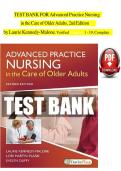
TEST BANK FOR Advanced Practice Nursing
fg fg fg fg fg
in the Care of Older Adults, 2nd Edition
fg fg fg fg fg fg fg fg fg
by Laurie Kennedy-Malone, Verified Chapters 1 - 19, Complete
fg fg fg fg fg fg fg fg
,
,Answers at the end of the Chapter
fg fg fg fg fg fg
Chapter1:ChangeswithAging yt yt yt
Multiple Choice ty
Identify the choice that best completes the statement or answers the question.
ty ty ty ty ty ty ty ty ty ty ty
1. The major impact of the physiological changes that occur with aging is:
ty ty ty ty ty ty ty ty ty ty ty
A. Reduced physiological reserve
ty ty
B. Reduced homeostatic mechanisms
ty ty
C. Impaired immunological response
ty ty
D. All of the above
ty ty ty
2. The strongest evidence regarding normal physiological aging is available through:
ty ty ty ty ty ty ty ty ty
, A. Randomized controlled clinical trials ty ty ty
B. Cross-sectional studies ty
C. Longitudinal studies ty
D. Case control studies
ty ty
3. All of the following statements are true about
ty ty ty ty ty ty ty
ty laboratory values in older adultsexcept: ty ty ty ty
A. Referenceranges are preferable ty ty
B. Abnormal findings are often due to physiological aging
ty ty ty ty ty ty ty
C. Normal ranges may not be applicable for older adults
ty ty ty ty ty ty ty ty
D. Reference values are not necessarily acceptable values
ty ty ty ty ty ty
4. Biochemical individuality is best described as: ty ty ty ty ty
A. Each individual’s variation is often much greater than that of a larger group
ty ty ty ty ty ty ty ty ty ty ty ty
B. The unique biochemical profile of a selected population
ty ty ty ty ty ty ty
C. The truly “normal” individual—falling within average range
ty ty ty ty ty ty
D. Each individual’s variation is often much smaller than that of a larger group
ty ty ty ty ty ty ty ty ty ty ty t y
5. Polypharmacy is best described as taking: ty ty ty ty ty
A. More than nine medications per day
ty ty ty ty ty
B. More than five medications per day
ty ty ty ty t y
fg fg fg fg fg
in the Care of Older Adults, 2nd Edition
fg fg fg fg fg fg fg fg fg
by Laurie Kennedy-Malone, Verified Chapters 1 - 19, Complete
fg fg fg fg fg fg fg fg
,
,Answers at the end of the Chapter
fg fg fg fg fg fg
Chapter1:ChangeswithAging yt yt yt
Multiple Choice ty
Identify the choice that best completes the statement or answers the question.
ty ty ty ty ty ty ty ty ty ty ty
1. The major impact of the physiological changes that occur with aging is:
ty ty ty ty ty ty ty ty ty ty ty
A. Reduced physiological reserve
ty ty
B. Reduced homeostatic mechanisms
ty ty
C. Impaired immunological response
ty ty
D. All of the above
ty ty ty
2. The strongest evidence regarding normal physiological aging is available through:
ty ty ty ty ty ty ty ty ty
, A. Randomized controlled clinical trials ty ty ty
B. Cross-sectional studies ty
C. Longitudinal studies ty
D. Case control studies
ty ty
3. All of the following statements are true about
ty ty ty ty ty ty ty
ty laboratory values in older adultsexcept: ty ty ty ty
A. Referenceranges are preferable ty ty
B. Abnormal findings are often due to physiological aging
ty ty ty ty ty ty ty
C. Normal ranges may not be applicable for older adults
ty ty ty ty ty ty ty ty
D. Reference values are not necessarily acceptable values
ty ty ty ty ty ty
4. Biochemical individuality is best described as: ty ty ty ty ty
A. Each individual’s variation is often much greater than that of a larger group
ty ty ty ty ty ty ty ty ty ty ty ty
B. The unique biochemical profile of a selected population
ty ty ty ty ty ty ty
C. The truly “normal” individual—falling within average range
ty ty ty ty ty ty
D. Each individual’s variation is often much smaller than that of a larger group
ty ty ty ty ty ty ty ty ty ty ty t y
5. Polypharmacy is best described as taking: ty ty ty ty ty
A. More than nine medications per day
ty ty ty ty ty
B. More than five medications per day
ty ty ty ty t y


