

Written by students who passed Immediately available after payment Read online or as PDF Wrong document? Swap it for free 4.6 TrustPilot
logo-home
Exam (elaborations)

REFINED 20 MCQs (Chapter 1) 1) Individualizing a Care Plan

Rating
-
Sold
-
Pages
393
Grade
A+
Uploaded on
19-03-2026
Written in
2025/2026

Reference: Chapter 1 — Individualizing a Care Plan Clinical Stem: A nurse is reviewing a standardized care plan for a postoperative patient experiencing fatigue, poor appetite, and anxiety. The plan includes routine activity progression. The patient states, “Even small tasks feel overwhelming,” and prefers frequent rest periods. What is the nurse’s best action? Options: A. Use the standardized plan without changes to maintain consistency B. Remove all activity goals until the patient feels better C. Modify the plan to match the patient’s stamina and preferences D. Ask the provider to rewrite the plan Correct Answer: C Rationale — Correct: Individualizing care requires adapting standardized plans to the patient’s current tolerance, preferences, and response to illness. This promotes achievable goals, prevents fatigue, and supports recovery. Incorrect: A. Ignores patient-specific needs and may worsen fatigue. B. Eliminates therapeutic progression and delays recovery. D. Nurses are responsible for care plan individualization. Teaching Point: Adapt care plans to patient tolerance and preferences. Citation: Gulanick & Myers, Chapter 1. 2) Prioritizing Nursing Diagnoses Reference: Chapter 1 — Prioritizing Nursing Diagnoses Clinical Stem: A patient presents after a fall with mild pain, requests discharge teaching, and wants to shower. The nurse notes confusion, unsteady gait, and oxygen saturation of 89% on room air. Which diagnosis is priority? Options: A. Acute pain B. Deficient knowledge C. Risk for falls D. Impaired gas exchange Correct Answer: D Rationale — Correct: Low oxygen saturation indicates impaired oxygenation, which is an immediate physiologic threat and takes priority per ABCs. Incorrect: A. Pain is secondary to oxygenation. B. Teaching is delayed until stable. C. Fall risk is important but not first priority. Teaching Point: ABCs override all other priorities. Citation: Gulanick & Myers, Chapter 1. 3) Clinical Judgment Challenge Reference: Chapter 1 — Clinical Judgment Challenge Clinical Stem: A home-care nurse visits a patient who states, “I’m fine,” but has unopened medications and spoiled food at home. The patient appears thin and fatigued. What is the best next action? Options: A. Document patient denial B. Further assess medication use and support systems C. Refer immediately to clinic D. Provide nutrition teaching only Correct Answer: B Rationale — Correct: Conflicting subjective and objective data require further assessment to identify underlying problems before intervention. Incorrect: A. Ignores objective concerns. C. Premature without full assessment. D. Teaching without assessment is ineffective. Teaching Point: Investigate inconsistencies before acting. Citation: Gulanick & Myers, Chapter 1. 4) Optimizing Care Reference: Chapter 1 — A Focus on Optimizing Care Clinical Stem: A stroke patient can perform basic ADLs but refuses therapy, stating, “There’s no point.” What is the best nursing action? Options: A. Wait for motivation B. Set small, realistic goals C. Encourage rest only D. Focus only on complication prevention Correct Answer: B Rationale — Correct: Optimizing care involves promoting achievable functional gains that build confidence and motivation. Incorrect: A. Delays recovery. C. Limits rehabilitation. D. Ignores functional progress. Teaching Point: Small successes drive recovery. Citation: Gulanick & Myers, Chapter 1. 5) Various Clinical Problems Reference: Chapter 1 — Various Clinical Problems Clinical Stem: Which patient requires immediate care-plan revision? Options: A. Family requesting teaching B. Patient with nausea C. Patient with new confusion D. Patient with poor wound healing Correct Answer: C Rationale — Correct: Acute mental status change signals potential serious physiologic deterioration requiring immediate reassessment. Incorrect: A. Non-urgent. B. Less critical. D. Important but not emergent. Teaching Point: Acute confusion = urgent reassessment. Citation: Gulanick & Myers, Chapter 1. 6) Quality and Safety Reference: Chapter 1 — Quality and Safety in Nursing Clinical Stem: A fall-risk patient was found standing unassisted despite documented precautions. What is the priority action? Options: A. Accept documentation B. Implement safety measures immediately C. Wait for next shift D. Reassure patient Correct Answer: B Rationale — Correct: Immediate intervention prevents harm and addresses failure in implementation. Incorrect: A. Documentation ≠ action. C. Delays safety. D. Not protective. Teaching Point: Safety must be enacted, not just documented. 7) Quality Improvement Reference: Chapter 1 — Tools for Quality Improvement Clinical Stem: Medication omissions are increasing. What is the best QI action? Options: A. Blame staff B. Analyze data trends C. Replace staff D. Tell staff to be careful Correct Answer: B Rationale — Correct: QI uses data to identify system issues and guide improvement. Incorrect: A/D. Not system-based. C. Does not address root cause. Teaching Point: QI = data-driven system improvement. 8) Patient Education Materials Reference: Chapter 1 — Patient Education Clinical Stem: A patient with low literacy needs discharge teaching. Best material? Options: A. Dense text B. Simple, visual instructions C. Long complication list D. Policy manual Correct Answer: B Rationale — Correct: Clear, simple, visual materials improve understanding and adherence. Teaching Point: Match teaching to literacy level. 9) Purpose of Care Plans Reference: Chapter 1 — Use of Care Plans Clinical Stem: A nurse views care plans as documentation only. Best correction? Options: A. Legal purpose only B. Guides care and outcomes C. Optional D. Only for complex patients Correct Answer: B Teaching Point: Care plans guide clinical thinking. 10) Individualized Intervention Reference: Chapter 1 — Individualizing Care Clinical Stem: Patient refuses group rehab. Best revision? Options: A. Keep plan B. Remove activity C. Offer individualized options D. Label noncompliant Correct Answer: C Teaching Point: Respect preferences to improve adherence. 11) Evaluating Effectiveness Reference: Chapter 1 — Evaluation Clinical Stem: Which shows effective fall prevention? Options: A. Quiet unit B. Calls for help C. Remembers teaching D. Family visits Correct Answer: B Teaching Point: Behavior change = best evidence. 12) Measurable Outcome Reference: Chapter 1 — Outcomes Clinical Stem: Best outcome? Options: A. Feel better B. Understand C. Eat 50% in 48 hrs D. Stay admitted Correct Answer: C Teaching Point: Outcomes must be measurable. 13) Priority Patient Reference: Chapter 1 — Prioritization Clinical Stem: Who to see first? Options: A. Teaching B. Pain C. New oxygen need D. Meal help Correct Answer: C Teaching Point: Airway/breathing first. 14) Revising Plan Reference: Chapter 1 — Individualizing Clinical Stem: Patient dizzy during ambulation. Best action? Options: A. Continue B. Revise plan C. Increase activity D. Document only Correct Answer: B Teaching Point: Modify plan based on response. 15) QI First Step Reference: Chapter 1 — QI Clinical Stem: First step in reducing pressure injuries? Options: A. Rewrite policy B. Collect baseline data C. Tell staff D. Blame Correct Answer: B Teaching Point: Measure before improving. 16) Education Tool Reference: Chapter 1 — Education Clinical Stem: Best material for walker use? Options: A. Dense booklet B. Visual handout C. Billing info D. Complication list Correct Answer: B Teaching Point: Use visual, simple instructions. 17) Nursing Role Reference: Chapter 1 — Care Plans Clinical Stem: Student says nurses just follow orders. Best response? Options: A. True B. Plans guide nursing care C. Only provider identifies problems D. Evaluate at discharge only Correct Answer: B Teaching Point: Nurses translate assessment into action. 18) Outcome Evaluation Reference: Chapter 1 — Evaluation Clinical Stem: Patient shows partial mobility improvement. Interpretation? Options: A. Goal met B. Partial progress → reassess C. Failure D. Stop therapy Correct Answer: B Teaching Point: Progress can be partial—reassess. 19) Safety Individualization Reference: Chapter 1 — Safety Clinical Stem: Hard-of-hearing patient ignores call light. Best action? Options: A. Continue reminders B. Add individualized strategies C. Blame patient D. Move bed Correct Answer: B Teaching Point: Adapt safety plans to patient ability. 20) Comprehensive Care Planning Reference: Chapter 1 — Clinical Judgment Clinical Stem: Patient fatigued, anxious, poor intake. Best action? Options: A. Discharge teaching only B. Assess and individualize plan C. Ignore emotional cues D. Wait for provider Correct Answer: B Teaching Point: Use all cues to guide care planning. Summary of Improvements Stronger clinical cues → higher discrimination Clearer priority logic (ABCs, safety, function) Enhanced NOC/NIC alignment Improved NCLEX readiness If you want next step, I can: Convert these into a full exam (printable PDF) Add difficulty levels + test blueprint Create case-based NGN-style questions (Next Gen NCLEX)

Show more Read less
Institution
NCLEX-RN
Course
NCLEX-RN

Content preview

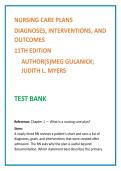
NURSING CARE PLANS
DIAGNOSES, INTERVENTIONS, AND
OUTCOMES
11TH EDITION
• AUTHOR(S)MEG GULANICK;
JUDITH L. MYERS


TEST BANK

Reference: Chapter 1 — What is a nursing care plan?
Stem:
A newly hired RN reviews a patient’s chart and sees a list of
diagnoses, goals, and interventions that were created after
admission. The RN asks why the plan is useful beyond
documentation. Which statement best describes the primary

,purpose of a nursing care plan?
The patient has multiple problems, and several disciplines are
involved in the care.
Options:
A. It replaces the need for ongoing assessment once the plan is
written.
B. It provides a framework for individualized nursing care and
communication.
C. It is mainly used to justify the provider’s medical treatment
plan.
D. It is designed only for discharge teaching.
Correct Answer: B
Rationale:
Correct: A nursing care plan organizes assessment data, nursing
diagnoses, interventions, and expected outcomes to guide
individualized care and support communication. It helps the
nurse deliver consistent, patient-centered care across the shift
and across disciplines.
A: Ongoing assessment is still required; the plan does not
replace reassessment.
C: The plan is nursing-focused, not a substitute for the
provider’s medical plan.
D: It is broader than discharge teaching and applies throughout
the episode of care.

,Teaching Point:
A care plan links assessment, diagnosis, interventions, and
outcomes for individualized nursing care.
Citation:
Gulanick, M., & Myers, J. (11th ed.). Nursing Care Plans:
Diagnoses, Interventions, and Outcomes. Chapter 1: What is a
nursing care plan?


2) Using care plans to individualize care
Reference: Chapter 1 — How to use nursing care plans:
diagnoses, interventions, and outcomes
Stem:
A nurse is caring for two adults with the same diagnosis of fluid
volume excess. One patient is independent at home and the
other has limited literacy and severe arthritis. Which action best
reflects individualized use of the care plan?
Both patients report the same symptoms, but their home
situations differ.
Options:
A. Use the same interventions for both patients because the
diagnosis is identical.
B. Base the plan only on laboratory values.
C. Adapt teaching, goals, and interventions to match each
patient’s abilities and needs.
D. Delay the care plan until all test results return.

, Correct Answer: C
Rationale:
Correct: Individualized care plans account for differences in
learning needs, function, resources, and preferences. Two
patients may share a diagnosis but need different interventions
to reach the same outcome.
A: Identical diagnoses do not mean identical care plans.
B: Lab data are important but not sufficient for a complete
nursing plan.
D: Planning begins with available assessment data and is refined
as more data arrive.
Teaching Point:
Same diagnosis does not mean same plan; tailor care to the
patient’s context.
Citation:
Gulanick, M., & Myers, J. (11th ed.). Nursing Care Plans:
Diagnoses, Interventions, and Outcomes. Chapter 1:
Individualizing a care plan.


3) Prioritizing nursing diagnoses
Reference: Chapter 1 — Prioritizing nursing diagnoses
Stem:
A postoperative patient reports incisional pain rated 8/10, has a
respiratory rate of 10/min, and is difficult to arouse after
receiving opioids. Which nursing diagnosis should the nurse


Written for

Institution
NCLEX-RN
Course
NCLEX-RN

Document information

Uploaded on
March 19, 2026
Number of pages
393
Written in
2025/2026
Type
Exam (elaborations)
Contains
Questions & answers

Subjects

  • use all cues to guide
$32.49
Get access to the full document:

Wrong document? Swap it for free Within 14 days of purchase and before downloading, you can choose a different document. You can simply spend the amount again.
Written by students who passed
Immediately available after payment
Read online or as PDF

Get to know the seller
Seller avatar
NursingTestBankPro
2.0
(2)

Get to know the seller

Seller avatar
NursingTestBankPro Teachme2-tutor
View profile
Follow You need to be logged in order to follow users or courses
Sold
2
Member since
1 year
Number of followers
0
Documents
226
Last sold
5 months ago
TextbookNursing

Clear, easy-to-use nursing test banks featuring textbook-aligned questions and NCLEX-style MCQs for nursing exams at every level. Focused nursing study resources made to simplify learning and strengthen exam readiness. Designed to help you study smarter and pass with confidence.

2.0

2 reviews

5
0
4
0
3
1
2
0
1
1

Recently viewed by you

Why students choose Stuvia

Created by fellow students, verified by reviews

Quality you can trust: written by students who passed their tests and reviewed by others who've used these notes.

Didn't get what you expected? Choose another document

No worries! You can instantly pick a different document that better fits what you're looking for.

Pay as you like, start learning right away

No subscription, no commitments. Pay the way you're used to via credit card and download your PDF document instantly.

Student with book image

“Bought, downloaded, and aced it. It really can be that simple.”

Alisha Student

Working on your references?

Create accurate citations in APA, MLA and Harvard with our free citation generator.

Working on your references?

Frequently asked questions

