

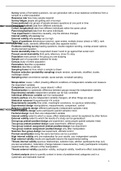
Survey series of formatted questions, we can generalize with a know statistical confidence from a
sample to a wider population
Response rate how many people respond
Survey fatigue people are getting sick of surveys
Cross-sectional one groups of people answers questions at one point in time
METHODSTrend (longitudinal) data from different individuals
8 Content
Cohort (longitudinal) data from different individuals within the same cohort
Panel (longitudinal) data from the same individuals
True experiment to determine causality, only the stimulus changes
Internal validity of a survey low
External validity of a survey can be high
Types of questions dichotomous (yes/no), open ended, multiple choice (check or ABC), rank
METHODSorder,
6 Survey
likert scale, semantic differential scale (two opposite words)
Problems wording survey leading questions, double negative wording, overlap answer options,
double-barreled question
Social desirability bias the respondent doesn’t want to go against that social norm
Prevent social desirability third party reference, show it’s okay
Population every person in the group you are studying
Sample part of a population selected for study
Census study of entire population
Parameters describe a population
Statistics describe a sample
Sampling frame list from which a sample is drawn
Random selection (probability sampling) simple random, systematic, stratified, cluster,
multistage cluster
Sampling error convenience sample, quota sample, snowball sampling
Manipulation cause > effect (creating different conditions of independent variable and measure
the dependent variable)
Comparison cause present, cause absent > effect
Randomization no systematic difference between groups except the independent variable
Experimental variable independent variable can be fully controlled
Individual difference variable can’t be manipulated
Ceteris paribus only the independent variable changers, all other things are equal
Statistical nuisance N experimental ≠ N control
Requirements causality time order, meaningful covariance, no spurious relationship,
Experimental design manipulations, measurements, comparison, control
Between subjects design different participants (independent samples t-test)
METHODSWithin
7 Experiment
subjects design same participants (paired samples t-test)
Factorial design more than one independent variable
Internal validity extent to which a cause, effect relationship cannot be explained by other factors
External validity extent to which the results of a study can be generalized
One-group pretest-posttest design pre-experiment, same people (paired samples t-test)
Two-group pretest-posttest design quasi-experiment, different groups
Two-group random assignment pretest-posttest design true-experiment
Two-group random assignment posttest design only after manipulation
Solomon four-group design true experiment, ultimate control
Pre-test sensitization doing the same test twice can be a problem
High internal validity only one explanation for your results, your independent variable
High external validity results are applicable beyond the experimental setting
Threats internal validity spurious relationships, selection bias, attrition (participants drop out),
pre-test sensitization, maturation (change between measurements), rivalry (participants compete),
experimental bias, diffusion of the manipulation
Threats external validity population validity, ecological validity, hawthorne effect (naturalness)
Content analysis aims to quantify content in terms of predetermined categories and in a
systematic and replicable manner
1
sample to a wider population
Response rate how many people respond
Survey fatigue people are getting sick of surveys
Cross-sectional one groups of people answers questions at one point in time
METHODSTrend (longitudinal) data from different individuals
8 Content
Cohort (longitudinal) data from different individuals within the same cohort
Panel (longitudinal) data from the same individuals
True experiment to determine causality, only the stimulus changes
Internal validity of a survey low
External validity of a survey can be high
Types of questions dichotomous (yes/no), open ended, multiple choice (check or ABC), rank
METHODSorder,
6 Survey
likert scale, semantic differential scale (two opposite words)
Problems wording survey leading questions, double negative wording, overlap answer options,
double-barreled question
Social desirability bias the respondent doesn’t want to go against that social norm
Prevent social desirability third party reference, show it’s okay
Population every person in the group you are studying
Sample part of a population selected for study
Census study of entire population
Parameters describe a population
Statistics describe a sample
Sampling frame list from which a sample is drawn
Random selection (probability sampling) simple random, systematic, stratified, cluster,
multistage cluster
Sampling error convenience sample, quota sample, snowball sampling
Manipulation cause > effect (creating different conditions of independent variable and measure
the dependent variable)
Comparison cause present, cause absent > effect
Randomization no systematic difference between groups except the independent variable
Experimental variable independent variable can be fully controlled
Individual difference variable can’t be manipulated
Ceteris paribus only the independent variable changers, all other things are equal
Statistical nuisance N experimental ≠ N control
Requirements causality time order, meaningful covariance, no spurious relationship,
Experimental design manipulations, measurements, comparison, control
Between subjects design different participants (independent samples t-test)
METHODSWithin
7 Experiment
subjects design same participants (paired samples t-test)
Factorial design more than one independent variable
Internal validity extent to which a cause, effect relationship cannot be explained by other factors
External validity extent to which the results of a study can be generalized
One-group pretest-posttest design pre-experiment, same people (paired samples t-test)
Two-group pretest-posttest design quasi-experiment, different groups
Two-group random assignment pretest-posttest design true-experiment
Two-group random assignment posttest design only after manipulation
Solomon four-group design true experiment, ultimate control
Pre-test sensitization doing the same test twice can be a problem
High internal validity only one explanation for your results, your independent variable
High external validity results are applicable beyond the experimental setting
Threats internal validity spurious relationships, selection bias, attrition (participants drop out),
pre-test sensitization, maturation (change between measurements), rivalry (participants compete),
experimental bias, diffusion of the manipulation
Threats external validity population validity, ecological validity, hawthorne effect (naturalness)
Content analysis aims to quantify content in terms of predetermined categories and in a
systematic and replicable manner
1


