
NR 509 ADVANCED HEALTH ASSESSMENT FINAL EXAM
2026/2027 | Latest 100% Verified Questions and Answers with
Complete Solutions | Pass Guaranteed - A+ Graded
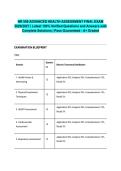
EXAMINATION BLUEPRINT
Table
Questio
Domain Bloom's Taxonomy Distribution
ns
1. Health History & Application 50%, Analysis 30%, Comprehension 15%,
12
Interviewing Recall 5%
2. Physical Examination Application 50%, Analysis 30%, Comprehension 15%,
15
Techniques Recall 5%
Application 50%, Analysis 30%, Comprehension 15%,
3. HEENT Assessment 10
Recall 5%
4. Cardiovascular Application 50%, Analysis 30%, Comprehension 15%,
15
Assessment Recall 5%
Application 50%, Analysis 30%, Comprehension 15%,
5. Respiratory Assessment 12
Recall 5%
, 6. Abdominal/GI Application 50%, Analysis 30%, Comprehension 15%,
10
Assessment Recall 5%
7.
Application 50%, Analysis 30%, Comprehension 15%,
Neurological/Musculoskelet 14
Recall 5%
al
Application 50%, Analysis 30%, Comprehension 15%,
8. Special Populations 12
Recall 5%
TOTAL 100
DOMAIN 1: HEALTH HISTORY AND INTERVIEWING TECHNIQUES (12
Questions)
Q1: Clinical Scenario - Therapeutic Communication
A 67-year-old male patient presents for a follow-up appointment. During the health
history interview, he becomes visibly anxious when discussing his recent chest pain
episodes. He states, "I'm probably just worrying too much. My father died of a heart
attack at my age, so I'm probably overreacting." Which response by the advanced
practice nurse demonstrates the most effective use of therapeutic communication and
facilitates comprehensive data collection?
A. "You're right to be concerned given your family history. Let's schedule you for a stress
test today to rule out anything serious."
,B. "Many patients minimize their symptoms. Tell me exactly what the chest pain feels
like and when it occurs."
C. "It sounds like your father's experience is weighing heavily on you. Can you describe
what happens during these episodes? When do they occur, and what were you doing?"
[CORRECT]
D. "Chest pain should never be ignored. We need to run several tests immediately to
determine if you're having a heart attack."
Correct Answer: C
Rationale: This response demonstrates empathic understanding (acknowledging the
emotional context), clarification (addressing the minimization without confrontation),
and open-ended questioning that elicits specific symptom characteristics essential for
differential diagnosis.
● Option A is incorrect because it prematurely jumps to diagnostic testing without
completing the symptom analysis, potentially missing critical historical details. It
also validates the patient's minimization rather than exploring it.
● Option B is incorrect because the confrontational tone ("Many patients
minimize") may increase anxiety and reduce the therapeutic alliance. While it
seeks information, the approach is not patient-centered.
● Option D is incorrect because it induces panic, uses closed-ended authoritative
language, and fails to gather essential history before testing. This violates the
principle of systematic data collection.
NR 509 Alignment: This question addresses Course Objective 1.3 (Therapeutic
Communication) and 2.1 (Comprehensive Health History), emphasizing the
Calgary-Cambridge Guide model for patient-centered interviewing.
Q2: Clinical Scenario - Cultural Competence
, A 42-year-old female patient from a Southeast Asian cultural background presents with
vague abdominal complaints. During the interview, she avoids eye contact, speaks
softly, and defers to her husband for answers. Her husband insists on remaining in the
examination room. Which approach by the advanced practice nurse best demonstrates
cultural competence while ensuring comprehensive health history collection?
A. Request the husband leave immediately to ensure HIPAA compliance and obtain
accurate information directly from the patient
B. Accept the cultural norms, conduct the interview with the husband present, but create
opportunities for private conversation by asking sensitive questions during the physical
examination when the husband steps out [CORRECT]
C. Proceed with the interview as is, assuming the patient is comfortable with her
husband answering all questions
D. Document that the patient is non-compliant with standard interview protocols and
schedule a follow-up with an interpreter
Correct Answer: B
Rationale: Cultural competence requires balancing respect for cultural values
(collectivist decision-making, gender roles) with the clinical necessity of obtaining
accurate, private health information.
● Option A violates cultural sensitivity and may destroy therapeutic trust; HIPAA
allows for patient-designated presence.
● Option C risks obtaining inaccurate history (proxy reporting bias) and misses
opportunities to screen for sensitive issues (domestic violence, sexual health,
mental health).
● Option D demonstrates cultural incompetence and bias; there is no indication of
language barriers requiring an interpreter.
2026/2027 | Latest 100% Verified Questions and Answers with
Complete Solutions | Pass Guaranteed - A+ Graded
EXAMINATION BLUEPRINT
Table
Questio
Domain Bloom's Taxonomy Distribution
ns
1. Health History & Application 50%, Analysis 30%, Comprehension 15%,
12
Interviewing Recall 5%
2. Physical Examination Application 50%, Analysis 30%, Comprehension 15%,
15
Techniques Recall 5%
Application 50%, Analysis 30%, Comprehension 15%,
3. HEENT Assessment 10
Recall 5%
4. Cardiovascular Application 50%, Analysis 30%, Comprehension 15%,
15
Assessment Recall 5%
Application 50%, Analysis 30%, Comprehension 15%,
5. Respiratory Assessment 12
Recall 5%
, 6. Abdominal/GI Application 50%, Analysis 30%, Comprehension 15%,
10
Assessment Recall 5%
7.
Application 50%, Analysis 30%, Comprehension 15%,
Neurological/Musculoskelet 14
Recall 5%
al
Application 50%, Analysis 30%, Comprehension 15%,
8. Special Populations 12
Recall 5%
TOTAL 100
DOMAIN 1: HEALTH HISTORY AND INTERVIEWING TECHNIQUES (12
Questions)
Q1: Clinical Scenario - Therapeutic Communication
A 67-year-old male patient presents for a follow-up appointment. During the health
history interview, he becomes visibly anxious when discussing his recent chest pain
episodes. He states, "I'm probably just worrying too much. My father died of a heart
attack at my age, so I'm probably overreacting." Which response by the advanced
practice nurse demonstrates the most effective use of therapeutic communication and
facilitates comprehensive data collection?
A. "You're right to be concerned given your family history. Let's schedule you for a stress
test today to rule out anything serious."
,B. "Many patients minimize their symptoms. Tell me exactly what the chest pain feels
like and when it occurs."
C. "It sounds like your father's experience is weighing heavily on you. Can you describe
what happens during these episodes? When do they occur, and what were you doing?"
[CORRECT]
D. "Chest pain should never be ignored. We need to run several tests immediately to
determine if you're having a heart attack."
Correct Answer: C
Rationale: This response demonstrates empathic understanding (acknowledging the
emotional context), clarification (addressing the minimization without confrontation),
and open-ended questioning that elicits specific symptom characteristics essential for
differential diagnosis.
● Option A is incorrect because it prematurely jumps to diagnostic testing without
completing the symptom analysis, potentially missing critical historical details. It
also validates the patient's minimization rather than exploring it.
● Option B is incorrect because the confrontational tone ("Many patients
minimize") may increase anxiety and reduce the therapeutic alliance. While it
seeks information, the approach is not patient-centered.
● Option D is incorrect because it induces panic, uses closed-ended authoritative
language, and fails to gather essential history before testing. This violates the
principle of systematic data collection.
NR 509 Alignment: This question addresses Course Objective 1.3 (Therapeutic
Communication) and 2.1 (Comprehensive Health History), emphasizing the
Calgary-Cambridge Guide model for patient-centered interviewing.
Q2: Clinical Scenario - Cultural Competence
, A 42-year-old female patient from a Southeast Asian cultural background presents with
vague abdominal complaints. During the interview, she avoids eye contact, speaks
softly, and defers to her husband for answers. Her husband insists on remaining in the
examination room. Which approach by the advanced practice nurse best demonstrates
cultural competence while ensuring comprehensive health history collection?
A. Request the husband leave immediately to ensure HIPAA compliance and obtain
accurate information directly from the patient
B. Accept the cultural norms, conduct the interview with the husband present, but create
opportunities for private conversation by asking sensitive questions during the physical
examination when the husband steps out [CORRECT]
C. Proceed with the interview as is, assuming the patient is comfortable with her
husband answering all questions
D. Document that the patient is non-compliant with standard interview protocols and
schedule a follow-up with an interpreter
Correct Answer: B
Rationale: Cultural competence requires balancing respect for cultural values
(collectivist decision-making, gender roles) with the clinical necessity of obtaining
accurate, private health information.
● Option A violates cultural sensitivity and may destroy therapeutic trust; HIPAA
allows for patient-designated presence.
● Option C risks obtaining inaccurate history (proxy reporting bias) and misses
opportunities to screen for sensitive issues (domestic violence, sexual health,
mental health).
● Option D demonstrates cultural incompetence and bias; there is no indication of
language barriers requiring an interpreter.


