

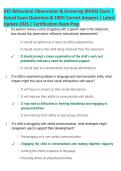
DCF Behavioral Observation & Screening (BOAS) Exam |
Actual Exam Questions & 100% Correct Answers | Latest
Update 2026 | Certification Exam Prep
1. If a teacher notices a child struggling with a specific task in the classroom,
how should this observation influence instructional assessments?
It should be ignored as it does not affect assessments.
It should result in the child being removed from the classroom.
It should prompt a closer examination of the child's work and
potentially indicate a need for additional support.
It should lead to a standardized test being administered.
2. If a child is experiencing delays in language and communication skills, what
impact might this have on their social interactions with peers?
It will have no impact on their social interactions.
It will improve their ability to communicate with adults.
It may lead to difficulties in forming friendships and engaging in
group activities.
It will enhance their ability to lead group activities.
3. If a child is struggling with verbal communication, what strategies might
caregivers use to support their development?
Encouraging only non-verbal communication
Engaging the child in conversations and reading together regularly
Limiting the child's exposure to language
Focusing solely on physical activities
,4. Why is it crucial to communicate the benefits of assessment to parents during
screening discussions?
It allows parents to choose their preferred screening method.
It informs parents about the legal requirements for screening.
It helps parents understand how assessment supports their child's
development.
It ensures parents are aware of the screening costs.
5. What is the purpose of school readiness test?
To determine whether young children have the prerequisite skills to
be successful in a typical kindergarten or first-grade curriculum.
To assess how much students have learned from what they have
presumably been specifically taught.
To predict how easily students are likely to learn in a specific content
domain.
To assess students' general capability to learn; to predict their general
academic success over the short run.
6. If a child is observed to be developing skills in spurts, what approach should
a caregiver take to support this child's growth?
Limit activities to those that the child is already comfortable with.
Focus solely on structured learning to ensure consistent progress.
Provide varied and stimulating activities that cater to the child's
interests and developmental stage.
Encourage competition among peers to motivate the child.
,7. What factors influence the unique rate of development in each child
according to the text?
Nutrition and exercise
Social interactions and education
Parental involvement and technology
Heredity and environment
8. The key benefits of developmental screening are:
Early detection
activities that strengthen the child's skills
quality information is available to parents regarding in-the-home
activities that support normal development
Common reference points and basis for interaction for all
stakeholders
all of the above
9. In a scenario where a child is exhibiting unusual behavior, which observation
method would be most appropriate to gather unbiased data, and why?
Non-participant observation, as it allows the observer to remain
detached from the child's activities.
Overt observation, as it provides immediate feedback from the child
about their behavior.
Participant observation, as it enables the observer to engage with the
child directly.
Covert observation, as it allows for unbiased data collection without
the child's awareness.
, 10. What are the key aspects of social and emotional development in children?
Language acquisition and communication
Physical growth and motor skills
Self-perception and relationships with others
Cognitive skills and problem-solving
11. Today, infant tests are primarily used for:
School placement
Predicting childhood intelligence
Identifying gifted children
Screening for early intervention
12. Some basic principles of development underlie the physical development
curriculum in a preschool setting. One of these is:
preschoolers are moving away from an egocentric perspective.
preschoolers are developing initiative vs. guilt.
development is sequential and cumulative.
object permanence is developed with experience.
13. : During a health education session, a nurse discusses the importance of
early identification of developmental delays with parents. What is a key
reason the nurse emphasizes for this early identification?
To decrease parental anxiety about child development.
To ensure the child is academically ahead of peers.
To facilitate the child's early entry into sports and physical activities.
Actual Exam Questions & 100% Correct Answers | Latest
Update 2026 | Certification Exam Prep
1. If a teacher notices a child struggling with a specific task in the classroom,
how should this observation influence instructional assessments?
It should be ignored as it does not affect assessments.
It should result in the child being removed from the classroom.
It should prompt a closer examination of the child's work and
potentially indicate a need for additional support.
It should lead to a standardized test being administered.
2. If a child is experiencing delays in language and communication skills, what
impact might this have on their social interactions with peers?
It will have no impact on their social interactions.
It will improve their ability to communicate with adults.
It may lead to difficulties in forming friendships and engaging in
group activities.
It will enhance their ability to lead group activities.
3. If a child is struggling with verbal communication, what strategies might
caregivers use to support their development?
Encouraging only non-verbal communication
Engaging the child in conversations and reading together regularly
Limiting the child's exposure to language
Focusing solely on physical activities
,4. Why is it crucial to communicate the benefits of assessment to parents during
screening discussions?
It allows parents to choose their preferred screening method.
It informs parents about the legal requirements for screening.
It helps parents understand how assessment supports their child's
development.
It ensures parents are aware of the screening costs.
5. What is the purpose of school readiness test?
To determine whether young children have the prerequisite skills to
be successful in a typical kindergarten or first-grade curriculum.
To assess how much students have learned from what they have
presumably been specifically taught.
To predict how easily students are likely to learn in a specific content
domain.
To assess students' general capability to learn; to predict their general
academic success over the short run.
6. If a child is observed to be developing skills in spurts, what approach should
a caregiver take to support this child's growth?
Limit activities to those that the child is already comfortable with.
Focus solely on structured learning to ensure consistent progress.
Provide varied and stimulating activities that cater to the child's
interests and developmental stage.
Encourage competition among peers to motivate the child.
,7. What factors influence the unique rate of development in each child
according to the text?
Nutrition and exercise
Social interactions and education
Parental involvement and technology
Heredity and environment
8. The key benefits of developmental screening are:
Early detection
activities that strengthen the child's skills
quality information is available to parents regarding in-the-home
activities that support normal development
Common reference points and basis for interaction for all
stakeholders
all of the above
9. In a scenario where a child is exhibiting unusual behavior, which observation
method would be most appropriate to gather unbiased data, and why?
Non-participant observation, as it allows the observer to remain
detached from the child's activities.
Overt observation, as it provides immediate feedback from the child
about their behavior.
Participant observation, as it enables the observer to engage with the
child directly.
Covert observation, as it allows for unbiased data collection without
the child's awareness.
, 10. What are the key aspects of social and emotional development in children?
Language acquisition and communication
Physical growth and motor skills
Self-perception and relationships with others
Cognitive skills and problem-solving
11. Today, infant tests are primarily used for:
School placement
Predicting childhood intelligence
Identifying gifted children
Screening for early intervention
12. Some basic principles of development underlie the physical development
curriculum in a preschool setting. One of these is:
preschoolers are moving away from an egocentric perspective.
preschoolers are developing initiative vs. guilt.
development is sequential and cumulative.
object permanence is developed with experience.
13. : During a health education session, a nurse discusses the importance of
early identification of developmental delays with parents. What is a key
reason the nurse emphasizes for this early identification?
To decrease parental anxiety about child development.
To ensure the child is academically ahead of peers.
To facilitate the child's early entry into sports and physical activities.


