

FSE 214 Final Study Terms EXAM
comprehensive questions and verified answers|
get it 100% ACCURATE!!
Save
Terms in this set (89)
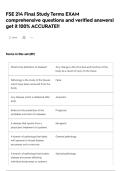
What is the definition of disease? Any change in the structure and function of the
body as a result of injury to the tissue.
Pathology is the study of the tissues False
which have been removed from the
body.
Any disease which is obtained after Acquired
birth.
Refers to the prediction of the Prognosis
probable outcome of a disease.
A disease that results from a iatrogenic
physician's treatment of a patient.
A branch of pathology that deals General pathology
with general or broad disease
processes such a necrosis
A branch of pathology that studies Special pathology
disease processes affecting
individual body areas or systems.
, A branch of pathology that studies X Pathology
changes which occur in cell of the X Special pathology
body at the microscopic level. X General pathology
X Gross pathology
Correct - None of the above
Two types of diseases are: Acute, Chronic
These are diseases that are Febrile
characterized by fever.
Match the terms with the ischemia - decreased blood flow to a part of
definitions. body
Thrombosis - formation of blood clot within the
heart or vessels
infarction - dying of a tissue due to lack of
ocygen
hematoma - a swelling filled with blood
Embolism - an object floating through blood
causing obstruction
edema - excessive accumulation of a fluid
Match the malformations to the aplasia - absence of body parts
terms etiology - refers to the study of the causes of
disease
hernia - protrusion of an organ through the wall
of the body cavity in which it is contained
pandemic - diseases that affect a large number of
people
cyst - a sac-like structure, containing fluid or a
semi-solid substance
When substances enter the body infiltration
and accumulate in excessive
amount, it is called.
comprehensive questions and verified answers|
get it 100% ACCURATE!!
Save
Terms in this set (89)
What is the definition of disease? Any change in the structure and function of the
body as a result of injury to the tissue.
Pathology is the study of the tissues False
which have been removed from the
body.
Any disease which is obtained after Acquired
birth.
Refers to the prediction of the Prognosis
probable outcome of a disease.
A disease that results from a iatrogenic
physician's treatment of a patient.
A branch of pathology that deals General pathology
with general or broad disease
processes such a necrosis
A branch of pathology that studies Special pathology
disease processes affecting
individual body areas or systems.
, A branch of pathology that studies X Pathology
changes which occur in cell of the X Special pathology
body at the microscopic level. X General pathology
X Gross pathology
Correct - None of the above
Two types of diseases are: Acute, Chronic
These are diseases that are Febrile
characterized by fever.
Match the terms with the ischemia - decreased blood flow to a part of
definitions. body
Thrombosis - formation of blood clot within the
heart or vessels
infarction - dying of a tissue due to lack of
ocygen
hematoma - a swelling filled with blood
Embolism - an object floating through blood
causing obstruction
edema - excessive accumulation of a fluid
Match the malformations to the aplasia - absence of body parts
terms etiology - refers to the study of the causes of
disease
hernia - protrusion of an organ through the wall
of the body cavity in which it is contained
pandemic - diseases that affect a large number of
people
cyst - a sac-like structure, containing fluid or a
semi-solid substance
When substances enter the body infiltration
and accumulate in excessive
amount, it is called.


