

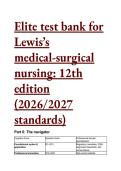
Elite test bank for
Lewis’s
medical-surgical
nursing: 12th
edition
(2026/2027
standards)
Part 0: The navigator
Cognitive focus Question block Professional domain
specialization
Foundational syntax & Q1–Q15 Regulatory mandates, 2026
application diagnostic thresholds, and
nomenclature.
Professional simulation Q16–Q40 High-acuity bedside
,Cognitive focus Question block Professional domain
specialization
decision-making and
AI-integrated documentation.
Grandmaster synthesis Q41–Q55 Multi-system failure,
hemodynamic crisis
management, and ethical
oversight.
Part I: The primer
Mastering medical-surgical nursing in the 2026/2027 environment requires the transition from
academic memorization to the rigorous application of clinical architecture. The professional who
anticipates physiological failure through advanced diagnostic intuition serves as the ultimate
safeguard against iatrogenic harm in increasingly complex healthcare systems.
The "Panic Button" Cheat Sheet
● Sepsis Redline: 30 mL/kg crystalloid is now specifically reserved for sepsis-induced
hypoperfusion (shock); it is no longer a default for stable sepsis.
● GOLD 2026 Threshold: A single moderate exacerbation in the previous 12 months
mandates reclassification to GOLD Category E.
● AHA Pillar Mandate: 4-pillar GDMT (ARNi, Beta-blocker, MRA, SGLT2i) must be initiated
or optimized prior to discharge following any heart failure hospitalization.
● NPG 12 Staffing: Hospitals must demonstrate acuity-based staffing plans with 24/7 RN
oversight to maintain Joint Commission accreditation.
Part II: The elite test bank
Questions 1–15: Foundational syntax & application
Q1: The 2026 Surviving Sepsis Campaign (SSC) guidelines have officially transitioned
away from the quick Sequential Organ Failure Assessment (qSOFA) as a standalone
screening tool for sepsis in medical-surgical units. What is the evidence-based rationale
for this shift in professional standards? A) qSOFA demonstrated excessive sensitivity,
resulting in high rates of false-positive sepsis alerts and clinical fatigue. B) Comparative analysis
shows that NEWS2 and MEWS provide significantly higher sensitivity for the early detection of
sepsis-related organ dysfunction. C) The qSOFA criteria require arterial blood gas data and
laboratory results that are not consistently available on general wards. D) Standardized
protocols now mandate the use of machine-learning algorithms to the exclusion of all manual
screening tools.
● The Answer: B) Comparative analysis shows that NEWS2 and MEWS provide
significantly higher sensitivity for the early detection of sepsis-related organ dysfunction.
● Distractor Analysis: Option A is an amateur trap; qSOFA was deprecated due to low
sensitivity, not high sensitivity, meaning it missed many patients in the early stages of the
septic cascade. Option C is factually incorrect, as qSOFA relies on bedside clinical
markers (respiratory rate, mentation, and blood pressure). Option D represents a common
misconception regarding automation; while AI assists in detection, clinical nursing
judgment using validated manual scales remains the legal gold standard for initiation.
, ● The Mentor's Analysis: In the 2026 clinical landscape, "failure to rescue" remains the
primary liability for medical-surgical practitioners. The qSOFA was originally designed for
the ICU setting to predict mortality, but for the floor nurse, it functioned as a "late-stage"
alarm. By the time a patient triggers two qSOFA points, the window for effective fluid
resuscitation and source control has often narrowed dangerously. Professional intuition
now dictates the use of the National Early Warning Score (NEWS2), which tracks six
physiological parameters, allowing the nurse to recognize cues of a "dysregulated host
response" before the onset of overt shock. This alignment with the 2026 NCSBN Clinical
Judgment Measurement Model (CJMM) emphasizes the "Recognize Cues" phase as the
most critical for sepsis survival.
Q2: According to the 2026 Global Initiative for Chronic Obstructive Lung Disease (GOLD)
report, how is "Disease Control" specifically distinguished from "Disease Stability"? A)
Disease Control requires a post-bronchodilator FEV_1/FVC ratio of > 0.80, while Stability allows
for a ratio of 0.70. B) Disease Stability is defined as a low activity state with no exacerbations,
while Disease Control adds the requirement that existing symptoms have a low daily impact on
the patient. C) Disease Control is achieved through pharmacotherapy alone, whereas Disease
Stability requires the addition of pulmonary rehabilitation. D) There is no clinical distinction; the
2026 report uses the terms interchangeably to describe patients who are not currently
hospitalized.
● The Answer: B) Disease Stability is defined as a low activity state with no exacerbations,
while Disease Control adds the requirement that existing symptoms have a low daily
impact on the patient.
● Distractor Analysis: Option A incorrectly identifies spirometry thresholds as the defining
factor for control; spirometry is diagnostic, not evaluative of daily activity. Option C
incorrectly characterizes the intervention type as the definition of the physiological state.
Option D is a dangerous trap for students who rely on older terminology; the 2026 report
introduces these precise definitions to provide concrete therapeutic targets beyond mere
airflow limitation.
● The Mentor's Analysis: The introduction of the "Disease Activity" framework in 2026
represents a shift toward "Proactive Precision Medicine". As a mentor, I advise you to
view COPD not as a fixed scar on the lungs, but as a dynamic biological process. A
patient can be "stable" (meaning they aren't getting worse or having exacerbations) but
still not be "controlled" if they are self-limiting their activities to avoid breathlessness. Our
professional goal in 2026 is "Disease Control," which requires the nurse to move beyond
the oxygen tank and assess the "4Ms"—Mentation, Mobility, Medications, and Morbidities.
This ensures the whole patient is treated, addressing the underlying biological drivers that
lead to the "accelerated lung aging" common in poorly controlled COPD.
Q3: The American Heart Association (AHA) 2026 guidelines for Heart Failure with
Reduced Ejection Fraction (HFrEF) mandate a "4-pillar" Guideline-Directed Medical
Therapy (GDMT). Which specific medication class is the most recent addition to this
mandate for all symptomatic HFrEF patients? A) Beta-adrenergic blockers (e.g., Carvedilol,
Metoprolol Succinate). B) Angiotensin receptor-neprilysin inhibitors (ARNi) (e.g.,
Sacubitril/Valsartan). C) Sodium-glucose cotransporter-2 (SGLT2) inhibitors (e.g., Empagliflozin,
Dapagliflozin). D) Long-acting nitrate therapy combined with Hydralazine.
● The Answer: C) Sodium-glucose cotransporter-2 (SGLT2) inhibitors.
● Distractor Analysis: Option A and B are foundational components of heart failure
therapy but were integrated as standards prior to the broad 2024-2026 SGLT2i mandate.
Option D is a specialized therapy specifically recommended for self-identified African
Lewis’s
medical-surgical
nursing: 12th
edition
(2026/2027
standards)
Part 0: The navigator
Cognitive focus Question block Professional domain
specialization
Foundational syntax & Q1–Q15 Regulatory mandates, 2026
application diagnostic thresholds, and
nomenclature.
Professional simulation Q16–Q40 High-acuity bedside
,Cognitive focus Question block Professional domain
specialization
decision-making and
AI-integrated documentation.
Grandmaster synthesis Q41–Q55 Multi-system failure,
hemodynamic crisis
management, and ethical
oversight.
Part I: The primer
Mastering medical-surgical nursing in the 2026/2027 environment requires the transition from
academic memorization to the rigorous application of clinical architecture. The professional who
anticipates physiological failure through advanced diagnostic intuition serves as the ultimate
safeguard against iatrogenic harm in increasingly complex healthcare systems.
The "Panic Button" Cheat Sheet
● Sepsis Redline: 30 mL/kg crystalloid is now specifically reserved for sepsis-induced
hypoperfusion (shock); it is no longer a default for stable sepsis.
● GOLD 2026 Threshold: A single moderate exacerbation in the previous 12 months
mandates reclassification to GOLD Category E.
● AHA Pillar Mandate: 4-pillar GDMT (ARNi, Beta-blocker, MRA, SGLT2i) must be initiated
or optimized prior to discharge following any heart failure hospitalization.
● NPG 12 Staffing: Hospitals must demonstrate acuity-based staffing plans with 24/7 RN
oversight to maintain Joint Commission accreditation.
Part II: The elite test bank
Questions 1–15: Foundational syntax & application
Q1: The 2026 Surviving Sepsis Campaign (SSC) guidelines have officially transitioned
away from the quick Sequential Organ Failure Assessment (qSOFA) as a standalone
screening tool for sepsis in medical-surgical units. What is the evidence-based rationale
for this shift in professional standards? A) qSOFA demonstrated excessive sensitivity,
resulting in high rates of false-positive sepsis alerts and clinical fatigue. B) Comparative analysis
shows that NEWS2 and MEWS provide significantly higher sensitivity for the early detection of
sepsis-related organ dysfunction. C) The qSOFA criteria require arterial blood gas data and
laboratory results that are not consistently available on general wards. D) Standardized
protocols now mandate the use of machine-learning algorithms to the exclusion of all manual
screening tools.
● The Answer: B) Comparative analysis shows that NEWS2 and MEWS provide
significantly higher sensitivity for the early detection of sepsis-related organ dysfunction.
● Distractor Analysis: Option A is an amateur trap; qSOFA was deprecated due to low
sensitivity, not high sensitivity, meaning it missed many patients in the early stages of the
septic cascade. Option C is factually incorrect, as qSOFA relies on bedside clinical
markers (respiratory rate, mentation, and blood pressure). Option D represents a common
misconception regarding automation; while AI assists in detection, clinical nursing
judgment using validated manual scales remains the legal gold standard for initiation.
, ● The Mentor's Analysis: In the 2026 clinical landscape, "failure to rescue" remains the
primary liability for medical-surgical practitioners. The qSOFA was originally designed for
the ICU setting to predict mortality, but for the floor nurse, it functioned as a "late-stage"
alarm. By the time a patient triggers two qSOFA points, the window for effective fluid
resuscitation and source control has often narrowed dangerously. Professional intuition
now dictates the use of the National Early Warning Score (NEWS2), which tracks six
physiological parameters, allowing the nurse to recognize cues of a "dysregulated host
response" before the onset of overt shock. This alignment with the 2026 NCSBN Clinical
Judgment Measurement Model (CJMM) emphasizes the "Recognize Cues" phase as the
most critical for sepsis survival.
Q2: According to the 2026 Global Initiative for Chronic Obstructive Lung Disease (GOLD)
report, how is "Disease Control" specifically distinguished from "Disease Stability"? A)
Disease Control requires a post-bronchodilator FEV_1/FVC ratio of > 0.80, while Stability allows
for a ratio of 0.70. B) Disease Stability is defined as a low activity state with no exacerbations,
while Disease Control adds the requirement that existing symptoms have a low daily impact on
the patient. C) Disease Control is achieved through pharmacotherapy alone, whereas Disease
Stability requires the addition of pulmonary rehabilitation. D) There is no clinical distinction; the
2026 report uses the terms interchangeably to describe patients who are not currently
hospitalized.
● The Answer: B) Disease Stability is defined as a low activity state with no exacerbations,
while Disease Control adds the requirement that existing symptoms have a low daily
impact on the patient.
● Distractor Analysis: Option A incorrectly identifies spirometry thresholds as the defining
factor for control; spirometry is diagnostic, not evaluative of daily activity. Option C
incorrectly characterizes the intervention type as the definition of the physiological state.
Option D is a dangerous trap for students who rely on older terminology; the 2026 report
introduces these precise definitions to provide concrete therapeutic targets beyond mere
airflow limitation.
● The Mentor's Analysis: The introduction of the "Disease Activity" framework in 2026
represents a shift toward "Proactive Precision Medicine". As a mentor, I advise you to
view COPD not as a fixed scar on the lungs, but as a dynamic biological process. A
patient can be "stable" (meaning they aren't getting worse or having exacerbations) but
still not be "controlled" if they are self-limiting their activities to avoid breathlessness. Our
professional goal in 2026 is "Disease Control," which requires the nurse to move beyond
the oxygen tank and assess the "4Ms"—Mentation, Mobility, Medications, and Morbidities.
This ensures the whole patient is treated, addressing the underlying biological drivers that
lead to the "accelerated lung aging" common in poorly controlled COPD.
Q3: The American Heart Association (AHA) 2026 guidelines for Heart Failure with
Reduced Ejection Fraction (HFrEF) mandate a "4-pillar" Guideline-Directed Medical
Therapy (GDMT). Which specific medication class is the most recent addition to this
mandate for all symptomatic HFrEF patients? A) Beta-adrenergic blockers (e.g., Carvedilol,
Metoprolol Succinate). B) Angiotensin receptor-neprilysin inhibitors (ARNi) (e.g.,
Sacubitril/Valsartan). C) Sodium-glucose cotransporter-2 (SGLT2) inhibitors (e.g., Empagliflozin,
Dapagliflozin). D) Long-acting nitrate therapy combined with Hydralazine.
● The Answer: C) Sodium-glucose cotransporter-2 (SGLT2) inhibitors.
● Distractor Analysis: Option A and B are foundational components of heart failure
therapy but were integrated as standards prior to the broad 2024-2026 SGLT2i mandate.
Option D is a specialized therapy specifically recommended for self-identified African


