

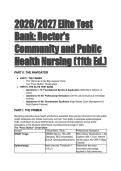
2026/2027 Elite Test
Bank: Rector's
Community and Public
Health Nursing (11th Ed.)
PART 0: THE NAVIGATOR
● PART I: THE PRIMER
○ The "Welcome to the Big Leagues" Hook
○ The "Panic Button" Cheat Sheet
● PART II: THE ELITE TEST BANK
○ Questions 1–15: Foundational Syntax & Application (Definitions, Metrics, &
Laws)
○ Questions 16–40: Professional Simulation (On-the-Job Scenarios & Immediate
Actions)
○ Questions 41–66: Grandmaster Synthesis (High-Stakes Crisis Management &
Multi-System Failures)
PART I: THE PRIMER
Mastering population-level health architecture separates task-oriented clinicians from elite public
health strategists who dictate community survival. Your ability to anticipate epidemiological
shifts, synthesize structural determinants, and execute clinical judgment across entire
populations is the absolute determinant of professional leverage in 2026.
The "Panic Button" Cheat Sheet
Domain Critical Metric / Rule Professional Implication
START Triage GREEN (Minor), YELLOW RED criteria: Respirations > 30,
(Delayed), RED (Immediate), Capillary refill > 2 sec, Altered
BLACK (Deceased/Expectant). mental status. No CPR in Mass
Casualty.
Epidemiology Herd Immunity Threshold: 1 - Determines the exact
(1/R_0) vaccination percentage
required to halt community
,Domain Critical Metric / Rule Professional Implication
transmission.
Emerging Threats Oropouche (Midge vector), Contextualizes 2026 NNDSS
H5N1 (Avian Flu/Dairy), PFAS surveillance updates and
("Forever Chemicals"). occupational hazards.
Licensure NLC 60-Day Relocation Rule Nurses relocating to a new
compact state must endorse
within 60 days of changing
primary residency.
Kill Values Potassium <2.5 / >6.0; Sodium Immediate intervention required
<120; Platelets <40,000; WBC to avert fatal arrhythmias,
<2,000 / >30,000; pH <7.20. herniation, hemorrhage, or
sepsis.
### PART II: THE ELITE TEST BANK
Questions 1–15: Foundational Syntax & Application
Q1: During a mass casualty incident (MCI) resulting from an industrial explosion, a public health
nurse triages a victim with massive cranial trauma, exposed brain matter, and apnea despite
airway repositioning. The victim has a faint carotid pulse. Which triage category is the MOST
APPROPRIATE for this patient? A) RED (Immediate) B) YELLOW (Delayed) C) GREEN (Minor)
D) BLACK (Expectant)
● The Answer: D (BLACK (Expectant))
● Distractor Analysis:
○ A is incorrect: While a pulse exists, the catastrophic head trauma and apnea dictate
a Black tag in an MCI to conserve resources for viable patients.
○ B is incorrect: Delayed implies the patient is stable enough to wait 30-60 minutes.
This patient is terminal.
○ C is incorrect: Green is strictly for the "walking wounded."
The Mentor's Analysis: Standard ER protocols dictate immediate intubation for an apneic
patient with a pulse. Disaster nursing forces a radical paradigm shift: the greatest good for the
greatest number. In an MCI, apnea persisting after airway adjustment is an automatic Black tag.
Professional Intuition: Do not burn critical minutes on unsalvageable injuries when viable Red
tags are bleeding out.
Q2: A community health nurse is calculating the basic reproduction number (R_0) of a novel
airborne pathogen to determine vaccination targets. If the R_0 is established at 15, what is the
MINIMUM percentage of the population that must acquire immunity to reach the herd immunity
threshold? A) 66% B) 80% C) 93% D) 100%
● The Answer: C (93%)
● Distractor Analysis:
○ A is incorrect: 66% was the estimated threshold for the original wild-type COVID-19
strain, which had a significantly lower R_0. * B is incorrect: 80% is the approximate
threshold for less infectious pathogens like Polio.
○ D is incorrect: 100% is statistically impossible and unnecessary to halt community
transmission.
The Mentor's Analysis: Elite practitioners do not guess; they calculate. The formula for the
Herd Immunity Threshold is 1 - (1/R_0). For an [span_48](start_span)[span_48](end_span)R_0
, of 15 (similar to measles), 1 - (1/15) = 1 - 0.067 = 0.933. Multiply by 100 to get 93.3%.
Professional Intuition: Higher infectivity demands a nearly impenetrable immunological wall.
Q3: The 2026 update to the CDC childhood immunization schedule alters the administration of
the varicella vaccine for toddlers. Which action by the clinic nurse represents the MOST
ACCURATE adherence to this updated policy? A) Administering varicella exclusively as a
combination MMRV vaccine to reduce injection trauma. B) Administering varicella as a
standalone immunization separated from the MMR vaccine. C) Delaying the varicella vaccine
until the child reaches school age. D) Requiring a signed waiver before administering any
live-attenuated virus.
● The Answer: B (Administering varicella as a standalone immunization separated from the
MMR vaccine.)
● Distractor Analysis:
○ A is incorrect: This is legacy practice. The 2026 update specifically moved away
from the combination MMRV for toddlers.
○ C is incorrect: Delaying the vaccine exposes the toddler to unacceptable risk and
violates the updated CDC age timeline.
○ D is incorrect: While informed consent is prioritized under 2026 guidelines , a
blanket waiver for all live vaccines is not a CDC protocol requirement.
The Mentor's Analysis: Policy shifts dictate clinical workflow. The 2026 CDC schedule update
specifically separated the varicella vaccine from the MMR combination for toddlers based on
updated risk-benefit analyses. Professional Intuition: Never rely on legacy schedules. The
target is always moving.
Q4: A public health nurse reviewing regional epidemiology data notes a persistent cluster of
rare endocrine cancers in a residential neighborhood situated downriver from an abandoned
chemical manufacturing plant. Which environmental contaminant should the nurse INITIALY
suspect? A) Lead B) Per- and polyfluoroalkyl substances (PFAS) C) Radon gas D) Asbestos
● The Answer: B (Per- and polyfluoroalkyl substances (PFAS))
● Distractor Analysis:
○ A is incorrect: Lead toxicity primarily presents with severe neurodevelopmental
deficits in children, not rare endocrine cancers.
○ C is incorrect: Radon exposure is heavily correlated with lung cancer, primarily in
enclosed, poorly ventilated spaces.
○ D is incorrect: Asbestos exposure causes mesothelioma via inhalation, not
ingestion from a water source.
The Mentor's Analysis: PFAS are "forever chemicals" that bioaccumulate in the environment
and the human body. Because they do not degrade, historical industrial dumping continues to
contaminate water tables decades later, manifesting as oncological clusters. Professional
Intuition: Match the exposure route (water) and the physiological manifestation (endocrine
disruption) to the agent.
Q5: Following the principles of "Public Health 3.0," the local health department aims to address
soaring rates of type 2 diabetes in an underserved urban sector. Which intervention BEST
represents this framework? A) Increasing the operational hours of the local public health clinic to
offer more blood glucose screenings. B) Distributing multilingual educational pamphlets on
carbohydrate counting to local households. C) Partnering with the city transit authority and local
grocers to establish subsidized fresh-food markets at major bus hubs. D) Hiring an additional
endocrinologist to manage complex diabetic cases at the county hospital.
● The Answer: C (Partnering with the city transit authority and local grocers to establish
subsidized fresh-food markets at major bus hubs.)
Bank: Rector's
Community and Public
Health Nursing (11th Ed.)
PART 0: THE NAVIGATOR
● PART I: THE PRIMER
○ The "Welcome to the Big Leagues" Hook
○ The "Panic Button" Cheat Sheet
● PART II: THE ELITE TEST BANK
○ Questions 1–15: Foundational Syntax & Application (Definitions, Metrics, &
Laws)
○ Questions 16–40: Professional Simulation (On-the-Job Scenarios & Immediate
Actions)
○ Questions 41–66: Grandmaster Synthesis (High-Stakes Crisis Management &
Multi-System Failures)
PART I: THE PRIMER
Mastering population-level health architecture separates task-oriented clinicians from elite public
health strategists who dictate community survival. Your ability to anticipate epidemiological
shifts, synthesize structural determinants, and execute clinical judgment across entire
populations is the absolute determinant of professional leverage in 2026.
The "Panic Button" Cheat Sheet
Domain Critical Metric / Rule Professional Implication
START Triage GREEN (Minor), YELLOW RED criteria: Respirations > 30,
(Delayed), RED (Immediate), Capillary refill > 2 sec, Altered
BLACK (Deceased/Expectant). mental status. No CPR in Mass
Casualty.
Epidemiology Herd Immunity Threshold: 1 - Determines the exact
(1/R_0) vaccination percentage
required to halt community
,Domain Critical Metric / Rule Professional Implication
transmission.
Emerging Threats Oropouche (Midge vector), Contextualizes 2026 NNDSS
H5N1 (Avian Flu/Dairy), PFAS surveillance updates and
("Forever Chemicals"). occupational hazards.
Licensure NLC 60-Day Relocation Rule Nurses relocating to a new
compact state must endorse
within 60 days of changing
primary residency.
Kill Values Potassium <2.5 / >6.0; Sodium Immediate intervention required
<120; Platelets <40,000; WBC to avert fatal arrhythmias,
<2,000 / >30,000; pH <7.20. herniation, hemorrhage, or
sepsis.
### PART II: THE ELITE TEST BANK
Questions 1–15: Foundational Syntax & Application
Q1: During a mass casualty incident (MCI) resulting from an industrial explosion, a public health
nurse triages a victim with massive cranial trauma, exposed brain matter, and apnea despite
airway repositioning. The victim has a faint carotid pulse. Which triage category is the MOST
APPROPRIATE for this patient? A) RED (Immediate) B) YELLOW (Delayed) C) GREEN (Minor)
D) BLACK (Expectant)
● The Answer: D (BLACK (Expectant))
● Distractor Analysis:
○ A is incorrect: While a pulse exists, the catastrophic head trauma and apnea dictate
a Black tag in an MCI to conserve resources for viable patients.
○ B is incorrect: Delayed implies the patient is stable enough to wait 30-60 minutes.
This patient is terminal.
○ C is incorrect: Green is strictly for the "walking wounded."
The Mentor's Analysis: Standard ER protocols dictate immediate intubation for an apneic
patient with a pulse. Disaster nursing forces a radical paradigm shift: the greatest good for the
greatest number. In an MCI, apnea persisting after airway adjustment is an automatic Black tag.
Professional Intuition: Do not burn critical minutes on unsalvageable injuries when viable Red
tags are bleeding out.
Q2: A community health nurse is calculating the basic reproduction number (R_0) of a novel
airborne pathogen to determine vaccination targets. If the R_0 is established at 15, what is the
MINIMUM percentage of the population that must acquire immunity to reach the herd immunity
threshold? A) 66% B) 80% C) 93% D) 100%
● The Answer: C (93%)
● Distractor Analysis:
○ A is incorrect: 66% was the estimated threshold for the original wild-type COVID-19
strain, which had a significantly lower R_0. * B is incorrect: 80% is the approximate
threshold for less infectious pathogens like Polio.
○ D is incorrect: 100% is statistically impossible and unnecessary to halt community
transmission.
The Mentor's Analysis: Elite practitioners do not guess; they calculate. The formula for the
Herd Immunity Threshold is 1 - (1/R_0). For an [span_48](start_span)[span_48](end_span)R_0
, of 15 (similar to measles), 1 - (1/15) = 1 - 0.067 = 0.933. Multiply by 100 to get 93.3%.
Professional Intuition: Higher infectivity demands a nearly impenetrable immunological wall.
Q3: The 2026 update to the CDC childhood immunization schedule alters the administration of
the varicella vaccine for toddlers. Which action by the clinic nurse represents the MOST
ACCURATE adherence to this updated policy? A) Administering varicella exclusively as a
combination MMRV vaccine to reduce injection trauma. B) Administering varicella as a
standalone immunization separated from the MMR vaccine. C) Delaying the varicella vaccine
until the child reaches school age. D) Requiring a signed waiver before administering any
live-attenuated virus.
● The Answer: B (Administering varicella as a standalone immunization separated from the
MMR vaccine.)
● Distractor Analysis:
○ A is incorrect: This is legacy practice. The 2026 update specifically moved away
from the combination MMRV for toddlers.
○ C is incorrect: Delaying the vaccine exposes the toddler to unacceptable risk and
violates the updated CDC age timeline.
○ D is incorrect: While informed consent is prioritized under 2026 guidelines , a
blanket waiver for all live vaccines is not a CDC protocol requirement.
The Mentor's Analysis: Policy shifts dictate clinical workflow. The 2026 CDC schedule update
specifically separated the varicella vaccine from the MMR combination for toddlers based on
updated risk-benefit analyses. Professional Intuition: Never rely on legacy schedules. The
target is always moving.
Q4: A public health nurse reviewing regional epidemiology data notes a persistent cluster of
rare endocrine cancers in a residential neighborhood situated downriver from an abandoned
chemical manufacturing plant. Which environmental contaminant should the nurse INITIALY
suspect? A) Lead B) Per- and polyfluoroalkyl substances (PFAS) C) Radon gas D) Asbestos
● The Answer: B (Per- and polyfluoroalkyl substances (PFAS))
● Distractor Analysis:
○ A is incorrect: Lead toxicity primarily presents with severe neurodevelopmental
deficits in children, not rare endocrine cancers.
○ C is incorrect: Radon exposure is heavily correlated with lung cancer, primarily in
enclosed, poorly ventilated spaces.
○ D is incorrect: Asbestos exposure causes mesothelioma via inhalation, not
ingestion from a water source.
The Mentor's Analysis: PFAS are "forever chemicals" that bioaccumulate in the environment
and the human body. Because they do not degrade, historical industrial dumping continues to
contaminate water tables decades later, manifesting as oncological clusters. Professional
Intuition: Match the exposure route (water) and the physiological manifestation (endocrine
disruption) to the agent.
Q5: Following the principles of "Public Health 3.0," the local health department aims to address
soaring rates of type 2 diabetes in an underserved urban sector. Which intervention BEST
represents this framework? A) Increasing the operational hours of the local public health clinic to
offer more blood glucose screenings. B) Distributing multilingual educational pamphlets on
carbohydrate counting to local households. C) Partnering with the city transit authority and local
grocers to establish subsidized fresh-food markets at major bus hubs. D) Hiring an additional
endocrinologist to manage complex diabetic cases at the county hospital.
● The Answer: C (Partnering with the city transit authority and local grocers to establish
subsidized fresh-food markets at major bus hubs.)


