
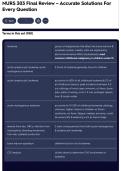
NURS 303 Final Review – Accurate Solutions For
Every Question
Save
Terms in this set (950)
leukemia group of malignancies that affect the bone marrow &
lymphatic system; healthy cells are replaced by
abnormal immature WBCs (leukoblasts); most
common childhood malignancy in children under 15
acute lymphocytic leukemia, acute 2 forms of leukemia generally found in children
myelogenous leukemia
acute lymphocytic leukemia accounts for 80% of all childhood leukemia & 1/3 of
all childhood cancers; peak incidence between 2-5
yrs; etiology of most cases unknown; s/s fever, bone
pain, pallor, bruising, sx for 1-2 wks, enlarged spleen,
liver, & lymph nodes
acute myelogenous leukemia accounts for 15-25% of childhood leukemia; etiology
unknown; higher chance in children w/ Down
syndrome; s/s fever, fatigue, malaise, anorexia, could
be severe/life threatening such as hemorrhage
anemia from dec. RBCs, infection from 3 main consequences from both acute myelogenous
neutropenia, bleeding tendencies & lymphocytic leukemias
from dec. platelet production
bone marrow aspiration definitive test for dx of leukemia
CSF analysis dx test done to determine CNS involvement in
leukemia
,induction/remission therapy 1st 2 phases of chemotherapy for leukemia; to
achieve complete remission or less than 5% leukemic
cells in bone marrow
intensification therapy/consolidation 3rd phase of chemotherapy for leukemia; to destroy
any remaining leukemic cells & prevent any from
emerging
maintenance therapy 4th phase of chemotherapy for leukemia; to sustain
remission phase, requires frequent monitoring of
CBC
AML, ALL hematopoietic stem cell transplant (HCST) is done
for children who have ______ during 1st remission or
children w/ _____ after 2nd remission
infertility a major chemotherapy side effect & cause for
concern for people before/at childbearing age
hair loss, fatigue, easy bruising, side effects of chemo
anemia, nausea, numbness, weight
changes, chemo brain, mood changes,
infertility
2-9 children diagnosed w/ leukemia between the ages of
________ will have a better outlook than those
diagnosed before or after those ranges
6 initial hospitalization for leukemia can last up to _____
weeks
mouth sores children receiving chemotherapy must be assessed
frequently for ___________________ to avoid risk of infection
and impaired intake
Ewing's sarcoma HIGHLY malignant & aggressive bone tumor, 25% of
children exhibit metastasis; occurs in the shafts of
long bones; tx surgical biopsy, radiation, & chemo;
amputation is not ideal
,femur, tibia, humerus, pelvis, chest most common sites of Ewing's sarcoma
wall, vertebrae
persistent & severe bone pain s/s of Ewing's sarcoma
surgical resection of bone, radiation, ideal tx of Ewing's sarcoma
chemotherapy
osteosarcoma most common bone tumor in children; usually occurs
in the metaphysis of long bones (distal femur,
proximal tibia, proximal humerus); tx includes
amputation or limb salvage procedure & chemo;
peak incidence at peak of growth spurt
osteoblasts bone forming cells; origination site of osteosarcomas
swelling, palpable mass, pain w/ frequent association w/ osteosarcomas
activity/pressure
fractures osteosarcomas increase the risk of _____________ due to
weakening of the bone
rhabdomyosarcoma most common soft tissue malignancy in children,
highly malignant & spreads through local extension
or lymphatic system; developed from skeletal muscle
cells; can cause pain in localized areas due to
compression by tumor
pain in lymph nodes, impairment of common findings in rhabdomyosarcoma
CNS
CT scan, MRI, open biopsy, bone scan, dx tests for rhabdomyosarcoma
bone marrow aspiration
Wilms Tumor/nephroblastoma rapidly developing malignant neoplasm of the kidney
(usually only affects 1), usually large at dx
, 2-3, 5 most cases of Wilms tumors occur between ______
years, with almost all occurring before age _____
midline Wilms tumor doesn't cross the _____________
Beckwith-Wiedemann syndrome a growth disorder syndrome synonymous with
enlargement of several organs including the skull,
tongue, and liver; inc. risk of Wilms tumor
nephrectomy treatment of choice for Wilms tumor
neuroblastoma malignancy that occurs in the adrenal gland,
anywhere along the sympathetic nervous system,
head, neck, pelvis, or chest; 2nd most commonly
occurring solid tumor; silent tumor, 1/2 of all cases
have metastasized before dx
masses/lumps, pain, weight loss, common neuroblastoma sx
fatigue, breathing problems, easy
bleeding/bruising
CT, MRI, chest x ray, bone scan, dx & metastasis testing for neuroblastomas
skeletal survey
stage the _________ of a neuroblastoma determines treatment
surgical excision of mass, chemo, therapeutic management of neuroblastomas
sometimes radiation
spontaneous regression neuroblastomas are one of the rare human
malignancies known to exhibit ________________________
intellectual disability/cognitive functional state in which significant limitations in
impairment intellectual status & adaptive behavior develop
before the age of 18 years, affecting ADLs; ranges
from mild to severe; IQ less than 70-75
Every Question
Save
Terms in this set (950)
leukemia group of malignancies that affect the bone marrow &
lymphatic system; healthy cells are replaced by
abnormal immature WBCs (leukoblasts); most
common childhood malignancy in children under 15
acute lymphocytic leukemia, acute 2 forms of leukemia generally found in children
myelogenous leukemia
acute lymphocytic leukemia accounts for 80% of all childhood leukemia & 1/3 of
all childhood cancers; peak incidence between 2-5
yrs; etiology of most cases unknown; s/s fever, bone
pain, pallor, bruising, sx for 1-2 wks, enlarged spleen,
liver, & lymph nodes
acute myelogenous leukemia accounts for 15-25% of childhood leukemia; etiology
unknown; higher chance in children w/ Down
syndrome; s/s fever, fatigue, malaise, anorexia, could
be severe/life threatening such as hemorrhage
anemia from dec. RBCs, infection from 3 main consequences from both acute myelogenous
neutropenia, bleeding tendencies & lymphocytic leukemias
from dec. platelet production
bone marrow aspiration definitive test for dx of leukemia
CSF analysis dx test done to determine CNS involvement in
leukemia
,induction/remission therapy 1st 2 phases of chemotherapy for leukemia; to
achieve complete remission or less than 5% leukemic
cells in bone marrow
intensification therapy/consolidation 3rd phase of chemotherapy for leukemia; to destroy
any remaining leukemic cells & prevent any from
emerging
maintenance therapy 4th phase of chemotherapy for leukemia; to sustain
remission phase, requires frequent monitoring of
CBC
AML, ALL hematopoietic stem cell transplant (HCST) is done
for children who have ______ during 1st remission or
children w/ _____ after 2nd remission
infertility a major chemotherapy side effect & cause for
concern for people before/at childbearing age
hair loss, fatigue, easy bruising, side effects of chemo
anemia, nausea, numbness, weight
changes, chemo brain, mood changes,
infertility
2-9 children diagnosed w/ leukemia between the ages of
________ will have a better outlook than those
diagnosed before or after those ranges
6 initial hospitalization for leukemia can last up to _____
weeks
mouth sores children receiving chemotherapy must be assessed
frequently for ___________________ to avoid risk of infection
and impaired intake
Ewing's sarcoma HIGHLY malignant & aggressive bone tumor, 25% of
children exhibit metastasis; occurs in the shafts of
long bones; tx surgical biopsy, radiation, & chemo;
amputation is not ideal
,femur, tibia, humerus, pelvis, chest most common sites of Ewing's sarcoma
wall, vertebrae
persistent & severe bone pain s/s of Ewing's sarcoma
surgical resection of bone, radiation, ideal tx of Ewing's sarcoma
chemotherapy
osteosarcoma most common bone tumor in children; usually occurs
in the metaphysis of long bones (distal femur,
proximal tibia, proximal humerus); tx includes
amputation or limb salvage procedure & chemo;
peak incidence at peak of growth spurt
osteoblasts bone forming cells; origination site of osteosarcomas
swelling, palpable mass, pain w/ frequent association w/ osteosarcomas
activity/pressure
fractures osteosarcomas increase the risk of _____________ due to
weakening of the bone
rhabdomyosarcoma most common soft tissue malignancy in children,
highly malignant & spreads through local extension
or lymphatic system; developed from skeletal muscle
cells; can cause pain in localized areas due to
compression by tumor
pain in lymph nodes, impairment of common findings in rhabdomyosarcoma
CNS
CT scan, MRI, open biopsy, bone scan, dx tests for rhabdomyosarcoma
bone marrow aspiration
Wilms Tumor/nephroblastoma rapidly developing malignant neoplasm of the kidney
(usually only affects 1), usually large at dx
, 2-3, 5 most cases of Wilms tumors occur between ______
years, with almost all occurring before age _____
midline Wilms tumor doesn't cross the _____________
Beckwith-Wiedemann syndrome a growth disorder syndrome synonymous with
enlargement of several organs including the skull,
tongue, and liver; inc. risk of Wilms tumor
nephrectomy treatment of choice for Wilms tumor
neuroblastoma malignancy that occurs in the adrenal gland,
anywhere along the sympathetic nervous system,
head, neck, pelvis, or chest; 2nd most commonly
occurring solid tumor; silent tumor, 1/2 of all cases
have metastasized before dx
masses/lumps, pain, weight loss, common neuroblastoma sx
fatigue, breathing problems, easy
bleeding/bruising
CT, MRI, chest x ray, bone scan, dx & metastasis testing for neuroblastomas
skeletal survey
stage the _________ of a neuroblastoma determines treatment
surgical excision of mass, chemo, therapeutic management of neuroblastomas
sometimes radiation
spontaneous regression neuroblastomas are one of the rare human
malignancies known to exhibit ________________________
intellectual disability/cognitive functional state in which significant limitations in
impairment intellectual status & adaptive behavior develop
before the age of 18 years, affecting ADLs; ranges
from mild to severe; IQ less than 70-75


