

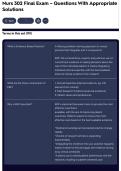
Nurs 302 Final Exam – Questions With Appropriate
Solutions
Save
Terms in this set (119)
What is Evidence Based Practice? A lifelong problem-solving approach to clinical
practice that integrates into 3 components.
EBP= the conscientious, explicit, and judicious use of
current best evidence in making decisions about the
care of the individual patient. It means integrating
individual clinical expertise with the best available
external clinical evidence from research
What are the three components of 1. Clinical Expertise (internal evidence, eg: info
EBP? learned from clinical)
2. Best Research Evidence (external evidence)
3. Patient values and preferences
Why is EBP important? EBP is important because it aims to provide the most
effective care that is
available, with the aim of improving patient
outcomes. Patients expect to receive the most
effective care based on the best available evidence.
*Medical knowledge and accepted practice change
rapidly
*Volume of research articles is expanding
exponentially
*Integrating the evidence into your practice regularly
makes it easier to find and apply the evidence during
busy clinical schedules
*It allows you to blend patient preferences with the
research, resulting in patient-centered care
,components of the quadruple aim • Better patient outcomes
• Reduced costs
• Better population Health
• Provider satisfaction
what are background questions - address general questions about a disease,
condition, or process - are the "what is", "why do",
and "how does" kind of questions.
- Novice practitioners such as health professions
students, typically have more background questions.
As one moves from novice to expert, practitioners
typically find themselves answering more foreground
questions in their day to day practice.
what are foreground questions - answer pointed questions regarding a specific
patient or population
- often investigate comparisons (e.g two treatment
approaches or two diagnostic tests)
• picot questions
Common Barriers to Using Evidence- • Lack of administrative/management support and
Based Practice mentors
• Resistance to change
• Misperceptions or negative attitudes about EBP
• Lack of EBP knowledge and skills
• Lack of autonomy over practice and lack of
incentives
• Lack of time/resources
Strategies to Eliminate Barriers to • Establishing a clear philosophy and organizational
Evidence-Based Practice vision in which EBP is valued and expected
• Developing a strategic plan to create a culture and
environment that fosters EBP
• Dispelling misperceptions about EBP
• Teaching the basics of EBP
• Encouraging questions about currently used clinical
practices
• Develop EBP mentors
, Initiatives to enhance EBP • IOM (National Academy of Medicine) Roundtable
on Evidence-Based Medicine
• Research- practice time gap
• NUETRAL venue for Key stakeholders to drive using
the evidence clinical effectiveness to practice
• 2020- 90% of all clinical decisions will be supported
by accurate, timely, and up-to-date info
• "The learning healthcare system"
• Ensure innovation to improve quality, safety and
value in healthcare
• U.S .Preventive Services Task Force
(USPSTF)
• Grade A- recommended
• Grade B- recommended- net benefit almost certain
• Grade C- recc selectively based on individual case
• Grade D- not recommended
• Grade I- Insufficient
what does the U.S .Preventive Services This task force reviews all the
Task Force prevention and evidence based medicine
(USPSTF) do research on specific preventive
services and provides evidence-based
recommendations
**Each member of the task force is a nationally
recognized expert in
disease prevention and evidence
**Every task force recommendation becomes a
valuable evidence-based tool
What is the hierarchy of evidence and Is a tool that ranks the strength of research evidence
why is it useful? based on the rigor of its methods
Solutions
Save
Terms in this set (119)
What is Evidence Based Practice? A lifelong problem-solving approach to clinical
practice that integrates into 3 components.
EBP= the conscientious, explicit, and judicious use of
current best evidence in making decisions about the
care of the individual patient. It means integrating
individual clinical expertise with the best available
external clinical evidence from research
What are the three components of 1. Clinical Expertise (internal evidence, eg: info
EBP? learned from clinical)
2. Best Research Evidence (external evidence)
3. Patient values and preferences
Why is EBP important? EBP is important because it aims to provide the most
effective care that is
available, with the aim of improving patient
outcomes. Patients expect to receive the most
effective care based on the best available evidence.
*Medical knowledge and accepted practice change
rapidly
*Volume of research articles is expanding
exponentially
*Integrating the evidence into your practice regularly
makes it easier to find and apply the evidence during
busy clinical schedules
*It allows you to blend patient preferences with the
research, resulting in patient-centered care
,components of the quadruple aim • Better patient outcomes
• Reduced costs
• Better population Health
• Provider satisfaction
what are background questions - address general questions about a disease,
condition, or process - are the "what is", "why do",
and "how does" kind of questions.
- Novice practitioners such as health professions
students, typically have more background questions.
As one moves from novice to expert, practitioners
typically find themselves answering more foreground
questions in their day to day practice.
what are foreground questions - answer pointed questions regarding a specific
patient or population
- often investigate comparisons (e.g two treatment
approaches or two diagnostic tests)
• picot questions
Common Barriers to Using Evidence- • Lack of administrative/management support and
Based Practice mentors
• Resistance to change
• Misperceptions or negative attitudes about EBP
• Lack of EBP knowledge and skills
• Lack of autonomy over practice and lack of
incentives
• Lack of time/resources
Strategies to Eliminate Barriers to • Establishing a clear philosophy and organizational
Evidence-Based Practice vision in which EBP is valued and expected
• Developing a strategic plan to create a culture and
environment that fosters EBP
• Dispelling misperceptions about EBP
• Teaching the basics of EBP
• Encouraging questions about currently used clinical
practices
• Develop EBP mentors
, Initiatives to enhance EBP • IOM (National Academy of Medicine) Roundtable
on Evidence-Based Medicine
• Research- practice time gap
• NUETRAL venue for Key stakeholders to drive using
the evidence clinical effectiveness to practice
• 2020- 90% of all clinical decisions will be supported
by accurate, timely, and up-to-date info
• "The learning healthcare system"
• Ensure innovation to improve quality, safety and
value in healthcare
• U.S .Preventive Services Task Force
(USPSTF)
• Grade A- recommended
• Grade B- recommended- net benefit almost certain
• Grade C- recc selectively based on individual case
• Grade D- not recommended
• Grade I- Insufficient
what does the U.S .Preventive Services This task force reviews all the
Task Force prevention and evidence based medicine
(USPSTF) do research on specific preventive
services and provides evidence-based
recommendations
**Each member of the task force is a nationally
recognized expert in
disease prevention and evidence
**Every task force recommendation becomes a
valuable evidence-based tool
What is the hierarchy of evidence and Is a tool that ranks the strength of research evidence
why is it useful? based on the rigor of its methods


