Language focus Unit 1 t/m 4
Unit 1
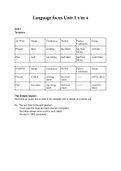
Tensens
ACTIVE Simple Continuous Perfect Perfect Future
Continuous
Present takes is taking has taken has been will take
taking
Past took was taking had taken had been would take
taking
PASSIVE Simple Continuous Perfect Perfect Future
Continuous
Present is taken is being has been ------- will be taken
taken taken
Past was taken was being had been -------- would be
taken taken taken
The Simple Aspect
Describes an action that is seen to be complete and is viewed as a whole unit.
Ex.: The sun rises in the east (always)
I have read the book and seen the film (complete)
My father always wore a suit to work habit)
He died in 1992 (complete)
, The continuous aspect
Expresses activities or a series of activities, viewed at some point between their beginning
and end. The activity is not permanent and the duration is limited
Ex.: I am staying with friends until I find something of my own (temporary)
Why are you wearing that silly hat? (in progress)
I have been learning English for years (duration)
The continuous aspect is generally avoided with “State Verbs” which express permanence:
Ex.: I hate my brother
I understand your situation
But: Mcdonalds, I am loving it (I’m lovin it).
The action of many verbs last a long time e.g. ‘live’ and ‘work’
The action of some verbs last a short time e.g. ‘cut’ and ‘hit’
She has cut her finger/I have been cutting wood
He hit her/He was hitting me.
The Perfect aspect
Action completed before another time:
Ex.: I have read his latest book
When I arrived, Mary had cooked the meal
Action producing a result relevant to a later situation:
Ex.: I have broken my leg and now I cannot walk
Sue has been working since six o’clock this morning
Active and Passive
The passive is used to express reflexive or impersonal ideas where other languages use the
active
Ex.: English is spoken all over the world
His books are sold in Europe
In passive sentences the focus of attention moves from the subject of the
active sentence to the object.
Ex.: Shakespeare wrote Hamlet in 1599 = active
Hamlet was written in 1599 (by Shakespeare) = passive
Unit 1
Tensens
ACTIVE Simple Continuous Perfect Perfect Future
Continuous
Present takes is taking has taken has been will take
taking
Past took was taking had taken had been would take
taking
PASSIVE Simple Continuous Perfect Perfect Future
Continuous
Present is taken is being has been ------- will be taken
taken taken
Past was taken was being had been -------- would be
taken taken taken
The Simple Aspect
Describes an action that is seen to be complete and is viewed as a whole unit.
Ex.: The sun rises in the east (always)
I have read the book and seen the film (complete)
My father always wore a suit to work habit)
He died in 1992 (complete)
, The continuous aspect
Expresses activities or a series of activities, viewed at some point between their beginning
and end. The activity is not permanent and the duration is limited
Ex.: I am staying with friends until I find something of my own (temporary)
Why are you wearing that silly hat? (in progress)
I have been learning English for years (duration)
The continuous aspect is generally avoided with “State Verbs” which express permanence:
Ex.: I hate my brother
I understand your situation
But: Mcdonalds, I am loving it (I’m lovin it).
The action of many verbs last a long time e.g. ‘live’ and ‘work’
The action of some verbs last a short time e.g. ‘cut’ and ‘hit’
She has cut her finger/I have been cutting wood
He hit her/He was hitting me.
The Perfect aspect
Action completed before another time:
Ex.: I have read his latest book
When I arrived, Mary had cooked the meal
Action producing a result relevant to a later situation:
Ex.: I have broken my leg and now I cannot walk
Sue has been working since six o’clock this morning
Active and Passive
The passive is used to express reflexive or impersonal ideas where other languages use the
active
Ex.: English is spoken all over the world
His books are sold in Europe
In passive sentences the focus of attention moves from the subject of the
active sentence to the object.
Ex.: Shakespeare wrote Hamlet in 1599 = active
Hamlet was written in 1599 (by Shakespeare) = passive