
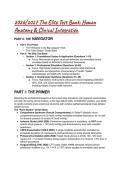
2026/2027 The Elite Test Bank: Human
Anatomy & Clinical Integration
PART 0: THE NAVIGATOR
● Part I: The Primer
○ The "Welcome to the Big Leagues" Hook
○ The "Panic Button" Cheat Sheet
● Part II: The Elite Test Bank
○ Section 1: Foundational Syntax & Application (Questions 1–15)
■ Focus: Microscopic-to-gross structural definitions and immediate clinical
correlates based on McKinley's anatomical frameworks.
○ Section 2: Professional Simulation (Questions 16–40)
■ Focus: High-fidelity localized scenarios requiring rapid anatomical
identification and intervention (incorporating UT Austin "Testlet"
methodologies and 2026 UHC Coding standards).
○ Section 3: Grandmaster Synthesis (Questions 41–66)
■ Focus: High-stakes, multi-system critical care crises integrating 2026/2027
AHA, ADA, and GOLD standards within complex environmental contexts,
including Kajiado County health networks.
PART I: THE PRIMER
Mastering the architectural blueprint of the human body transforms rote academic memorization
into elite, life-saving clinical intuition. In the high-stakes reality of 2026/2027 practice, your ability
to rapidly correlate gross anatomical structures with complex pathophysiological crises dictates
patient survival.
The "Panic Button" Cheat Sheet:
● Compartment Syndrome (Fascial Compartments): A \Delta P (diastolic minus
compartment pressure) \le 30 \text{ mmHg} mandates immediate fasciotomy; do not wait
for absolute pressure to exceed 40 \text{ mmHg}.
● Ischemic Stroke (AHA 2026): Permissive hypertension is mandatory; do NOT lower
systolic blood pressure < 140 \text{ mmHg} post-thrombectomy, even with complete
reperfusion.
● COPD Exacerbation (GOLD 2026): A single moderate exacerbation mandates an
immediate escalation of maintenance pharmacotherapy to arrest alveolar destruction.
● Perioperative Diabetes (ADA 2026): Target blood glucose is strictly 100 - 180 \text{
mg/dL} (5.6 - 10.0 \text{ mmol/L}) during surgery; preoperative A1C must be < 8\% prior to
elective procedures.
● Surgical Billing (UHC 2026): CPT codes 10000–69999 absolutely require precise
anatomical modifiers (e.g., FA, F1-F9, LT, RT); failure equates to immediate claim denial.
,PART II: THE ELITE TEST BANK
Section 1: Foundational Syntax & Application
Q1: A 28-year-old client suffers severe full-thickness burns over the anterior thorax. According
to histological principles, the destruction of the stratum basale completely halts which PRIMARY
physiological mechanism of the integumentary system? A) The synthesis of cholecalciferol
(Vitamin D3) by dermal fibroblasts. B) The mitotic regeneration of keratinocytes required for
re-epithelialization. C) The immediate vasoconstriction of papillary plexus vessels to preserve
core temperature. D) The secretion of sebum to prevent trans-epidermal water loss.
● The Answer: B (The mitotic regeneration of keratinocytes required for
re-epithelialization.)
● Distractor Analysis:
○ A is incorrect: Cholecalciferol is synthesized by keratinocytes in the epidermis, not
fibroblasts in the dermis.
○ C is incorrect: Vasoconstriction is a neural response mediated by dermal blood
vessels, not the epidermal stratum basale.
○ D is incorrect: Sebum is produced by sebaceous glands located deeper in the
dermis.
The Mentor's Analysis: The stratum basale contains the active epidermal stem cells. When a
full-thickness burn obliterates this layer, the skin loses its intrinsic regenerative engine,
mandating surgical skin grafting. Professional Intuition: If the basement membrane is gone,
native healing is gone. Prepare the operative suite for autografts.
Q2: During a routine dissection, a structure is identified that consists of densely packed, parallel
collagen fibers with fibroblasts squeezed between them. This tissue has notoriously poor
vascularity. Which clinical complication is MOST LIKELY to occur following a complete tear of
this structure? A) Rapid, expansive hematoma formation within the surrounding fascial
compartment. B) Prolonged healing time requiring extensive immobilization or surgical
reconstruction. C) Immediate loss of sensory innervation to the distal extremity. D) Spontaneous
regeneration facilitated by high local concentrations of osteoprogenitor cells.
● The Answer: B (Prolonged healing time requiring extensive immobilization or surgical
reconstruction.)
● Distractor Analysis:
○ A is incorrect: Due to poor vascularity, dense regular connective tissue
(tendons/ligaments) does not produce massive hematomas when torn.
○ C is incorrect: Tendons lack the extensive sensory tracts found in major peripheral
nerves.
○ D is incorrect: Osteoprogenitor cells reside in the periosteum and endosteum of
bone.
The Mentor's Analysis: Form dictates function, and vascularity dictates healing. Dense regular
connective tissue sacrifices blood supply for tensile strength. Professional Intuition: Always
manage patient expectations; a torn ligament will often take longer to heal than a fractured bone
simply due to the lack of an inherent vascular delivery system for macrophages and fibroblasts.
Q3: A pediatric patient presents with a diaphyseal fracture of the femur. Radiographs reveal that
the fracture line crosses the epiphyseal plate. What is the MOST CRITICAL long-term
developmental risk associated with this specific anatomical disruption? A) Chronic osteomyelitis
, due to the exposure of red bone marrow. B) Premature cessation of interstitial bone growth
leading to limb length discrepancy. C) Failure of appositional growth resulting in a structurally
thin diaphysis. D) Hypertrophy of the articular cartilage causing early-onset osteoarthritis.
● The Answer: B (Premature cessation of interstitial bone growth leading to limb length
discrepancy.)
● Distractor Analysis:
○ A is incorrect: Osteomyelitis is an infection risk associated with open fractures, not
an inherent risk of epiphyseal plate involvement.
○ C is incorrect: Appositional growth (growth in width) occurs at the periosteum, not
the epiphyseal plate.
○ D is incorrect: Articular cartilage is located at the joint surface, physically distinct
from the deeper epiphyseal plate.
The Mentor's Analysis: The epiphyseal plate is the sole engine for longitudinal (interstitial)
bone growth in children. Damage here can permanently fuse the resting and proliferating zones.
Professional Intuition: Treat any pediatric joint-adjacent fracture as an epiphyseal injury until
proven otherwise. Limb-length inequality is a career-ending miss.
Q4: A client undergoes a total hip arthroplasty. The surgeon must cleanly disarticulate the
femoral head from the acetabulum. Which specific ligament, providing a conduit for the artery to
the head of the femur, must be DIRECTLY severed during this procedure? A) Iliofemoral
ligament. B) Ischiofemoral ligament. C) Ligament of the head of the femur (ligamentum teres).
D) Transverse acetabular ligament.
● The Answer: C (Ligament of the head of the femur (ligamentum teres).)
● Distractor Analysis:
○ A is incorrect: The iliofemoral ligament stabilizes the anterior capsule but does not
attach directly to the fovea capitis.
○ B is incorrect: The ischiofemoral ligament supports the posterior articular capsule.
○ D is incorrect: The transverse acetabular ligament bridges the acetabular notch, not
the femoral head.
The Mentor's Analysis: The ligamentum teres is structurally weak but highly significant
because it houses a critical artery. In adults, this artery provides limited supply, but its disruption
during trauma requires clinical awareness. Professional Intuition: In femoral neck fractures,
assume the circumflex arteries are torn; if the ligamentum teres artery is insufficient, avascular
necrosis of the femoral head is imminent.
Q5: Following a motor vehicle collision, a client exhibits a "winged scapula." Which nerve and
corresponding muscle have MOST LIKELY been compromised? A) Thoracodorsal nerve;
Latissimus dorsi. B) Long thoracic nerve; Serratus anterior. C) Spinal accessory nerve;
Trapezius. D) Dorsal scapular nerve; Rhomboid major.
● The Answer: B (Long thoracic nerve; Serratus anterior.)
● Distractor Analysis:
○ A is incorrect: The latissimus dorsi extends and adducts the arm; its paralysis does
not cause scapular winging.
○ C is incorrect: Trapezius paralysis (CN XI) causes shoulder droop, but true classic
medial winging is a serratus deficit.
○ D is incorrect: Rhomboid paralysis causes lateral displacement of the scapula.
The Mentor's Analysis: The serratus anterior holds the medial border of the scapula flush
against the thoracic cage. The long thoracic nerve runs superficially along the lateral thorax,
making it highly vulnerable to trauma. Professional Intuition: When a patient cannot push
against a wall without their shoulder blade popping out, the long thoracic nerve is offline.
Anatomy & Clinical Integration
PART 0: THE NAVIGATOR
● Part I: The Primer
○ The "Welcome to the Big Leagues" Hook
○ The "Panic Button" Cheat Sheet
● Part II: The Elite Test Bank
○ Section 1: Foundational Syntax & Application (Questions 1–15)
■ Focus: Microscopic-to-gross structural definitions and immediate clinical
correlates based on McKinley's anatomical frameworks.
○ Section 2: Professional Simulation (Questions 16–40)
■ Focus: High-fidelity localized scenarios requiring rapid anatomical
identification and intervention (incorporating UT Austin "Testlet"
methodologies and 2026 UHC Coding standards).
○ Section 3: Grandmaster Synthesis (Questions 41–66)
■ Focus: High-stakes, multi-system critical care crises integrating 2026/2027
AHA, ADA, and GOLD standards within complex environmental contexts,
including Kajiado County health networks.
PART I: THE PRIMER
Mastering the architectural blueprint of the human body transforms rote academic memorization
into elite, life-saving clinical intuition. In the high-stakes reality of 2026/2027 practice, your ability
to rapidly correlate gross anatomical structures with complex pathophysiological crises dictates
patient survival.
The "Panic Button" Cheat Sheet:
● Compartment Syndrome (Fascial Compartments): A \Delta P (diastolic minus
compartment pressure) \le 30 \text{ mmHg} mandates immediate fasciotomy; do not wait
for absolute pressure to exceed 40 \text{ mmHg}.
● Ischemic Stroke (AHA 2026): Permissive hypertension is mandatory; do NOT lower
systolic blood pressure < 140 \text{ mmHg} post-thrombectomy, even with complete
reperfusion.
● COPD Exacerbation (GOLD 2026): A single moderate exacerbation mandates an
immediate escalation of maintenance pharmacotherapy to arrest alveolar destruction.
● Perioperative Diabetes (ADA 2026): Target blood glucose is strictly 100 - 180 \text{
mg/dL} (5.6 - 10.0 \text{ mmol/L}) during surgery; preoperative A1C must be < 8\% prior to
elective procedures.
● Surgical Billing (UHC 2026): CPT codes 10000–69999 absolutely require precise
anatomical modifiers (e.g., FA, F1-F9, LT, RT); failure equates to immediate claim denial.
,PART II: THE ELITE TEST BANK
Section 1: Foundational Syntax & Application
Q1: A 28-year-old client suffers severe full-thickness burns over the anterior thorax. According
to histological principles, the destruction of the stratum basale completely halts which PRIMARY
physiological mechanism of the integumentary system? A) The synthesis of cholecalciferol
(Vitamin D3) by dermal fibroblasts. B) The mitotic regeneration of keratinocytes required for
re-epithelialization. C) The immediate vasoconstriction of papillary plexus vessels to preserve
core temperature. D) The secretion of sebum to prevent trans-epidermal water loss.
● The Answer: B (The mitotic regeneration of keratinocytes required for
re-epithelialization.)
● Distractor Analysis:
○ A is incorrect: Cholecalciferol is synthesized by keratinocytes in the epidermis, not
fibroblasts in the dermis.
○ C is incorrect: Vasoconstriction is a neural response mediated by dermal blood
vessels, not the epidermal stratum basale.
○ D is incorrect: Sebum is produced by sebaceous glands located deeper in the
dermis.
The Mentor's Analysis: The stratum basale contains the active epidermal stem cells. When a
full-thickness burn obliterates this layer, the skin loses its intrinsic regenerative engine,
mandating surgical skin grafting. Professional Intuition: If the basement membrane is gone,
native healing is gone. Prepare the operative suite for autografts.
Q2: During a routine dissection, a structure is identified that consists of densely packed, parallel
collagen fibers with fibroblasts squeezed between them. This tissue has notoriously poor
vascularity. Which clinical complication is MOST LIKELY to occur following a complete tear of
this structure? A) Rapid, expansive hematoma formation within the surrounding fascial
compartment. B) Prolonged healing time requiring extensive immobilization or surgical
reconstruction. C) Immediate loss of sensory innervation to the distal extremity. D) Spontaneous
regeneration facilitated by high local concentrations of osteoprogenitor cells.
● The Answer: B (Prolonged healing time requiring extensive immobilization or surgical
reconstruction.)
● Distractor Analysis:
○ A is incorrect: Due to poor vascularity, dense regular connective tissue
(tendons/ligaments) does not produce massive hematomas when torn.
○ C is incorrect: Tendons lack the extensive sensory tracts found in major peripheral
nerves.
○ D is incorrect: Osteoprogenitor cells reside in the periosteum and endosteum of
bone.
The Mentor's Analysis: Form dictates function, and vascularity dictates healing. Dense regular
connective tissue sacrifices blood supply for tensile strength. Professional Intuition: Always
manage patient expectations; a torn ligament will often take longer to heal than a fractured bone
simply due to the lack of an inherent vascular delivery system for macrophages and fibroblasts.
Q3: A pediatric patient presents with a diaphyseal fracture of the femur. Radiographs reveal that
the fracture line crosses the epiphyseal plate. What is the MOST CRITICAL long-term
developmental risk associated with this specific anatomical disruption? A) Chronic osteomyelitis
, due to the exposure of red bone marrow. B) Premature cessation of interstitial bone growth
leading to limb length discrepancy. C) Failure of appositional growth resulting in a structurally
thin diaphysis. D) Hypertrophy of the articular cartilage causing early-onset osteoarthritis.
● The Answer: B (Premature cessation of interstitial bone growth leading to limb length
discrepancy.)
● Distractor Analysis:
○ A is incorrect: Osteomyelitis is an infection risk associated with open fractures, not
an inherent risk of epiphyseal plate involvement.
○ C is incorrect: Appositional growth (growth in width) occurs at the periosteum, not
the epiphyseal plate.
○ D is incorrect: Articular cartilage is located at the joint surface, physically distinct
from the deeper epiphyseal plate.
The Mentor's Analysis: The epiphyseal plate is the sole engine for longitudinal (interstitial)
bone growth in children. Damage here can permanently fuse the resting and proliferating zones.
Professional Intuition: Treat any pediatric joint-adjacent fracture as an epiphyseal injury until
proven otherwise. Limb-length inequality is a career-ending miss.
Q4: A client undergoes a total hip arthroplasty. The surgeon must cleanly disarticulate the
femoral head from the acetabulum. Which specific ligament, providing a conduit for the artery to
the head of the femur, must be DIRECTLY severed during this procedure? A) Iliofemoral
ligament. B) Ischiofemoral ligament. C) Ligament of the head of the femur (ligamentum teres).
D) Transverse acetabular ligament.
● The Answer: C (Ligament of the head of the femur (ligamentum teres).)
● Distractor Analysis:
○ A is incorrect: The iliofemoral ligament stabilizes the anterior capsule but does not
attach directly to the fovea capitis.
○ B is incorrect: The ischiofemoral ligament supports the posterior articular capsule.
○ D is incorrect: The transverse acetabular ligament bridges the acetabular notch, not
the femoral head.
The Mentor's Analysis: The ligamentum teres is structurally weak but highly significant
because it houses a critical artery. In adults, this artery provides limited supply, but its disruption
during trauma requires clinical awareness. Professional Intuition: In femoral neck fractures,
assume the circumflex arteries are torn; if the ligamentum teres artery is insufficient, avascular
necrosis of the femoral head is imminent.
Q5: Following a motor vehicle collision, a client exhibits a "winged scapula." Which nerve and
corresponding muscle have MOST LIKELY been compromised? A) Thoracodorsal nerve;
Latissimus dorsi. B) Long thoracic nerve; Serratus anterior. C) Spinal accessory nerve;
Trapezius. D) Dorsal scapular nerve; Rhomboid major.
● The Answer: B (Long thoracic nerve; Serratus anterior.)
● Distractor Analysis:
○ A is incorrect: The latissimus dorsi extends and adducts the arm; its paralysis does
not cause scapular winging.
○ C is incorrect: Trapezius paralysis (CN XI) causes shoulder droop, but true classic
medial winging is a serratus deficit.
○ D is incorrect: Rhomboid paralysis causes lateral displacement of the scapula.
The Mentor's Analysis: The serratus anterior holds the medial border of the scapula flush
against the thoracic cage. The long thoracic nerve runs superficially along the lateral thorax,
making it highly vulnerable to trauma. Professional Intuition: When a patient cannot push
against a wall without their shoulder blade popping out, the long thoracic nerve is offline.


