
BESTLEC
Test Bank
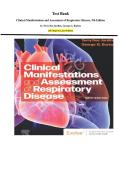
Clinical Manifestations and Assessment of Respiratory Disease, 9th Edition
by Terry Des Jardins, George G. Burton
(All Chapters| Latest Edition)
C
LE
ST
BE
, BESTLEC
Chapter 01: The Patient Interview
MULTIPLE CHOICE
1. The respiratory care practitioner is conducting a patient interview. The main purpose of
this interview is to:
a. review data with the patient.
b. gather subjective data from the patient.
c. gather objective data from the patient.
d. fill out the history form or checklist.
ANS: B
C
The interview is a meeting between the respiratory care practitioner and the patient. It allows the
collection of subjective data about the patient’s feelings regarding his/her condition. The history
LE
should be done before the interview. Although data can be reviewed, that isnot the primary
purpose of the interview.
2. For there to be a successful interview, the respiratory therapist must:
ST
a. provide leading questions to guide the patient.
b. reassure the patient.
c. be an active listener.
BE
d. use medical terminology to show knowledge of the subject matter.
ANS: C
The personal qualities that a respiratory the rapist must have to conduct a successful interview
include being an active listener, having a genuine concern for the patient, and having empathy.
Leading questions must be avoided. Reassurance may provide a false sense of comfort to the
patient.
Medical jargon can sound exclusionary and paternalistic to a patient.
3. Which of the following would be found on a history form?
1. Age
2. Chief complaint
3. Present health
, BESTLEC
4. Family history
5. Health insurance providera. 1,
4
b. 2, 3
c. 3, 4, 5
d. 1, 2, 3, 4
ANS: D
Age, chief complaint, present health, and family history are typically found on a health history
form because each can impact the patient’s health. Health insurance provider information, while
needed for billing purposes, would not be found on the history form.
4. External factors the respiratory care practitioner should make efforts to provide during an
C
interview include which of the following?
1.
2.
Minimize or prevent interruptions.
Ensure privacy during discussions.
LE
3. Interviewer is the same sex as the patient to prevent bias.
ST
4. Be comfortable for the patient and interviewer.
a. 1, 4
b. 2, 3
BE
c. 1, 2, 4
d. 2, 3, 4
ANS: C
External factors, such as a good physical setting, enhance the interviewing process. Regardless of
the interview setting (the patient’s bedside, a crowded emergency room, an office in the hospital
or clinic, or the patient’s home), efforts should be made to (1) ensure privacy, (2) prevent
interruptions, and (3) secure a comfortable physical environment (e.g., comfortable room
temperature, sufficient lighting, absence of noise). An interviewer of either gender, who acts
professionally, should be able to interview a patient of either gender.
5. The respiratory therapist is conducting a patient interview. The therapist chooses to use
open-ended questions. Open-ended questions allow the therapist to do which of the following?
, BESTLEC
1. Gather information when a patient introduces a new topic.
2. Introduce a new subject area.
3. Begin the interview process.
4. Gather specific information.
a. 4
b. 1, 3
c. 1, 2, 3
d. 2, 3, 4
ANS: C
C
An open-ended question should be used to start the interview, introduce a new section of
questions, and gather more information from a patient’s topic. Closed or direct questions are
LE
used to gather specific information.
6. The direct question interview format is used to:
ST
1. speed up the interview.
2. let the patient fully explain his/her situation.
BE
3. help the respiratory therapist show empathy.
4. gather specific information.
a. 1, 4
b. 2, 3
c. 3, 4
d. 1, 2, 3
ANS: A
Direct or closed questions are best to gather specific information and speed up the interview.
Open- ended questions are best suited to let the patient fully explain his/her situation and
possibly help the respiratory therapist show empathy.
Test Bank
Clinical Manifestations and Assessment of Respiratory Disease, 9th Edition
by Terry Des Jardins, George G. Burton
(All Chapters| Latest Edition)
C
LE
ST
BE
, BESTLEC
Chapter 01: The Patient Interview
MULTIPLE CHOICE
1. The respiratory care practitioner is conducting a patient interview. The main purpose of
this interview is to:
a. review data with the patient.
b. gather subjective data from the patient.
c. gather objective data from the patient.
d. fill out the history form or checklist.
ANS: B
C
The interview is a meeting between the respiratory care practitioner and the patient. It allows the
collection of subjective data about the patient’s feelings regarding his/her condition. The history
LE
should be done before the interview. Although data can be reviewed, that isnot the primary
purpose of the interview.
2. For there to be a successful interview, the respiratory therapist must:
ST
a. provide leading questions to guide the patient.
b. reassure the patient.
c. be an active listener.
BE
d. use medical terminology to show knowledge of the subject matter.
ANS: C
The personal qualities that a respiratory the rapist must have to conduct a successful interview
include being an active listener, having a genuine concern for the patient, and having empathy.
Leading questions must be avoided. Reassurance may provide a false sense of comfort to the
patient.
Medical jargon can sound exclusionary and paternalistic to a patient.
3. Which of the following would be found on a history form?
1. Age
2. Chief complaint
3. Present health
, BESTLEC
4. Family history
5. Health insurance providera. 1,
4
b. 2, 3
c. 3, 4, 5
d. 1, 2, 3, 4
ANS: D
Age, chief complaint, present health, and family history are typically found on a health history
form because each can impact the patient’s health. Health insurance provider information, while
needed for billing purposes, would not be found on the history form.
4. External factors the respiratory care practitioner should make efforts to provide during an
C
interview include which of the following?
1.
2.
Minimize or prevent interruptions.
Ensure privacy during discussions.
LE
3. Interviewer is the same sex as the patient to prevent bias.
ST
4. Be comfortable for the patient and interviewer.
a. 1, 4
b. 2, 3
BE
c. 1, 2, 4
d. 2, 3, 4
ANS: C
External factors, such as a good physical setting, enhance the interviewing process. Regardless of
the interview setting (the patient’s bedside, a crowded emergency room, an office in the hospital
or clinic, or the patient’s home), efforts should be made to (1) ensure privacy, (2) prevent
interruptions, and (3) secure a comfortable physical environment (e.g., comfortable room
temperature, sufficient lighting, absence of noise). An interviewer of either gender, who acts
professionally, should be able to interview a patient of either gender.
5. The respiratory therapist is conducting a patient interview. The therapist chooses to use
open-ended questions. Open-ended questions allow the therapist to do which of the following?
, BESTLEC
1. Gather information when a patient introduces a new topic.
2. Introduce a new subject area.
3. Begin the interview process.
4. Gather specific information.
a. 4
b. 1, 3
c. 1, 2, 3
d. 2, 3, 4
ANS: C
C
An open-ended question should be used to start the interview, introduce a new section of
questions, and gather more information from a patient’s topic. Closed or direct questions are
LE
used to gather specific information.
6. The direct question interview format is used to:
ST
1. speed up the interview.
2. let the patient fully explain his/her situation.
BE
3. help the respiratory therapist show empathy.
4. gather specific information.
a. 1, 4
b. 2, 3
c. 3, 4
d. 1, 2, 3
ANS: A
Direct or closed questions are best to gather specific information and speed up the interview.
Open- ended questions are best suited to let the patient fully explain his/her situation and
possibly help the respiratory therapist show empathy.


