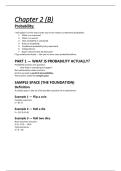
Chapter 2 (B)
Probability:
I will explain it in the exact order your brain needs to understand probability:
1. What is an outcome?
2. What is an event?
3. How probability is calculated
4. Rules of probability
5. Conditional probability (very important)
6. Independence
7. Bayes’ theorem (the hardest part)
I’ll go slowly and clearly — like you’ve never seen probability before.
PART 1 — WHAT IS PROBABILITY ACTUALLY?
Probability answers one question:
How likely is something to happen?
But mathematics needs structure.
So first we build a world of all possibilities.
That world is called the sample space.
SAMPLE SPACE (THE FOUNDATION)
Definition
A sample space is the set of all possible outcomes of an experiment.
Example 1 — Flip a coin
Possible outcomes:
S = {H, T}
Example 2 — Roll a die
S = {1,2,3,4,5,6}
Example 3 — Roll two dice
Now outcomes are pairs:
(1,1), (1,2), … (6,6)
Total outcomes:
6 × 6 = 36
, Types of sample spaces
1) Discrete
Countable outcomes
Example: number on dice
2) Continuous
Measured values
Example: weight of a person between 60 and 140 kg
EVENTS (WHAT WE ACTUALLY CARE ABOUT)
An event is a subset of the sample space.
Meaning:
We don’t care about all outcomes — only some.
Example — roll a die
S = {1,2,3,4,5,6}
Event A: even numbers
A = {2,4,6}
Event B: divisible by 3
B = {3,6}
So:
Sample space = everything possible
Event = something specific happening
SET LOGIC (VERY IMPORTANT FOR PROBABILITY)
You must understand these words:
Union → OR
Intersection → AND
Complement → NOT
Union (A ∪ B)
Occurs if A OR B happens
Intersection (A ∩ B)
Occurs if A AND B happen
Complement (Aᶜ)
Occurs if A does NOT happen
Mutually exclusive
Cannot happen together
A∩B=∅
Probability:
I will explain it in the exact order your brain needs to understand probability:
1. What is an outcome?
2. What is an event?
3. How probability is calculated
4. Rules of probability
5. Conditional probability (very important)
6. Independence
7. Bayes’ theorem (the hardest part)
I’ll go slowly and clearly — like you’ve never seen probability before.
PART 1 — WHAT IS PROBABILITY ACTUALLY?
Probability answers one question:
How likely is something to happen?
But mathematics needs structure.
So first we build a world of all possibilities.
That world is called the sample space.
SAMPLE SPACE (THE FOUNDATION)
Definition
A sample space is the set of all possible outcomes of an experiment.
Example 1 — Flip a coin
Possible outcomes:
S = {H, T}
Example 2 — Roll a die
S = {1,2,3,4,5,6}
Example 3 — Roll two dice
Now outcomes are pairs:
(1,1), (1,2), … (6,6)
Total outcomes:
6 × 6 = 36
, Types of sample spaces
1) Discrete
Countable outcomes
Example: number on dice
2) Continuous
Measured values
Example: weight of a person between 60 and 140 kg
EVENTS (WHAT WE ACTUALLY CARE ABOUT)
An event is a subset of the sample space.
Meaning:
We don’t care about all outcomes — only some.
Example — roll a die
S = {1,2,3,4,5,6}
Event A: even numbers
A = {2,4,6}
Event B: divisible by 3
B = {3,6}
So:
Sample space = everything possible
Event = something specific happening
SET LOGIC (VERY IMPORTANT FOR PROBABILITY)
You must understand these words:
Union → OR
Intersection → AND
Complement → NOT
Union (A ∪ B)
Occurs if A OR B happens
Intersection (A ∩ B)
Occurs if A AND B happen
Complement (Aᶜ)
Occurs if A does NOT happen
Mutually exclusive
Cannot happen together
A∩B=∅