
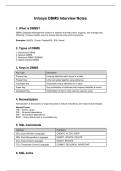
Infosys DBMS Interview Notes
1. What is DBMS?
DBMS (Database Management System) is software that helps store, organize, and manage data
efficiently. It allows multiple users to access data securely and concurrently.
Examples: MySQL, Oracle, PostgreSQL, SQL Server.
2. Types of DBMS
1. Hierarchical DBMS
2. Network DBMS
3. Relational DBMS (RDBMS)
4. Object-Oriented DBMS
3. Keys in DBMS
Key Type Description
Primary Key Uniquely identifies each record in a table.
Foreign Key Links two tables together using reference.
Candidate Key All possible unique identifiers for a table.
Super Key Any combination of attributes that uniquely identifies a record.
Composite Key Combination of two or more columns used as a key.
4. Normalization
Normalization is the process of organizing data to reduce redundancy and improve data integrity.
Normal Forms:
1NF – Atomic values
2NF – No partial dependency
3NF – No transitive dependency
BCNF – Every determinant is a candidate key.
5. SQL Commands
Category Examples
DDL (Data Definition Language) CREATE, ALTER, DROP
DML (Data Manipulation Language) INSERT, UPDATE, DELETE
DCL (Data Control Language) GRANT, REVOKE
TCL (Transaction Control Language) COMMIT, ROLLBACK, SAVEPOINT
6. SQL Joins
1. What is DBMS?
DBMS (Database Management System) is software that helps store, organize, and manage data
efficiently. It allows multiple users to access data securely and concurrently.
Examples: MySQL, Oracle, PostgreSQL, SQL Server.
2. Types of DBMS
1. Hierarchical DBMS
2. Network DBMS
3. Relational DBMS (RDBMS)
4. Object-Oriented DBMS
3. Keys in DBMS
Key Type Description
Primary Key Uniquely identifies each record in a table.
Foreign Key Links two tables together using reference.
Candidate Key All possible unique identifiers for a table.
Super Key Any combination of attributes that uniquely identifies a record.
Composite Key Combination of two or more columns used as a key.
4. Normalization
Normalization is the process of organizing data to reduce redundancy and improve data integrity.
Normal Forms:
1NF – Atomic values
2NF – No partial dependency
3NF – No transitive dependency
BCNF – Every determinant is a candidate key.
5. SQL Commands
Category Examples
DDL (Data Definition Language) CREATE, ALTER, DROP
DML (Data Manipulation Language) INSERT, UPDATE, DELETE
DCL (Data Control Language) GRANT, REVOKE
TCL (Transaction Control Language) COMMIT, ROLLBACK, SAVEPOINT
6. SQL Joins


