

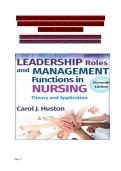
TEST BANK for Leadership Roles and Management
Functions in Nursing: Theory and Application 11th
Edition by Carol J. Huston
All Chapters Fully Covered 1-25| Verified Questions & Correct
Answers with Rationales for Exam Preparations| A+ GRADED
Page | 1
, Table of Contents M M
Chapter 1 Decision Making, Problem Solving, Critical Thinking, and Clinical Reasoning: Requisites for
M M M M M M M M M M M M
Successful Leadership and Management
M M M M
Chapter 2 Classical Views of Leadership and Management
M M M M M M M
Chapter 3 Twenty-First-Century Thinking About Leadership and
M M M M M M
Management Chapter 4 Ethical Issues
M M M M M
Chapter 5 Legal and Legislative Issues
M M M M M
Chapter 6 Patient, Subordinate, Workplace, and Professional Advocacy
M M M M M M M
Chapter 7 Organizational Planning
M M M M
Chapter 8 Planned Change
M M M
Chapter 9 Time Management
M M M M
Chapter 10 Fiscal Planning
M M M M
Chapter 11 Career Planning and Development in Nursing
M M M M M M M
Chapter 12 Organizational Structure
M M M M
Chapter 13 Organizational, Political, and Personal Power
M M M M M M
Chapter 14 Organizing Patient Care
M M M M M
Chapter 15 Employee Recruitment, Selection, Placement, and Indoctrination
M M M M M M M
Chapter 16 Socializing and Educating Staff in a Learning Organization
M M M M M M M M M M
Chapter 17 Staffing Needs and Scheduling Policies
M M M M M M M
Chapter 18 Creating a Motivating Climate
M M M M M
Chapter 19 Organizational, Interpersonal, and Group Communication
M M M M M M
Chapter 20 Delegation
M M M
Chapter 21 Effective Conflict Resolution and Negotiation
M M M M M M
Chapter 22 Collective Bargaining, Unionization, and Employment Laws
M M M M M M M
Chapter 23 Quality Control
M M M M
Chapter 24 Performance Appraisal
M M M
Page | 2
,Chapter 25 Problem Employees: Rule Breakers, Marginal Employees, and Those with Substance Use
M M M M M M M M M M M M
Disorder
M
Chapter 1 Decision Making, Problem Solving, Critical Thinking, and Clinical
M M M M M M M M M
Reasoning: Requisites for Successful Leadership and Management
M M M M M M M
1. What statement is true regarding decision making?
M M M M M M
A) It is an analysis of a situation
M M M M M M
B) It is closely related to evaluation
M M M M M
C) It involves choosing between courses of action
M M M M M M
D) It is dependent upon finding the cause of a
M M M M M M M M
problem Correct Answer: C
M M M M
Feedback:
Decision making is a complex cognitive process often defined as choosing a particular course of action.
M M M M M M M M M M M M M M M
Problem solving is part of decision making and is a systematic process that focuses on analyzing a
M M M M M M M M M M M M M M M M M
difficult situation. Critical thinking, sometimes referred to as reflective thinking, is related to
M M M M M M M M M M M M M
evaluation and has a broader scope than decision making and problem solving.
M M M M M M M M M M M M
2. What is a weakness of the traditional problem-solving model?
M M M M M M M M
A) Its need for implementation time
M M M M
B) Its lack of a step requiring evaluation of results
M M M M M M M M
C) Its failure to gather sufficient data
M M M M M
D) Its failure to evaluate alternatives
M M M M
Correct Answer: A
M M M
Feedback:
The traditional problem-solving model is less effective when time constraints are a consideration.
M M M M M M M M M M M M
Decision making can occur without the full analysis required in problem solving. Because problem
M M M M M M M M M M M M M M
solving attempts to identify the root problem in situations, much time and energy are spent on
M M M M M M M M M M M M M M M M
identifying the real problem.
M M M M
Page | 3
, 3. Which of the following statements is true regarding decision making?
M M M M M M M M M
A) Scientific methods provide identical decisions by different individuals for the same problems
M M M M M M M M M M M
B) Decisions are greatly influenced by each person's value system
M M M M M M M M
C) Personal beliefs can be adjusted for when the scientific approach to problem solving is used
M M M M M M M M M M M M M M
D) Past experience has little to do with the quality of the
M M M M M M M M M M
decision Correct Answer: B
M M M M
Feedback:
Values, life experience, individual preference, and individual ways of thinking will influence a
M M M M M M M M M M M M
person's decision making. No matter how objective the criteria will be, value judgments will always
M M M M M M M M M M M M M M M
play a part in a person's decision making, either consciously or subconsciously.
M M M M M M M M M M M M
4. What influences the quality of a decision most often?
M M M M M M M M
A) The decision maker's immediate superior
M M M M
B) The type of decision that needs to be made
M M M M M M M M
C) Questions asked and alternatives generated
M M M M
D) The time of day the decision is made Correct Answer:
M M M M M M M M M
C Feedback:
M M
The greater the number of alternatives that can be generated by the decision maker, the better the final
M M M M M M M M M M M M M M M M M
decision will be. The alternatives generated and the final choices are limited by each person's value
M M M M M M M M M M M M M M M M
system.
M
5. What does knowledge about good decision making lead one to believe?
M M M M M M M M M M
A) Good decision makers are usually right-brain, intuitive thinkers
M M M M M M M
B) Effective decision makers are sensitive to the situation and to others
M M M M M M M M M M
C) Good decisions are usually made by left-brain, logical thinkers
M M M M M M M M
D) Good decision making requires analytical rather than creative
M M M M M M M
processes Correct Answer: B
M M M M
Page | 4
Functions in Nursing: Theory and Application 11th
Edition by Carol J. Huston
All Chapters Fully Covered 1-25| Verified Questions & Correct
Answers with Rationales for Exam Preparations| A+ GRADED
Page | 1
, Table of Contents M M
Chapter 1 Decision Making, Problem Solving, Critical Thinking, and Clinical Reasoning: Requisites for
M M M M M M M M M M M M
Successful Leadership and Management
M M M M
Chapter 2 Classical Views of Leadership and Management
M M M M M M M
Chapter 3 Twenty-First-Century Thinking About Leadership and
M M M M M M
Management Chapter 4 Ethical Issues
M M M M M
Chapter 5 Legal and Legislative Issues
M M M M M
Chapter 6 Patient, Subordinate, Workplace, and Professional Advocacy
M M M M M M M
Chapter 7 Organizational Planning
M M M M
Chapter 8 Planned Change
M M M
Chapter 9 Time Management
M M M M
Chapter 10 Fiscal Planning
M M M M
Chapter 11 Career Planning and Development in Nursing
M M M M M M M
Chapter 12 Organizational Structure
M M M M
Chapter 13 Organizational, Political, and Personal Power
M M M M M M
Chapter 14 Organizing Patient Care
M M M M M
Chapter 15 Employee Recruitment, Selection, Placement, and Indoctrination
M M M M M M M
Chapter 16 Socializing and Educating Staff in a Learning Organization
M M M M M M M M M M
Chapter 17 Staffing Needs and Scheduling Policies
M M M M M M M
Chapter 18 Creating a Motivating Climate
M M M M M
Chapter 19 Organizational, Interpersonal, and Group Communication
M M M M M M
Chapter 20 Delegation
M M M
Chapter 21 Effective Conflict Resolution and Negotiation
M M M M M M
Chapter 22 Collective Bargaining, Unionization, and Employment Laws
M M M M M M M
Chapter 23 Quality Control
M M M M
Chapter 24 Performance Appraisal
M M M
Page | 2
,Chapter 25 Problem Employees: Rule Breakers, Marginal Employees, and Those with Substance Use
M M M M M M M M M M M M
Disorder
M
Chapter 1 Decision Making, Problem Solving, Critical Thinking, and Clinical
M M M M M M M M M
Reasoning: Requisites for Successful Leadership and Management
M M M M M M M
1. What statement is true regarding decision making?
M M M M M M
A) It is an analysis of a situation
M M M M M M
B) It is closely related to evaluation
M M M M M
C) It involves choosing between courses of action
M M M M M M
D) It is dependent upon finding the cause of a
M M M M M M M M
problem Correct Answer: C
M M M M
Feedback:
Decision making is a complex cognitive process often defined as choosing a particular course of action.
M M M M M M M M M M M M M M M
Problem solving is part of decision making and is a systematic process that focuses on analyzing a
M M M M M M M M M M M M M M M M M
difficult situation. Critical thinking, sometimes referred to as reflective thinking, is related to
M M M M M M M M M M M M M
evaluation and has a broader scope than decision making and problem solving.
M M M M M M M M M M M M
2. What is a weakness of the traditional problem-solving model?
M M M M M M M M
A) Its need for implementation time
M M M M
B) Its lack of a step requiring evaluation of results
M M M M M M M M
C) Its failure to gather sufficient data
M M M M M
D) Its failure to evaluate alternatives
M M M M
Correct Answer: A
M M M
Feedback:
The traditional problem-solving model is less effective when time constraints are a consideration.
M M M M M M M M M M M M
Decision making can occur without the full analysis required in problem solving. Because problem
M M M M M M M M M M M M M M
solving attempts to identify the root problem in situations, much time and energy are spent on
M M M M M M M M M M M M M M M M
identifying the real problem.
M M M M
Page | 3
, 3. Which of the following statements is true regarding decision making?
M M M M M M M M M
A) Scientific methods provide identical decisions by different individuals for the same problems
M M M M M M M M M M M
B) Decisions are greatly influenced by each person's value system
M M M M M M M M
C) Personal beliefs can be adjusted for when the scientific approach to problem solving is used
M M M M M M M M M M M M M M
D) Past experience has little to do with the quality of the
M M M M M M M M M M
decision Correct Answer: B
M M M M
Feedback:
Values, life experience, individual preference, and individual ways of thinking will influence a
M M M M M M M M M M M M
person's decision making. No matter how objective the criteria will be, value judgments will always
M M M M M M M M M M M M M M M
play a part in a person's decision making, either consciously or subconsciously.
M M M M M M M M M M M M
4. What influences the quality of a decision most often?
M M M M M M M M
A) The decision maker's immediate superior
M M M M
B) The type of decision that needs to be made
M M M M M M M M
C) Questions asked and alternatives generated
M M M M
D) The time of day the decision is made Correct Answer:
M M M M M M M M M
C Feedback:
M M
The greater the number of alternatives that can be generated by the decision maker, the better the final
M M M M M M M M M M M M M M M M M
decision will be. The alternatives generated and the final choices are limited by each person's value
M M M M M M M M M M M M M M M M
system.
M
5. What does knowledge about good decision making lead one to believe?
M M M M M M M M M M
A) Good decision makers are usually right-brain, intuitive thinkers
M M M M M M M
B) Effective decision makers are sensitive to the situation and to others
M M M M M M M M M M
C) Good decisions are usually made by left-brain, logical thinkers
M M M M M M M M
D) Good decision making requires analytical rather than creative
M M M M M M M
processes Correct Answer: B
M M M M
Page | 4


