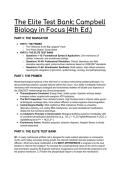
The Elite Test Bank: Campbell
Biology in Focus (4th Ed.)
PART 0: THE NAVIGATOR
● PART I: THE PRIMER
○ The "Welcome to the Big Leagues" Hook
○ The "Panic Button" Cheat Sheet
● PART II: THE ELITE TEST BANK
○ Questions 1–15: Foundational Syntax & Application: Core mechanics of
cellular, molecular, and evolutionary biology.
○ Questions 16–40: Professional Simulation: Clinical, laboratory, and field
scenarios requiring rapid, protocol-driven decisions based on 2026/2027 standards.
○ Questions 41–66: Grandmaster Synthesis: Multi-system, high-stakes scenarios
requiring the integration of genomics, spatial biology, ecology, and pathophysiology.
PART I: THE PRIMER
Mastering biological systems at the elite level is not about memorizing isolated pathways; it is
about predicting systemic cascade failures before they occur. Your ability to integrate molecular
mechanics with macroscopic ecological and evolutionary realities will dictate your trajectory in
the 2026/2027 biotechnology and clinical landscapes.
● Thermodynamic Constraint: Energy flows, matter cycles. Systemic entropy always
increases unless coupled with exergonic ATP hydrolysis.
● The SA:V Imperative: Form dictates function. High Surface Area to Volume ratios govern
all biological exchange rates, from cellular diffusion to whole-organism thermoregulation.
● Central Dogma Reality: DNA \rightarrow RNA \rightarrow Protein is a baseline.
Alternative splicing, non-coding RNA interference, and post-translational modifications
dictate the true functional phenotype.
● Le Chatelier's Principle in Homeostasis: Biological buffering systems immediately shift
to counteract physiological disturbances (e.g., CO_2 + H_2O \rightleftharpoons H_2CO_3
\rightleftharpoons H^+ + HCO_3^-).
● Evolutionary Axiom: Mutation proposes, selection disposes. Adaptive fitness is strictly
context-dependent.
PART II: THE ELITE TEST BANK
Q1: A newly synthesized artificial cell is designed for rapid nutrient absorption in a bioreactor.
As the cell's radius increases during growth, the internal metabolic demand outpaces nutrient
diffusion. Which structural modification is the MOST APPROPRIATE to engineer into the next
iteration to resolve this limitation? A) Increase the overall spherical radius of the cell to expand
total membrane capacity. B) Engineer extensive invaginations and microvilli-like projections onto
the plasma membrane. C) Thicken the phospholipid bilayer to increase the membrane's
,structural integrity. D) Upregulate the synthesis of internal cytosolic fluid to dilute accumulated
metabolic waste.
● The Answer: B (Engineer extensive invaginations and microvilli-like projections onto the
plasma membrane.)
● Distractor Analysis:
○ A is incorrect: Increasing the radius decreases the Surface Area to Volume (SA:V)
ratio, exacerbating the diffusion limitation. Volume scales cubically (r^3) while
surface area scales quadratically (r^2). * C is incorrect: A thicker membrane
increases the diffusion distance, reducing the rate of transport across the boundary.
○ D is incorrect: Dilution does not solve the fundamental boundary-layer bottleneck of
molecular exchange.
The Mentor's Analysis: The SA:V ratio is the inescapable physical constraint of all living
systems. When volume outpaces surface area, the cell starves or suffocates. You cannot cheat
geometry; you must manipulate it.
SA:V Strategy Biological Example Engineering Application
Membrane Invagination Intestinal microvilli Bioreactor nutrient absorption
Flattening Erythrocytes (RBCs) Enhanced gas exchange
Branching Fungal mycelia Maximizing soil contact
Professional Intuition: Whenever exchange rates are compromised, maximize membrane
folding before altering metabolic pathways.
Q2: During a laboratory assay evaluating protein folding in a novel solvent, you observe that
secondary structures (alpha-helices and beta-pleated sheets) fail to form, though the primary
polypeptide sequence remains intact. The solvent MOST LIKELY disrupts which of the following
chemical interactions? A) Peptide bonds between adjacent amino acids. B) Disulfide bridges
between cysteine residues. C) Hydrogen bonds between the polypeptide backbone
constituents. D) Hydrophobic interactions among nonpolar side chains.
● The Answer: C (Hydrogen bonds between the polypeptide backbone constituents.)
● Distractor Analysis:
○ A is incorrect: Peptide bonds form the primary structure. If these were broken, the
sequence would not be intact.
○ B is incorrect: Disulfide bridges stabilize tertiary and quaternary structures, not
localized secondary structures.
○ D is incorrect: Hydrophobic interactions drive tertiary structure folding, collapsing
the protein into its functional 3D conformation.
The Mentor's Analysis: Protein architecture is hierarchical. Primary structure is covalent;
secondary is hydrogen-bonded along the backbone; tertiary relies on R-group interactions.
Professional Intuition: Isolate the exact tier of structural failure to identify the specific chemical
bond being compromised.
Q3: A patient in the ICU presents with severe respiratory acidosis (pH = 7.15, elevated
PaCO_2). Based on the bicarbonate buffer system (CO_2 + H_2O \rightleftharpoons H_2CO_3
\rightleftharpoons H^+ + HCO_3^-), what is the IMMEDIATE biochemical consequence of
retaining excess carbon dioxide? A) The equilibrium shifts left, consuming H^+ and raising the
pH. B) The equilibrium shifts right, generating H^+ and lowering the pH. C) Bicarbonate
(HCO_3^-) is completely depleted, neutralizing the blood. D) Carbonic acid (H_2CO_3)
dissociates into oxygen and carbon monoxide.
● The Answer: B (The equilibrium shifts right, generating H^+ and lowering the pH.)
● Distractor Analysis:
, ○ A is incorrect: This violates Le Chatelier's Principle. Adding reactant (CO_2) pushes
the reaction to the product side, not the reactant side.
○ C is incorrect: Bicarbonate levels will actually rise as the reaction shifts right, though
kidneys will later compensate to retain even more.
○ D is incorrect: This is a chemical hallucination. Carbonic acid does not decompose
into carbon monoxide in biological systems.
The Mentor's Analysis: Biological chemistry obeys Le Chatelier. A mass-action shift driven by
hypoventilation forces the generation of hydrogen ions. Professional Intuition: Treat the
underlying cause (ventilation) rather than just chasing the symptom (pH).
Q4: A researcher treats a culture of eukaryotic cells with an experimental toxin that specifically
punctures the inner mitochondrial membrane, making it freely permeable to protons (H^+).
Which outcome will IMMEDIATELY follow? A) Glycolysis will halt due to an overaccumulation of
ATP. B) Oxygen consumption will cease as the electron transport chain (ETC) denatures. C)
ATP synthesis by oxidative phosphorylation will stop, though electron transport continues. D)
The Krebs cycle will reverse, synthesizing glucose from carbon dioxide.
● The Answer: C (ATP synthesis by oxidative phosphorylation will stop, though electron
transport continues.)
● Distractor Analysis:
○ A is incorrect: Glycolysis will likely upregulate (Pasteur effect) to compensate for the
lack of mitochondrial ATP.
○ B is incorrect: The ETC proteins are not denatured; they will continue to pump
protons, but the gradient instantly dissipates. Oxygen is still consumed.
○ D is incorrect: The Krebs cycle cannot run in reverse to fix carbon; that is the
domain of the Calvin cycle in autotrophs.
The Mentor's Analysis: Uncoupling agents destroy the proton motive force without stopping
the electron transport chain. The energy is lost as heat instead of being captured by ATP
synthase. Professional Intuition: When the gradient falls, oxidative ATP production fails,
regardless of oxygen availability.
Q5: In a C3 plant exposed to intense heat and arid conditions, stomata close to conserve water.
This induces photorespiration. Which biochemical event is the PRIMARY cause of this wasteful
process? A) Rubisco binds O_2 instead of CO_2, consuming ATP and releasing CO_2. B)
Photosystem II ceases to split water, halting the light reactions. C) The Calvin cycle shifts to
produce lipids instead of G3P. D) PEP carboxylase degrades prematurely in the bundle-sheath
cells.
● The Answer: A (Rubisco binds O_2 instead of CO_2, consuming ATP and releasing
CO_2.)
● Distractor Analysis:
○ B is incorrect: Light reactions continue as long as light is present, which is why O_2
builds up inside the closed leaf.
○ C is incorrect: The Calvin cycle does not spontaneously alter its enzymatic output to
lipids under heat stress.
○ D is incorrect: C3 plants do not utilize PEP carboxylase or bundle-sheath spatial
separation; that is a C4 adaptation.
The Mentor's Analysis: Rubisco is a flawed enzyme with an affinity for both oxygen and
carbon dioxide. Under closed-stomata conditions, the O_2 ratio spikes, driving competitive
inhibition. Professional Intuition: Evolution is not perfect; it works with the tools available.
Photorespiration is a legacy flaw of an ancient atmosphere.
Q6: A karyotype analysis of a human fetus reveals 47 chromosomes, specifically identifying
Biology in Focus (4th Ed.)
PART 0: THE NAVIGATOR
● PART I: THE PRIMER
○ The "Welcome to the Big Leagues" Hook
○ The "Panic Button" Cheat Sheet
● PART II: THE ELITE TEST BANK
○ Questions 1–15: Foundational Syntax & Application: Core mechanics of
cellular, molecular, and evolutionary biology.
○ Questions 16–40: Professional Simulation: Clinical, laboratory, and field
scenarios requiring rapid, protocol-driven decisions based on 2026/2027 standards.
○ Questions 41–66: Grandmaster Synthesis: Multi-system, high-stakes scenarios
requiring the integration of genomics, spatial biology, ecology, and pathophysiology.
PART I: THE PRIMER
Mastering biological systems at the elite level is not about memorizing isolated pathways; it is
about predicting systemic cascade failures before they occur. Your ability to integrate molecular
mechanics with macroscopic ecological and evolutionary realities will dictate your trajectory in
the 2026/2027 biotechnology and clinical landscapes.
● Thermodynamic Constraint: Energy flows, matter cycles. Systemic entropy always
increases unless coupled with exergonic ATP hydrolysis.
● The SA:V Imperative: Form dictates function. High Surface Area to Volume ratios govern
all biological exchange rates, from cellular diffusion to whole-organism thermoregulation.
● Central Dogma Reality: DNA \rightarrow RNA \rightarrow Protein is a baseline.
Alternative splicing, non-coding RNA interference, and post-translational modifications
dictate the true functional phenotype.
● Le Chatelier's Principle in Homeostasis: Biological buffering systems immediately shift
to counteract physiological disturbances (e.g., CO_2 + H_2O \rightleftharpoons H_2CO_3
\rightleftharpoons H^+ + HCO_3^-).
● Evolutionary Axiom: Mutation proposes, selection disposes. Adaptive fitness is strictly
context-dependent.
PART II: THE ELITE TEST BANK
Q1: A newly synthesized artificial cell is designed for rapid nutrient absorption in a bioreactor.
As the cell's radius increases during growth, the internal metabolic demand outpaces nutrient
diffusion. Which structural modification is the MOST APPROPRIATE to engineer into the next
iteration to resolve this limitation? A) Increase the overall spherical radius of the cell to expand
total membrane capacity. B) Engineer extensive invaginations and microvilli-like projections onto
the plasma membrane. C) Thicken the phospholipid bilayer to increase the membrane's
,structural integrity. D) Upregulate the synthesis of internal cytosolic fluid to dilute accumulated
metabolic waste.
● The Answer: B (Engineer extensive invaginations and microvilli-like projections onto the
plasma membrane.)
● Distractor Analysis:
○ A is incorrect: Increasing the radius decreases the Surface Area to Volume (SA:V)
ratio, exacerbating the diffusion limitation. Volume scales cubically (r^3) while
surface area scales quadratically (r^2). * C is incorrect: A thicker membrane
increases the diffusion distance, reducing the rate of transport across the boundary.
○ D is incorrect: Dilution does not solve the fundamental boundary-layer bottleneck of
molecular exchange.
The Mentor's Analysis: The SA:V ratio is the inescapable physical constraint of all living
systems. When volume outpaces surface area, the cell starves or suffocates. You cannot cheat
geometry; you must manipulate it.
SA:V Strategy Biological Example Engineering Application
Membrane Invagination Intestinal microvilli Bioreactor nutrient absorption
Flattening Erythrocytes (RBCs) Enhanced gas exchange
Branching Fungal mycelia Maximizing soil contact
Professional Intuition: Whenever exchange rates are compromised, maximize membrane
folding before altering metabolic pathways.
Q2: During a laboratory assay evaluating protein folding in a novel solvent, you observe that
secondary structures (alpha-helices and beta-pleated sheets) fail to form, though the primary
polypeptide sequence remains intact. The solvent MOST LIKELY disrupts which of the following
chemical interactions? A) Peptide bonds between adjacent amino acids. B) Disulfide bridges
between cysteine residues. C) Hydrogen bonds between the polypeptide backbone
constituents. D) Hydrophobic interactions among nonpolar side chains.
● The Answer: C (Hydrogen bonds between the polypeptide backbone constituents.)
● Distractor Analysis:
○ A is incorrect: Peptide bonds form the primary structure. If these were broken, the
sequence would not be intact.
○ B is incorrect: Disulfide bridges stabilize tertiary and quaternary structures, not
localized secondary structures.
○ D is incorrect: Hydrophobic interactions drive tertiary structure folding, collapsing
the protein into its functional 3D conformation.
The Mentor's Analysis: Protein architecture is hierarchical. Primary structure is covalent;
secondary is hydrogen-bonded along the backbone; tertiary relies on R-group interactions.
Professional Intuition: Isolate the exact tier of structural failure to identify the specific chemical
bond being compromised.
Q3: A patient in the ICU presents with severe respiratory acidosis (pH = 7.15, elevated
PaCO_2). Based on the bicarbonate buffer system (CO_2 + H_2O \rightleftharpoons H_2CO_3
\rightleftharpoons H^+ + HCO_3^-), what is the IMMEDIATE biochemical consequence of
retaining excess carbon dioxide? A) The equilibrium shifts left, consuming H^+ and raising the
pH. B) The equilibrium shifts right, generating H^+ and lowering the pH. C) Bicarbonate
(HCO_3^-) is completely depleted, neutralizing the blood. D) Carbonic acid (H_2CO_3)
dissociates into oxygen and carbon monoxide.
● The Answer: B (The equilibrium shifts right, generating H^+ and lowering the pH.)
● Distractor Analysis:
, ○ A is incorrect: This violates Le Chatelier's Principle. Adding reactant (CO_2) pushes
the reaction to the product side, not the reactant side.
○ C is incorrect: Bicarbonate levels will actually rise as the reaction shifts right, though
kidneys will later compensate to retain even more.
○ D is incorrect: This is a chemical hallucination. Carbonic acid does not decompose
into carbon monoxide in biological systems.
The Mentor's Analysis: Biological chemistry obeys Le Chatelier. A mass-action shift driven by
hypoventilation forces the generation of hydrogen ions. Professional Intuition: Treat the
underlying cause (ventilation) rather than just chasing the symptom (pH).
Q4: A researcher treats a culture of eukaryotic cells with an experimental toxin that specifically
punctures the inner mitochondrial membrane, making it freely permeable to protons (H^+).
Which outcome will IMMEDIATELY follow? A) Glycolysis will halt due to an overaccumulation of
ATP. B) Oxygen consumption will cease as the electron transport chain (ETC) denatures. C)
ATP synthesis by oxidative phosphorylation will stop, though electron transport continues. D)
The Krebs cycle will reverse, synthesizing glucose from carbon dioxide.
● The Answer: C (ATP synthesis by oxidative phosphorylation will stop, though electron
transport continues.)
● Distractor Analysis:
○ A is incorrect: Glycolysis will likely upregulate (Pasteur effect) to compensate for the
lack of mitochondrial ATP.
○ B is incorrect: The ETC proteins are not denatured; they will continue to pump
protons, but the gradient instantly dissipates. Oxygen is still consumed.
○ D is incorrect: The Krebs cycle cannot run in reverse to fix carbon; that is the
domain of the Calvin cycle in autotrophs.
The Mentor's Analysis: Uncoupling agents destroy the proton motive force without stopping
the electron transport chain. The energy is lost as heat instead of being captured by ATP
synthase. Professional Intuition: When the gradient falls, oxidative ATP production fails,
regardless of oxygen availability.
Q5: In a C3 plant exposed to intense heat and arid conditions, stomata close to conserve water.
This induces photorespiration. Which biochemical event is the PRIMARY cause of this wasteful
process? A) Rubisco binds O_2 instead of CO_2, consuming ATP and releasing CO_2. B)
Photosystem II ceases to split water, halting the light reactions. C) The Calvin cycle shifts to
produce lipids instead of G3P. D) PEP carboxylase degrades prematurely in the bundle-sheath
cells.
● The Answer: A (Rubisco binds O_2 instead of CO_2, consuming ATP and releasing
CO_2.)
● Distractor Analysis:
○ B is incorrect: Light reactions continue as long as light is present, which is why O_2
builds up inside the closed leaf.
○ C is incorrect: The Calvin cycle does not spontaneously alter its enzymatic output to
lipids under heat stress.
○ D is incorrect: C3 plants do not utilize PEP carboxylase or bundle-sheath spatial
separation; that is a C4 adaptation.
The Mentor's Analysis: Rubisco is a flawed enzyme with an affinity for both oxygen and
carbon dioxide. Under closed-stomata conditions, the O_2 ratio spikes, driving competitive
inhibition. Professional Intuition: Evolution is not perfect; it works with the tools available.
Photorespiration is a legacy flaw of an ancient atmosphere.
Q6: A karyotype analysis of a human fetus reveals 47 chromosomes, specifically identifying