
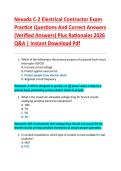
Nevada C-2 Electrical Contractor Exam
Practice Questions And Correct Answers
(Verified Answers) Plus Rationales 2026
Q&A | Instant Download Pdf
1. Which of the following is the primary purpose of a ground-fault circuit
interrupter (GFCI)?
A. Increase circuit voltage
B. Protect against overcurrent
C. Protect people from electric shock
D. Regulate circuit frequency
Rationale: A GFCI is designed to quickly cut off power when it detects a
ground fault, preventing serious electric shock to people.
2. What is the maximum allowable voltage drop for branch circuits
supplying sensitive electronic equipment?
A. 10%
B. 7%
C. 5%
D. 3%
Rationale: NEC recommends that voltage drop should not exceed 3% for
branch circuits serving sensitive electronics to ensure proper operation.
3. In conduit installations, which type of conduit is most suitable for wet
locations?
A. EMT
B. PVC
, C. FMC
D. RMC
Rationale: PVC conduit is corrosion-resistant and suitable for wet locations,
making it compliant with NEC standards.
4. The ampacity of a conductor is determined primarily by:
A. Conductor length
B. Conductor size and insulation type
C. Number of outlets
D. Type of load
Rationale: Ampacity depends on the wire gauge, insulation type, ambient
temperature, and installation conditions.
5. What is the NEC’s standard for grounding electrode conductors in
residential systems?
A. Copper only
B. Aluminum only
C. Copper or aluminum with proper sizing
D. Steel only
Rationale: NEC allows copper or aluminum grounding electrodes, provided
sizing and connection meet code requirements.
6. Which type of transformer is commonly used to step down voltage for
residential lighting?
A. Isolation transformer
B. Autotransformer
C. Distribution transformer
D. Potential transformer
Rationale: Distribution transformers reduce utility voltage to standard
residential voltages like 120/240V.
7. What is the NEC-required minimum working space in front of electrical
panels rated 200A?
, A. 24 inches
B. 28 inches
C. 30 inches
D. 36 inches
Rationale: NEC 110.26 requires a minimum of 36 inches of clear working
space in front of panels for safety and maintenance.
8. Which conductor material is most common in residential wiring?
A. Aluminum
B. Copper
C. Steel
D. Silver
Rationale: Copper is preferred in residential wiring due to its high
conductivity, durability, and reliability.
9. A service panel with a 200-amp rating should have what minimum
conductor size for copper feeders?
A. 2 AWG
B. 1 AWG
C. 4/0 AWG
D. 6 AWG
Rationale: NEC specifies that a 200A service requires 4/0 AWG copper
conductors to safely handle the load.
10. What device is required to protect a 120V, 20A circuit from
overload?
A. GFCI
B. Circuit breaker or fuse rated at 20A
C. Surge protector
D. Transformer
Rationale: Circuit breakers or fuses protect circuits from overcurrent
conditions by interrupting power when the load exceeds rated capacity.



