
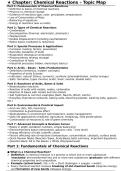
★ Chapter: Chemical Reactions – Topic Map
Part 1: Fundamentals of Chemical Reactions
• Definition & basics of chemical reactions
• Physical vs chemical change
• Evidence of reactions (gas, color, precipitate, temperature)
• Law of Conservation of Mass
• Balancing of equations
• Energy in reactions (exo vs endo)
Part 2: Types of Chemical Reactions
• Combination
• Decomposition (thermal, electrolytic, photolytic)
• Displacement
• Double Displacement (including neutralization)
• Redox basics (oxidation & reduction)
Part 3: Special Processes & Applications
• Corrosion (rusting: factors, prevention)
• Rancidity (oxidation of food)
• Respiration (biological combustion)
• Photosynthesis (energy storage)
• Combustion of fuels
• Industrial processes (Haber, electrolysis basics)
Part 4: Acids – Bases – Salts (Fundamentals)
• Definitions (Arrhenius, modern concepts)
• Properties of acids & bases
• Indicators: natural (litmus, turmeric), synthetic (phenolphthalein, methyl orange)
• Salts: formation, types (normal, acidic, basic, neutral, double salts)
Part 5: Reactions of Acids, Bases & Salts
• Neutralization reactions
• Reaction of acids with metals, oxides, carbonates
• Reaction of bases with metals and non-metals
• Salt hydrolysis & common examples (NaCl, Na₂CO₃, NH₄Cl, CaCO₃)
• Everyday importance (antacids, baking soda, bleaching powder, washing soda, gypsum,
etc.)
Part 6: Environmental & Practical Impact
• Acid rain (SO₂, NOₓ chemistry)
• Combustion & greenhouse effect
• Neutralization in environment (soil treatment, waste management)
• Daily life applications (medicine, agriculture, metallurgy, food preservation)
• Conservation of resources & role of green chemistry
Part 7: Advanced Concepts & Revision Corner
• Redox in depth (oxidation numbers, simple balancing)
• Electrochemistry basics (electrolysis, galvanic cells – intro level)
• Energy efficiency of fuels (calorific value)
• Factors affecting rate of reactions (temperature, concentration, catalysts, surface area)
• Quick Review Tables (Reaction Types, Acids-Bases-Salts summary, Important Equations)
• Question Bank: Fill in the blanks + MCQs (Olympiad level)
Part 1: Fundamentals of Chemical Reactions
● What is a Chemical Reaction?
Definition: A chemical reaction is a process in which one or more substances
(reactants) are transformed into one or more new substances (products) with different
chemical properties and composition.
Example (school level): 2H₂ + O₂ → 2H₂O (hydrogen + oxygen → water).
Every chemical reaction involves breaking of old chemical bonds (requires energy)
and formation of new bonds (releases energy).
, o If bond formation releases more energy than bond breaking → exothermic
reaction.
o If bond breaking consumes more energy than bond formation → endothermic
reaction.
Olympiad Tip: Always analyze bonds — reactions are energy transactions at the atomic
level.
● Difference Between Physical & Chemical Changes
Physical Change: Change in state, shape, or size without altering chemical
composition.
Example: Ice → Water → Steam (H₂O remains the same).
Chemical Change: New substance(s) with new properties formed.
Example: Mg + O₂ → MgO (grey metal → white ash).
Test to identify chemical change:
1. New substance formed.
2. Irreversible (generally).
3. Energy exchange involved.
● Evidence (Indicators) of a Chemical Reaction
Change in State/Color – Copper turns green (Cu → CuCO₃·Cu(OH)₂).
Gas Evolution – Zn + 2HCl → ZnCl₂ + H₂↑.
Formation of Precipitate – AgNO₃ + NaCl → AgCl↓ (white ppt) + NaNO₃.
Change in Temperature/Light – CaO + H₂O → Ca(OH)₂ + heat.
Emission of Sound/Smell – Crackers burning, food spoiling.
Olympiad Hint: Sometimes no visible change happens, yet a reaction occurs (e.g.,
electrolysis). Watch for hidden changes at molecular level.
● Representation of Chemical Reactions
1. Word Equation: Sodium + Chlorine → Sodium chloride.
2. Unbalanced Chemical Equation: Na + Cl₂ → NaCl.
3. Balanced Chemical Equation: 2Na + Cl₂ → 2NaCl.
Law of Conservation of Mass: Mass is neither created nor destroyed.
Antoine Lavoisier (1774) proved this with careful experiments.
In symbols:
Σ mass of reactants = Σ mass of products.
Hinglish Insight: “Atoms ekdum accountant ki tarah behave karte hain – entry aur exit
equal honi chahiye, warna balance sheet gadbad ho jaayegi.”
● Balancing of Chemical Equations
Why? Because atoms are neither created nor destroyed.
Method: Hit & trial, or using algebraic coefficients.
Example:
Fe + H₂O → Fe₃O₄ + H₂
Balanced: 3Fe + 4H₂O → Fe₃O₄ + 4H₂.
Olympiad Tip: In MCQs, don’t confuse coefficients (numbers in front, can change) with
subscripts (in chemical formula, fixed by nature).
● Energy in Chemical Reactions
Exothermic Reactions: Release energy.
o Combustion: CH₄ + 2O₂ → CO₂ + 2H₂O + energy.
o Respiration: C₆H₁₂O₆ + 6O₂ → 6CO₂ + 6H₂O + energy (~2830 kJ/mol).
Endothermic Reactions: Absorb energy.
o Photosynthesis: 6CO₂ + 6H₂O → C₆H₁₂O₆ + 6O₂ (absorbs sunlight).
o Thermal decomposition: CaCO₃ → CaO + CO₂ (requires heat).
Unit of Energy:
Joule (J), Kilojoule (kJ), or Calorie.
1 cal = 4.18 J.
Olympiad Connection: Expect numerical Qs like: If 10 g CH₄ burns completely, how much
heat is released?
(Hint: Use molar mass and ΔH = –890 kJ/mol for CH₄).
Part 1: Fundamentals of Chemical Reactions
• Definition & basics of chemical reactions
• Physical vs chemical change
• Evidence of reactions (gas, color, precipitate, temperature)
• Law of Conservation of Mass
• Balancing of equations
• Energy in reactions (exo vs endo)
Part 2: Types of Chemical Reactions
• Combination
• Decomposition (thermal, electrolytic, photolytic)
• Displacement
• Double Displacement (including neutralization)
• Redox basics (oxidation & reduction)
Part 3: Special Processes & Applications
• Corrosion (rusting: factors, prevention)
• Rancidity (oxidation of food)
• Respiration (biological combustion)
• Photosynthesis (energy storage)
• Combustion of fuels
• Industrial processes (Haber, electrolysis basics)
Part 4: Acids – Bases – Salts (Fundamentals)
• Definitions (Arrhenius, modern concepts)
• Properties of acids & bases
• Indicators: natural (litmus, turmeric), synthetic (phenolphthalein, methyl orange)
• Salts: formation, types (normal, acidic, basic, neutral, double salts)
Part 5: Reactions of Acids, Bases & Salts
• Neutralization reactions
• Reaction of acids with metals, oxides, carbonates
• Reaction of bases with metals and non-metals
• Salt hydrolysis & common examples (NaCl, Na₂CO₃, NH₄Cl, CaCO₃)
• Everyday importance (antacids, baking soda, bleaching powder, washing soda, gypsum,
etc.)
Part 6: Environmental & Practical Impact
• Acid rain (SO₂, NOₓ chemistry)
• Combustion & greenhouse effect
• Neutralization in environment (soil treatment, waste management)
• Daily life applications (medicine, agriculture, metallurgy, food preservation)
• Conservation of resources & role of green chemistry
Part 7: Advanced Concepts & Revision Corner
• Redox in depth (oxidation numbers, simple balancing)
• Electrochemistry basics (electrolysis, galvanic cells – intro level)
• Energy efficiency of fuels (calorific value)
• Factors affecting rate of reactions (temperature, concentration, catalysts, surface area)
• Quick Review Tables (Reaction Types, Acids-Bases-Salts summary, Important Equations)
• Question Bank: Fill in the blanks + MCQs (Olympiad level)
Part 1: Fundamentals of Chemical Reactions
● What is a Chemical Reaction?
Definition: A chemical reaction is a process in which one or more substances
(reactants) are transformed into one or more new substances (products) with different
chemical properties and composition.
Example (school level): 2H₂ + O₂ → 2H₂O (hydrogen + oxygen → water).
Every chemical reaction involves breaking of old chemical bonds (requires energy)
and formation of new bonds (releases energy).
, o If bond formation releases more energy than bond breaking → exothermic
reaction.
o If bond breaking consumes more energy than bond formation → endothermic
reaction.
Olympiad Tip: Always analyze bonds — reactions are energy transactions at the atomic
level.
● Difference Between Physical & Chemical Changes
Physical Change: Change in state, shape, or size without altering chemical
composition.
Example: Ice → Water → Steam (H₂O remains the same).
Chemical Change: New substance(s) with new properties formed.
Example: Mg + O₂ → MgO (grey metal → white ash).
Test to identify chemical change:
1. New substance formed.
2. Irreversible (generally).
3. Energy exchange involved.
● Evidence (Indicators) of a Chemical Reaction
Change in State/Color – Copper turns green (Cu → CuCO₃·Cu(OH)₂).
Gas Evolution – Zn + 2HCl → ZnCl₂ + H₂↑.
Formation of Precipitate – AgNO₃ + NaCl → AgCl↓ (white ppt) + NaNO₃.
Change in Temperature/Light – CaO + H₂O → Ca(OH)₂ + heat.
Emission of Sound/Smell – Crackers burning, food spoiling.
Olympiad Hint: Sometimes no visible change happens, yet a reaction occurs (e.g.,
electrolysis). Watch for hidden changes at molecular level.
● Representation of Chemical Reactions
1. Word Equation: Sodium + Chlorine → Sodium chloride.
2. Unbalanced Chemical Equation: Na + Cl₂ → NaCl.
3. Balanced Chemical Equation: 2Na + Cl₂ → 2NaCl.
Law of Conservation of Mass: Mass is neither created nor destroyed.
Antoine Lavoisier (1774) proved this with careful experiments.
In symbols:
Σ mass of reactants = Σ mass of products.
Hinglish Insight: “Atoms ekdum accountant ki tarah behave karte hain – entry aur exit
equal honi chahiye, warna balance sheet gadbad ho jaayegi.”
● Balancing of Chemical Equations
Why? Because atoms are neither created nor destroyed.
Method: Hit & trial, or using algebraic coefficients.
Example:
Fe + H₂O → Fe₃O₄ + H₂
Balanced: 3Fe + 4H₂O → Fe₃O₄ + 4H₂.
Olympiad Tip: In MCQs, don’t confuse coefficients (numbers in front, can change) with
subscripts (in chemical formula, fixed by nature).
● Energy in Chemical Reactions
Exothermic Reactions: Release energy.
o Combustion: CH₄ + 2O₂ → CO₂ + 2H₂O + energy.
o Respiration: C₆H₁₂O₆ + 6O₂ → 6CO₂ + 6H₂O + energy (~2830 kJ/mol).
Endothermic Reactions: Absorb energy.
o Photosynthesis: 6CO₂ + 6H₂O → C₆H₁₂O₆ + 6O₂ (absorbs sunlight).
o Thermal decomposition: CaCO₃ → CaO + CO₂ (requires heat).
Unit of Energy:
Joule (J), Kilojoule (kJ), or Calorie.
1 cal = 4.18 J.
Olympiad Connection: Expect numerical Qs like: If 10 g CH₄ burns completely, how much
heat is released?
(Hint: Use molar mass and ΔH = –890 kJ/mol for CH₄).


