
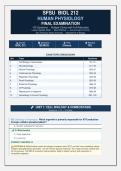
SFSU BIOL 212
HUMAN PHYSIOLOGY
FINAL EXAMINATION
100 Questions · Multiple-Choice with Full Rationales
Latest Update 2026 · Most Difficult — Actual Exam Format
San Francisco State University · Department of Biology
📚 Course 📋 Questions ⏱ Time 🎯 Passing
BIOL 212 100 MCQ 3 Hours 70%
EXAM TOPIC BREAKDOWN
Unit Topic Questions
1 Cell Biology & Homeostasis Q1–10
2 Neurophysiology Q11–22
3 Muscle Physiology Q23–31
4 Cardiovascular Physiology Q32–43
5 Respiratory Physiology Q44–54
6 Renal Physiology Q55–65
7 Endocrine Physiology Q66–74
8 GI Physiology Q75–82
9 Reproductive & Integrative Q83–90
10 Hematology & Immune Physiology Q91–100
🧬 UNIT 1: CELL BIOLOGY & HOMEOSTASIS
Questions 1–10 | 10 Points
Q1 [Cell Biology & Homeostasis] Which organelle is primarily responsible for ATP production
through oxidative phosphorylation?
A. Smooth endoplasmic reticulum
✔ B. Mitochondria
C. Golgi apparatus
D. Lysosome
CORRECT ANSWER: B
📖 RATIONALE: Mitochondria contain the electron transport chain (ETC) on their inner membrane, where
oxidative phosphorylation generates ~32–34 ATP per glucose molecule. The cristae increase surface area
for this process. The SER is involved in lipid synthesis, Golgi in protein sorting, and lysosomes in
intracellular digestion.
,Q2 [Cell Biology & Homeostasis] A patient's thermostat-like body temperature control system
detects a drop in core temperature and triggers shivering. This is an example of:
A. Positive feedback
B. Feedforward regulation
✔ C. Negative feedback
D. Paracrine signaling
CORRECT ANSWER: C
📖 RATIONALE: Negative feedback loops restore a variable to its set point by triggering a response
OPPOSITE to the perturbation. A drop in temperature triggers heat production (shivering,
vasoconstriction) until temperature returns to 37°C. Positive feedback amplifies the stimulus (e.g., oxytocin
during labor). Feedforward anticipates change before it occurs.
Q3 [Cell Biology & Homeostasis] The Na⁺/K⁺-ATPase pump moves ions against their
electrochemical gradient. This process is classified as:
A. Passive transport
B. Facilitated diffusion
✔ C. Primary active transport
D. Secondary active transport
CORRECT ANSWER: C
📖 RATIONALE: Primary active transport uses ATP directly to move ions against their gradient. Na⁺/K⁺-
ATPase pumps 3 Na⁺ out and 2 K⁺ in per ATP hydrolyzed, maintaining the resting membrane potential.
Secondary active transport (e.g., SGLT1) uses the gradient established by primary active transport to co-
transport another molecule.
Q4 [Cell Biology & Homeostasis] Osmolarity of normal plasma is approximately 290 mOsm/L.
If a red blood cell is placed in a 150 mOsm/L solution, what will occur?
A. The cell will crenate (shrink)
✔ B. The cell will lyse (burst)
C. No net water movement
D. The cell will undergo apoptosis
CORRECT ANSWER: B
📖 RATIONALE: A 150 mOsm/L solution is HYPOTONIC relative to the cell interior (~290 mOsm/L).
Water moves by osmosis DOWN its osmotic gradient — INTO the cell. The RBC swells and may lyse
(hemolysis). In a hypertonic solution (>290 mOsm/L), water leaves the cell causing crenation. Isotonic
solution (290 mOsm/L) produces no net movement.
Q5 [Cell Biology & Homeostasis] Which second messenger is produced when adenylyl
cyclase is activated by a Gs protein-coupled receptor?
A. IP3 (inositol trisphosphate)
B. DAG (diacylglycerol)
✔ C. cAMP (cyclic AMP)
, D. Calcium ions (Ca²⁺)
CORRECT ANSWER: C
📖 RATIONALE: Gs-coupled receptors activate adenylyl cyclase, which converts ATP to cAMP. cAMP
then activates protein kinase A (PKA), which phosphorylates numerous target proteins. Gq-coupled
receptors activate phospholipase C, generating IP3 and DAG. IP3 triggers Ca²⁺ release from the ER.
Q6 [Cell Biology & Homeostasis] Which type of epithelium is best adapted for absorption and
secretion, such as in the kidney tubules?
A. Stratified squamous
✔ B. Simple columnar
C. Pseudostratified ciliated columnar
D. Transitional
CORRECT ANSWER: B
📖 RATIONALE: Simple columnar epithelium (with microvilli/brush border) is specialized for absorption
and secretion due to its large surface area, single-cell layer for efficient transport, and numerous
mitochondria. Stratified squamous provides protection. Pseudostratified ciliated columnar lines the
respiratory tract for mucociliary clearance. Transitional epithelium allows distension (urinary bladder).
Q7 [Cell Biology & Homeostasis] A drug blocks gap junctions in cardiac muscle. What is the
most likely consequence?
A. Impaired enzyme secretion
✔ B. Uncoordinated cardiac contractions
C. Decreased hormone production
D. Reduced phagocytosis
CORRECT ANSWER: B
📖 RATIONALE: Gap junctions (connexons) directly connect adjacent cardiomyocytes cytoplasm,
allowing rapid electrical signal propagation. This is what makes the heart a functional syncytium — it
contracts as a coordinated unit. Blocking gap junctions disrupts electrical coupling, causing uncoordinated
(arrhythmic) contractions. Enzyme secretion involves exocytosis; hormones use the bloodstream.
Q8 [Cell Biology & Homeostasis] Intracellular receptors such as glucocorticoid receptors,
when activated, primarily:
A. Open ion channels
B. Activate membrane-bound enzymes
✔ C. Alter gene transcription
D. Increase cAMP production
CORRECT ANSWER: C
📖 RATIONALE: Steroid/thyroid hormones are lipid-soluble, so they diffuse through the plasma
membrane and bind intracellular (nuclear) receptors. The hormone-receptor complex acts as a
transcription factor, binding DNA response elements to upregulate or downregulate specific gene
expression. Effects are slow (hours) but prolonged compared to membrane receptor signaling.
, Q9 [Cell Biology & Homeostasis] Which component of the extracellular matrix is primarily
responsible for tensile strength in tendons and skin?
A. Elastin
B. Fibronectin
✔ C. Type I collagen
D. Hyaluronic acid
CORRECT ANSWER: C
📖 RATIONALE: Type I collagen is the most abundant protein in the human body and provides high
tensile strength. Triple helix collagen fibers resist stretching forces. Elastin provides elasticity (recoil).
Fibronectin mediates cell-ECM adhesion. Hyaluronic acid is a glycosaminoglycan that retains water,
providing compressive resistance in cartilage.
Q10 [Cell Biology & Homeostasis] The apical surface of cells in the proximal convoluted
tubule contains microvilli forming a brush border. The primary function of this adaptation
is to:
A. Increase secretory surface area
✔ B. Increase absorptive surface area
C. Facilitate paracellular transport
D. Provide structural support
CORRECT ANSWER: B
📖 RATIONALE: Microvilli increase the apical surface area approximately 20-fold, dramatically increasing
the membrane area available for transport proteins (e.g., Na⁺-glucose cotransporters, Na⁺-amino acid
cotransporters). This allows massive reabsorption of filtered solutes in the PCT — about 65–70% of
filtered Na⁺, glucose, and amino acids are reclaimed here.
HUMAN PHYSIOLOGY
FINAL EXAMINATION
100 Questions · Multiple-Choice with Full Rationales
Latest Update 2026 · Most Difficult — Actual Exam Format
San Francisco State University · Department of Biology
📚 Course 📋 Questions ⏱ Time 🎯 Passing
BIOL 212 100 MCQ 3 Hours 70%
EXAM TOPIC BREAKDOWN
Unit Topic Questions
1 Cell Biology & Homeostasis Q1–10
2 Neurophysiology Q11–22
3 Muscle Physiology Q23–31
4 Cardiovascular Physiology Q32–43
5 Respiratory Physiology Q44–54
6 Renal Physiology Q55–65
7 Endocrine Physiology Q66–74
8 GI Physiology Q75–82
9 Reproductive & Integrative Q83–90
10 Hematology & Immune Physiology Q91–100
🧬 UNIT 1: CELL BIOLOGY & HOMEOSTASIS
Questions 1–10 | 10 Points
Q1 [Cell Biology & Homeostasis] Which organelle is primarily responsible for ATP production
through oxidative phosphorylation?
A. Smooth endoplasmic reticulum
✔ B. Mitochondria
C. Golgi apparatus
D. Lysosome
CORRECT ANSWER: B
📖 RATIONALE: Mitochondria contain the electron transport chain (ETC) on their inner membrane, where
oxidative phosphorylation generates ~32–34 ATP per glucose molecule. The cristae increase surface area
for this process. The SER is involved in lipid synthesis, Golgi in protein sorting, and lysosomes in
intracellular digestion.
,Q2 [Cell Biology & Homeostasis] A patient's thermostat-like body temperature control system
detects a drop in core temperature and triggers shivering. This is an example of:
A. Positive feedback
B. Feedforward regulation
✔ C. Negative feedback
D. Paracrine signaling
CORRECT ANSWER: C
📖 RATIONALE: Negative feedback loops restore a variable to its set point by triggering a response
OPPOSITE to the perturbation. A drop in temperature triggers heat production (shivering,
vasoconstriction) until temperature returns to 37°C. Positive feedback amplifies the stimulus (e.g., oxytocin
during labor). Feedforward anticipates change before it occurs.
Q3 [Cell Biology & Homeostasis] The Na⁺/K⁺-ATPase pump moves ions against their
electrochemical gradient. This process is classified as:
A. Passive transport
B. Facilitated diffusion
✔ C. Primary active transport
D. Secondary active transport
CORRECT ANSWER: C
📖 RATIONALE: Primary active transport uses ATP directly to move ions against their gradient. Na⁺/K⁺-
ATPase pumps 3 Na⁺ out and 2 K⁺ in per ATP hydrolyzed, maintaining the resting membrane potential.
Secondary active transport (e.g., SGLT1) uses the gradient established by primary active transport to co-
transport another molecule.
Q4 [Cell Biology & Homeostasis] Osmolarity of normal plasma is approximately 290 mOsm/L.
If a red blood cell is placed in a 150 mOsm/L solution, what will occur?
A. The cell will crenate (shrink)
✔ B. The cell will lyse (burst)
C. No net water movement
D. The cell will undergo apoptosis
CORRECT ANSWER: B
📖 RATIONALE: A 150 mOsm/L solution is HYPOTONIC relative to the cell interior (~290 mOsm/L).
Water moves by osmosis DOWN its osmotic gradient — INTO the cell. The RBC swells and may lyse
(hemolysis). In a hypertonic solution (>290 mOsm/L), water leaves the cell causing crenation. Isotonic
solution (290 mOsm/L) produces no net movement.
Q5 [Cell Biology & Homeostasis] Which second messenger is produced when adenylyl
cyclase is activated by a Gs protein-coupled receptor?
A. IP3 (inositol trisphosphate)
B. DAG (diacylglycerol)
✔ C. cAMP (cyclic AMP)
, D. Calcium ions (Ca²⁺)
CORRECT ANSWER: C
📖 RATIONALE: Gs-coupled receptors activate adenylyl cyclase, which converts ATP to cAMP. cAMP
then activates protein kinase A (PKA), which phosphorylates numerous target proteins. Gq-coupled
receptors activate phospholipase C, generating IP3 and DAG. IP3 triggers Ca²⁺ release from the ER.
Q6 [Cell Biology & Homeostasis] Which type of epithelium is best adapted for absorption and
secretion, such as in the kidney tubules?
A. Stratified squamous
✔ B. Simple columnar
C. Pseudostratified ciliated columnar
D. Transitional
CORRECT ANSWER: B
📖 RATIONALE: Simple columnar epithelium (with microvilli/brush border) is specialized for absorption
and secretion due to its large surface area, single-cell layer for efficient transport, and numerous
mitochondria. Stratified squamous provides protection. Pseudostratified ciliated columnar lines the
respiratory tract for mucociliary clearance. Transitional epithelium allows distension (urinary bladder).
Q7 [Cell Biology & Homeostasis] A drug blocks gap junctions in cardiac muscle. What is the
most likely consequence?
A. Impaired enzyme secretion
✔ B. Uncoordinated cardiac contractions
C. Decreased hormone production
D. Reduced phagocytosis
CORRECT ANSWER: B
📖 RATIONALE: Gap junctions (connexons) directly connect adjacent cardiomyocytes cytoplasm,
allowing rapid electrical signal propagation. This is what makes the heart a functional syncytium — it
contracts as a coordinated unit. Blocking gap junctions disrupts electrical coupling, causing uncoordinated
(arrhythmic) contractions. Enzyme secretion involves exocytosis; hormones use the bloodstream.
Q8 [Cell Biology & Homeostasis] Intracellular receptors such as glucocorticoid receptors,
when activated, primarily:
A. Open ion channels
B. Activate membrane-bound enzymes
✔ C. Alter gene transcription
D. Increase cAMP production
CORRECT ANSWER: C
📖 RATIONALE: Steroid/thyroid hormones are lipid-soluble, so they diffuse through the plasma
membrane and bind intracellular (nuclear) receptors. The hormone-receptor complex acts as a
transcription factor, binding DNA response elements to upregulate or downregulate specific gene
expression. Effects are slow (hours) but prolonged compared to membrane receptor signaling.
, Q9 [Cell Biology & Homeostasis] Which component of the extracellular matrix is primarily
responsible for tensile strength in tendons and skin?
A. Elastin
B. Fibronectin
✔ C. Type I collagen
D. Hyaluronic acid
CORRECT ANSWER: C
📖 RATIONALE: Type I collagen is the most abundant protein in the human body and provides high
tensile strength. Triple helix collagen fibers resist stretching forces. Elastin provides elasticity (recoil).
Fibronectin mediates cell-ECM adhesion. Hyaluronic acid is a glycosaminoglycan that retains water,
providing compressive resistance in cartilage.
Q10 [Cell Biology & Homeostasis] The apical surface of cells in the proximal convoluted
tubule contains microvilli forming a brush border. The primary function of this adaptation
is to:
A. Increase secretory surface area
✔ B. Increase absorptive surface area
C. Facilitate paracellular transport
D. Provide structural support
CORRECT ANSWER: B
📖 RATIONALE: Microvilli increase the apical surface area approximately 20-fold, dramatically increasing
the membrane area available for transport proteins (e.g., Na⁺-glucose cotransporters, Na⁺-amino acid
cotransporters). This allows massive reabsorption of filtered solutes in the PCT — about 65–70% of
filtered Na⁺, glucose, and amino acids are reclaimed here.


