

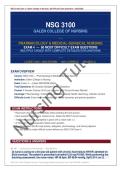
NSG 3100 Exam 4 | Galen College of Nursing | 80 Difficult Exam Questions | 2025/2026
NSG 3100
GALEN COLLEGE OF NURSING
━━━━━━━━━━━━━━━━━━━━━━━━━━━━━━━━━━━━━━━━━━━━━
━━
PHARMACOLOGY & MEDICAL-SURGICAL NURSING
EXAM 4 — 80 MOST DIFFICULT EXAM QUESTIONS
MULTIPLE CHOICE WITH COMPLETE DETAILED EXPLANATIONS
━━━━━━━━━━━━━━━━━━━━━━━━━━━━━━━━━━━━━━━━━━━━━
━━
LATEST EDITION · 100% CORRECT · GRADED A+
EXAM OVERVIEW
Course: NSG 3100 — Pharmacology & Medical-Surgical Nursing
Institution: Galen College of Nursing
Exam: Exam 4 — Latest 2025/2026 Edition
Total Questions: 80 Complex Multiple-Choice Questions
Format: 4 Answer Choices (A–D) per question with Correct Answer Marked
Coverage: Pharmacology, Critical Care, OB/Peds, Mental Health, Med-Surg, Infection Control
Difficulty Level: Exam-level complexity with clinical scenarios and priority questions
EXAM INSTRUCTIONS
• Read each clinical scenario carefully before selecting the best answer.
• Each question contains four choices (A–D). Select the MOST correct answer.
• The correct answer is highlighted in green with a check mark (✓).
• A thorough clinical explanation follows each question.
• Questions reflect NCLEX-style priority, delegation, pharmacology, and clinical judgment.
• Use this guide to master difficult content before your NSG 3100 Exam 4.
QUESTIONS & ANSWERS
Q · Cardiovascular Pharmacology — Beta-Blockers
A nurse is caring for a 64-year-old patient with chronic heart failure (HFrEF) admitted for
fluid overload. The patient is prescribed carvedilol 6.25 mg PO BID. While performing the
morning assessment, the nurse notes: HR 48 bpm, BP 88/54 mmHg, SpO2 91% on 2L
NSG 3100 | Galen College of Nursing | Pharmacology & Med-Surg Nursing | Exam Prep 2025/2026 | Graded A+
,NSG 3100 Exam 4 | Galen College of Nursing | 80 Difficult Exam Questions | 2025/2026
NC, and increasing dyspnea. The patient also reports feeling 'dizzy and weak.' Which
nursing action is the PRIORITY?
A. Administer the scheduled carvedilol dose, then notify the physician about the vital signs
after completion of medication administration
B. Withhold the carvedilol dose, place the patient in Trendelenburg position, and administer a
500 mL IV fluid bolus immediately
✓ C. Hold the carvedilol dose, notify the prescriber immediately of the heart rate, blood
pressure, SpO2 and symptoms, and continue monitoring
D. Administer atropine 0.5 mg IV push for symptomatic bradycardia per standing hospital
protocol before calling the physician
CORRECT ANSWER: Choice C
DETAILED EXPLANATION
Beta-blockers such as carvedilol (a non-selective beta-1, beta-2, and alpha-1 blocker) are first-line
therapy for HFrEF but carry the serious risk of bradycardia and hypotension, particularly during initiation
or dose titration. Generally accepted parameters for withholding a beta-blocker include a heart rate <
50–60 bpm and systolic BP < 90–100 mmHg — this patient has HR 48 and SBP 88, which clearly
warrant withholding the dose. The PRIORITY action following the nursing process is to withhold the drug
to prevent further cardiovascular depression, then promptly notify the prescriber with full assessment
data (HR, BP, SpO2, symptoms) so that a clinical decision can be made. Choice A is dangerous —
administering carvedilol when HR is 48 and SBP is 88 could precipitate hemodynamic collapse. Choice
B: Trendelenburg (head-down) is contraindicated in heart failure because it increases venous return and
preload, worsening pulmonary congestion; fluid bolus would also exacerbate fluid overload. Choice D:
Atropine requires a physician order in most settings and should not be administered before notifying the
prescriber, as the cause of bradycardia must first be evaluated. The priority follows: ASSESS → HOLD
drug → NOTIFY → MONITOR.
Q · Neurological Nursing — Increased Intracranial Pressure
A nurse in the neurological ICU is caring for a patient with a traumatic brain injury (GCS
7) on continuous ICP monitoring. The ICP has been ranging 18–22 mmHg. The nurse
notes a sudden spike to 38 mmHg sustained for 3 minutes. The patient's current MAP is
78 mmHg. Which intervention should the nurse implement FIRST?
A. Administer mannitol 1 g/kg IV as ordered and recheck ICP in 30 minutes
✓ B. Calculate the cerebral perfusion pressure (CPP) and notify the physician; ensure
HOB is at 30 degrees and head/neck in neutral alignment
C. Hyperventilate the patient to a PaCO2 of 30–35 mmHg using the manual resuscitation bag
D. Reposition the patient to the left lateral decubitus position to reduce venous compression
CORRECT ANSWER: Choice B
DETAILED EXPLANATION
Cerebral Perfusion Pressure (CPP) = MAP − ICP. With MAP 78 and ICP 38: CPP = 78 − 38 = 40 mmHg.
Normal CPP target for TBI is 60–70 mmHg (Brain Trauma Foundation guidelines). A CPP of 40 is
critically low and indicates severely compromised cerebral perfusion. The FIRST action must be to
calculate CPP and immediately notify the physician because urgent interventions are needed.
Concurrently, nurse-initiated ICP reduction measures include: maintaining HOB at 30–45 degrees
(reduces venous resistance and ICP), head/neck in neutral alignment (prevents jugular venous
obstruction), minimizing stimulation, and ensuring adequate sedation and analgesia. Choice A: Mannitol
is appropriate but requires a physician order verification and assessment of serum osmolality
(contraindicated if osmolality > 320 mOsm/kg) before administration. It is not the first independent
nursing action. Choice C: Prophylactic hyperventilation to PaCO2 30–35 mmHg is NO LONGER
recommended by current BTF guidelines because cerebral vasoconstriction from hypocapnia reduces
CBF and can worsen ischemia; brief hyperventilation may be used for acute herniation ONLY. Choice D:
NSG 3100 | Galen College of Nursing | Pharmacology & Med-Surg Nursing | Exam Prep 2025/2026 | Graded A+
,NSG 3100 Exam 4 | Galen College of Nursing | 80 Difficult Exam Questions | 2025/2026
Left lateral positioning is used for pregnant patients; for TBI, neutral alignment and 30-degree HOB
elevation are standard.
Q · Respiratory Nursing — ARDS / Mechanical Ventilation
A nurse is caring for a patient on mechanical ventilation for ARDS. Current settings:
FiO2 0.70, PEEP 12 cmH2O, Vt 400 mL (patient weight 80 kg), RR 22/min. Recent ABG:
pH 7.28, PaCO2 52 mmHg, PaO2 58 mmHg, HCO3 23 mEq/L, SpO2 88%. The physician
orders are to follow ARDS Network lung-protective ventilation protocol. Which ventilator
adjustment is MOST consistent with this protocol?
A. Increase tidal volume to 700 mL to improve minute ventilation and correct the hypercapnia
B. Decrease PEEP to 5 cmH2O to reduce barotrauma risk, and increase FiO2 to 1.0 to
improve oxygenation
✓ C. Maintain tidal volume at 6 mL/kg IBW (approximately 480 mL), accept permissive
hypercapnia, and titrate PEEP/FiO2 per the ARDSNet low-PEEP/FiO2 table to achieve SpO2
88–95%
D. Switch to pressure-control ventilation with an inspiratory pressure of 35 cmH2O to maximize
tidal volume delivery
CORRECT ANSWER: Choice C
DETAILED EXPLANATION
The ARDSNet lung-protective ventilation strategy (ARMA trial, 2000 — NEJM) demonstrated a 22%
reduction in mortality using: Tidal volume: 6 mL/kg Ideal Body Weight (IBW) — the patient at 80 kg IBW
should receive 480 mL Vt (currently at 400 mL, which is 5 mL/kg, also acceptable). Plateau pressure
goal: ≤ 30 cmH2O. Permissive hypercapnia: accepting PaCO2 up to 50–60+ mmHg to avoid
volutrauma/barotrauma — this patient's pH 7.28 with PaCO2 52 is acceptable under lung-protective
strategy. Oxygenation goal: SpO2 88–95% or PaO2 55–80 mmHg — SpO2 88% is acceptable.
PEEP/FiO2 tables guide titration. Choice A: Increasing Vt to 700 mL (8.75 mL/kg IBW) violates lung-
protective protocol, risks volutrauma and worsens VILI (ventilator-induced lung injury). Choice B:
Decreasing PEEP increases risk of atelectrauma (repeated alveolar collapse/re-expansion); PEEP of 12
is appropriate for this oxygenation failure; FiO2 1.0 increases oxygen toxicity risk. Choice D: Plateau
pressure of 35 cmH2O exceeds the 30 cmH2O limit; high peak pressures worsen barotrauma.
Q · Pharmacology — Anticoagulation Therapy
A patient on warfarin therapy for atrial fibrillation (target INR 2.0–3.0) presents to the
clinic. INR today is 5.8. The patient reports no active bleeding but notes easy bruising
and mild gum bleeding when brushing teeth. Warfarin dose is 5 mg daily. Which is the
MOST appropriate nursing action/expected intervention?
A. Administer vitamin K 10 mg IV push immediately to rapidly reverse the anticoagulation
✓ B. Withhold warfarin, educate on bleeding precautions, recheck INR in 24–48 hours; if
no active significant bleeding, low-dose oral vitamin K 1–2.5 mg may be prescribed
C. Continue the current warfarin dose and recheck INR in 1 week; minor gum bleeding is
expected with anticoagulation
D. Hold warfarin and administer fresh frozen plasma (FFP) immediately for the
supratherapeutic INR
CORRECT ANSWER: Choice B
DETAILED EXPLANATION
Management of elevated INR is guided by the presence or absence of active bleeding and the degree of
INR elevation. For INR 5–9 with no significant bleeding (minor bleeding like easy bruising/gum bleeding
is not considered 'significant' or 'life-threatening'): ACCP guidelines recommend: Holding warfarin 1–2
doses; Low-dose oral vitamin K (1–2.5 mg) can be given if there is a higher risk of bleeding; Close
NSG 3100 | Galen College of Nursing | Pharmacology & Med-Surg Nursing | Exam Prep 2025/2026 | Graded A+
, NSG 3100 Exam 4 | Galen College of Nursing | 80 Difficult Exam Questions | 2025/2026
follow-up with INR recheck in 24–48 hours; Patient education on bleeding precautions (soft toothbrush,
electric razor, fall precautions, when to seek emergency care). Choice A: IV vitamin K 10 mg would fully
reverse anticoagulation for 7–14 days (warfarin resistance), making re-anticoagulation for AFib very
difficult. IV vitamin K is reserved for INR > 10 with bleeding or INR > 20. Additionally, IV vitamin K can
cause anaphylaxis. Choice C: Continuing warfarin at the same dose with INR of 5.8 puts the patient at
high bleeding risk — this is negligent. Choice D: FFP is used for immediate reversal needed for active
severe bleeding or emergency surgery; inappropriate for a supratherapeutic INR without significant
active bleeding due to risks of volume overload, transfusion reactions, and infection.
Q · Endocrine Nursing — Diabetic Ketoacidosis (DKA)
A 22-year-old patient with Type 1 DM is admitted with DKA. Labs: glucose 520 mg/dL, K+
3.2 mEq/L, Na+ 132 mEq/L, pH 7.18, HCO3 9 mEq/L, anion gap 28, urine ketones large.
The patient is confused, HR 128, BP 94/62. IV access is established and orders are
received. Which sequence of interventions reflects the CORRECT priority order for DKA
management?
A. Begin insulin drip at 0.1 units/kg/hr → IV fluid bolus NS 1L → potassium replacement →
sodium bicarbonate for acidosis
✓ B. IV fluid resuscitation with NS (1–1.5 L/hr initially) → potassium replacement to
achieve K+ ≥ 3.5 before insulin → begin insulin infusion → reassess and titrate
C. Administer sodium bicarbonate 50 mEq IV immediately → IV fluids → insulin drip →
potassium when urine output established
D. Begin insulin drip at 0.2 units/kg/hr → normal saline 250 mL/hr → hold potassium until
repeat labs in 4 hours
CORRECT ANSWER: Choice B
DETAILED EXPLANATION
DKA management follows a precise priority sequence critically important for nursing practice: STEP 1 —
IV Fluid Resuscitation FIRST: Patients with DKA are severely volume depleted (3–6L deficit). Normal
saline 0.9% at 1–1.5 L/hr for the first 1–2 hours is the critical first intervention to restore perfusion, not
only treating hypovolemia but also facilitating renal clearance of ketones and helping lower glucose.
STEP 2 — Potassium Replacement BEFORE insulin: This patient's K+ is 3.2 mEq/L. DKA causes
profound total body potassium depletion (despite serum levels that may appear normal or elevated due
to acidosis shifting K+ extracellularly). Insulin drives K+ INTO cells, causing potentially fatal
hypokalemia. The standard of care requires K+ ≥ 3.5 mEq/L before insulin is started. STEP 3 — Insulin
infusion: 0.1 units/kg/hr regular insulin IV after K+ is ≥ 3.5. Choice A reverses critical order — starting
insulin before potassium replacement with K+ 3.2 can precipitate life-threatening hypokalemia and
cardiac arrhythmias. Choice C: NaHCO3 is controversial and generally not recommended unless pH <
6.9 because it can cause paradoxical CSF acidosis, worsen hypokalemia, and delay ketone clearance.
This patient's pH is 7.18, not low enough for bicarb. Choice D: Withholding potassium for 4 hours while
running insulin is dangerous with K+ already 3.2.
Q · Pharmacology — Opioid Analgesics & Respiratory Depression
A post-operative patient received morphine 4 mg IV for pain 45 minutes ago. The nurse
enters the room and finds the patient with a RR of 6 breaths/min, SpO2 84%, responds
only to sternal rub, and lips are cyanotic. What is the nurse's PRIORITY action
sequence?
A. Apply 100% non-rebreather mask → call rapid response → prepare naloxone 0.4 mg IV
B. Call the physician for orders → apply oxygen → document the assessment findings
✓ C. Stimulate the patient vigorously → apply supplemental oxygen → administer
naloxone 0.4–2 mg IV/IM, titrate → call rapid response team
NSG 3100 | Galen College of Nursing | Pharmacology & Med-Surg Nursing | Exam Prep 2025/2026 | Graded A+
NSG 3100
GALEN COLLEGE OF NURSING
━━━━━━━━━━━━━━━━━━━━━━━━━━━━━━━━━━━━━━━━━━━━━
━━
PHARMACOLOGY & MEDICAL-SURGICAL NURSING
EXAM 4 — 80 MOST DIFFICULT EXAM QUESTIONS
MULTIPLE CHOICE WITH COMPLETE DETAILED EXPLANATIONS
━━━━━━━━━━━━━━━━━━━━━━━━━━━━━━━━━━━━━━━━━━━━━
━━
LATEST EDITION · 100% CORRECT · GRADED A+
EXAM OVERVIEW
Course: NSG 3100 — Pharmacology & Medical-Surgical Nursing
Institution: Galen College of Nursing
Exam: Exam 4 — Latest 2025/2026 Edition
Total Questions: 80 Complex Multiple-Choice Questions
Format: 4 Answer Choices (A–D) per question with Correct Answer Marked
Coverage: Pharmacology, Critical Care, OB/Peds, Mental Health, Med-Surg, Infection Control
Difficulty Level: Exam-level complexity with clinical scenarios and priority questions
EXAM INSTRUCTIONS
• Read each clinical scenario carefully before selecting the best answer.
• Each question contains four choices (A–D). Select the MOST correct answer.
• The correct answer is highlighted in green with a check mark (✓).
• A thorough clinical explanation follows each question.
• Questions reflect NCLEX-style priority, delegation, pharmacology, and clinical judgment.
• Use this guide to master difficult content before your NSG 3100 Exam 4.
QUESTIONS & ANSWERS
Q · Cardiovascular Pharmacology — Beta-Blockers
A nurse is caring for a 64-year-old patient with chronic heart failure (HFrEF) admitted for
fluid overload. The patient is prescribed carvedilol 6.25 mg PO BID. While performing the
morning assessment, the nurse notes: HR 48 bpm, BP 88/54 mmHg, SpO2 91% on 2L
NSG 3100 | Galen College of Nursing | Pharmacology & Med-Surg Nursing | Exam Prep 2025/2026 | Graded A+
,NSG 3100 Exam 4 | Galen College of Nursing | 80 Difficult Exam Questions | 2025/2026
NC, and increasing dyspnea. The patient also reports feeling 'dizzy and weak.' Which
nursing action is the PRIORITY?
A. Administer the scheduled carvedilol dose, then notify the physician about the vital signs
after completion of medication administration
B. Withhold the carvedilol dose, place the patient in Trendelenburg position, and administer a
500 mL IV fluid bolus immediately
✓ C. Hold the carvedilol dose, notify the prescriber immediately of the heart rate, blood
pressure, SpO2 and symptoms, and continue monitoring
D. Administer atropine 0.5 mg IV push for symptomatic bradycardia per standing hospital
protocol before calling the physician
CORRECT ANSWER: Choice C
DETAILED EXPLANATION
Beta-blockers such as carvedilol (a non-selective beta-1, beta-2, and alpha-1 blocker) are first-line
therapy for HFrEF but carry the serious risk of bradycardia and hypotension, particularly during initiation
or dose titration. Generally accepted parameters for withholding a beta-blocker include a heart rate <
50–60 bpm and systolic BP < 90–100 mmHg — this patient has HR 48 and SBP 88, which clearly
warrant withholding the dose. The PRIORITY action following the nursing process is to withhold the drug
to prevent further cardiovascular depression, then promptly notify the prescriber with full assessment
data (HR, BP, SpO2, symptoms) so that a clinical decision can be made. Choice A is dangerous —
administering carvedilol when HR is 48 and SBP is 88 could precipitate hemodynamic collapse. Choice
B: Trendelenburg (head-down) is contraindicated in heart failure because it increases venous return and
preload, worsening pulmonary congestion; fluid bolus would also exacerbate fluid overload. Choice D:
Atropine requires a physician order in most settings and should not be administered before notifying the
prescriber, as the cause of bradycardia must first be evaluated. The priority follows: ASSESS → HOLD
drug → NOTIFY → MONITOR.
Q · Neurological Nursing — Increased Intracranial Pressure
A nurse in the neurological ICU is caring for a patient with a traumatic brain injury (GCS
7) on continuous ICP monitoring. The ICP has been ranging 18–22 mmHg. The nurse
notes a sudden spike to 38 mmHg sustained for 3 minutes. The patient's current MAP is
78 mmHg. Which intervention should the nurse implement FIRST?
A. Administer mannitol 1 g/kg IV as ordered and recheck ICP in 30 minutes
✓ B. Calculate the cerebral perfusion pressure (CPP) and notify the physician; ensure
HOB is at 30 degrees and head/neck in neutral alignment
C. Hyperventilate the patient to a PaCO2 of 30–35 mmHg using the manual resuscitation bag
D. Reposition the patient to the left lateral decubitus position to reduce venous compression
CORRECT ANSWER: Choice B
DETAILED EXPLANATION
Cerebral Perfusion Pressure (CPP) = MAP − ICP. With MAP 78 and ICP 38: CPP = 78 − 38 = 40 mmHg.
Normal CPP target for TBI is 60–70 mmHg (Brain Trauma Foundation guidelines). A CPP of 40 is
critically low and indicates severely compromised cerebral perfusion. The FIRST action must be to
calculate CPP and immediately notify the physician because urgent interventions are needed.
Concurrently, nurse-initiated ICP reduction measures include: maintaining HOB at 30–45 degrees
(reduces venous resistance and ICP), head/neck in neutral alignment (prevents jugular venous
obstruction), minimizing stimulation, and ensuring adequate sedation and analgesia. Choice A: Mannitol
is appropriate but requires a physician order verification and assessment of serum osmolality
(contraindicated if osmolality > 320 mOsm/kg) before administration. It is not the first independent
nursing action. Choice C: Prophylactic hyperventilation to PaCO2 30–35 mmHg is NO LONGER
recommended by current BTF guidelines because cerebral vasoconstriction from hypocapnia reduces
CBF and can worsen ischemia; brief hyperventilation may be used for acute herniation ONLY. Choice D:
NSG 3100 | Galen College of Nursing | Pharmacology & Med-Surg Nursing | Exam Prep 2025/2026 | Graded A+
,NSG 3100 Exam 4 | Galen College of Nursing | 80 Difficult Exam Questions | 2025/2026
Left lateral positioning is used for pregnant patients; for TBI, neutral alignment and 30-degree HOB
elevation are standard.
Q · Respiratory Nursing — ARDS / Mechanical Ventilation
A nurse is caring for a patient on mechanical ventilation for ARDS. Current settings:
FiO2 0.70, PEEP 12 cmH2O, Vt 400 mL (patient weight 80 kg), RR 22/min. Recent ABG:
pH 7.28, PaCO2 52 mmHg, PaO2 58 mmHg, HCO3 23 mEq/L, SpO2 88%. The physician
orders are to follow ARDS Network lung-protective ventilation protocol. Which ventilator
adjustment is MOST consistent with this protocol?
A. Increase tidal volume to 700 mL to improve minute ventilation and correct the hypercapnia
B. Decrease PEEP to 5 cmH2O to reduce barotrauma risk, and increase FiO2 to 1.0 to
improve oxygenation
✓ C. Maintain tidal volume at 6 mL/kg IBW (approximately 480 mL), accept permissive
hypercapnia, and titrate PEEP/FiO2 per the ARDSNet low-PEEP/FiO2 table to achieve SpO2
88–95%
D. Switch to pressure-control ventilation with an inspiratory pressure of 35 cmH2O to maximize
tidal volume delivery
CORRECT ANSWER: Choice C
DETAILED EXPLANATION
The ARDSNet lung-protective ventilation strategy (ARMA trial, 2000 — NEJM) demonstrated a 22%
reduction in mortality using: Tidal volume: 6 mL/kg Ideal Body Weight (IBW) — the patient at 80 kg IBW
should receive 480 mL Vt (currently at 400 mL, which is 5 mL/kg, also acceptable). Plateau pressure
goal: ≤ 30 cmH2O. Permissive hypercapnia: accepting PaCO2 up to 50–60+ mmHg to avoid
volutrauma/barotrauma — this patient's pH 7.28 with PaCO2 52 is acceptable under lung-protective
strategy. Oxygenation goal: SpO2 88–95% or PaO2 55–80 mmHg — SpO2 88% is acceptable.
PEEP/FiO2 tables guide titration. Choice A: Increasing Vt to 700 mL (8.75 mL/kg IBW) violates lung-
protective protocol, risks volutrauma and worsens VILI (ventilator-induced lung injury). Choice B:
Decreasing PEEP increases risk of atelectrauma (repeated alveolar collapse/re-expansion); PEEP of 12
is appropriate for this oxygenation failure; FiO2 1.0 increases oxygen toxicity risk. Choice D: Plateau
pressure of 35 cmH2O exceeds the 30 cmH2O limit; high peak pressures worsen barotrauma.
Q · Pharmacology — Anticoagulation Therapy
A patient on warfarin therapy for atrial fibrillation (target INR 2.0–3.0) presents to the
clinic. INR today is 5.8. The patient reports no active bleeding but notes easy bruising
and mild gum bleeding when brushing teeth. Warfarin dose is 5 mg daily. Which is the
MOST appropriate nursing action/expected intervention?
A. Administer vitamin K 10 mg IV push immediately to rapidly reverse the anticoagulation
✓ B. Withhold warfarin, educate on bleeding precautions, recheck INR in 24–48 hours; if
no active significant bleeding, low-dose oral vitamin K 1–2.5 mg may be prescribed
C. Continue the current warfarin dose and recheck INR in 1 week; minor gum bleeding is
expected with anticoagulation
D. Hold warfarin and administer fresh frozen plasma (FFP) immediately for the
supratherapeutic INR
CORRECT ANSWER: Choice B
DETAILED EXPLANATION
Management of elevated INR is guided by the presence or absence of active bleeding and the degree of
INR elevation. For INR 5–9 with no significant bleeding (minor bleeding like easy bruising/gum bleeding
is not considered 'significant' or 'life-threatening'): ACCP guidelines recommend: Holding warfarin 1–2
doses; Low-dose oral vitamin K (1–2.5 mg) can be given if there is a higher risk of bleeding; Close
NSG 3100 | Galen College of Nursing | Pharmacology & Med-Surg Nursing | Exam Prep 2025/2026 | Graded A+
, NSG 3100 Exam 4 | Galen College of Nursing | 80 Difficult Exam Questions | 2025/2026
follow-up with INR recheck in 24–48 hours; Patient education on bleeding precautions (soft toothbrush,
electric razor, fall precautions, when to seek emergency care). Choice A: IV vitamin K 10 mg would fully
reverse anticoagulation for 7–14 days (warfarin resistance), making re-anticoagulation for AFib very
difficult. IV vitamin K is reserved for INR > 10 with bleeding or INR > 20. Additionally, IV vitamin K can
cause anaphylaxis. Choice C: Continuing warfarin at the same dose with INR of 5.8 puts the patient at
high bleeding risk — this is negligent. Choice D: FFP is used for immediate reversal needed for active
severe bleeding or emergency surgery; inappropriate for a supratherapeutic INR without significant
active bleeding due to risks of volume overload, transfusion reactions, and infection.
Q · Endocrine Nursing — Diabetic Ketoacidosis (DKA)
A 22-year-old patient with Type 1 DM is admitted with DKA. Labs: glucose 520 mg/dL, K+
3.2 mEq/L, Na+ 132 mEq/L, pH 7.18, HCO3 9 mEq/L, anion gap 28, urine ketones large.
The patient is confused, HR 128, BP 94/62. IV access is established and orders are
received. Which sequence of interventions reflects the CORRECT priority order for DKA
management?
A. Begin insulin drip at 0.1 units/kg/hr → IV fluid bolus NS 1L → potassium replacement →
sodium bicarbonate for acidosis
✓ B. IV fluid resuscitation with NS (1–1.5 L/hr initially) → potassium replacement to
achieve K+ ≥ 3.5 before insulin → begin insulin infusion → reassess and titrate
C. Administer sodium bicarbonate 50 mEq IV immediately → IV fluids → insulin drip →
potassium when urine output established
D. Begin insulin drip at 0.2 units/kg/hr → normal saline 250 mL/hr → hold potassium until
repeat labs in 4 hours
CORRECT ANSWER: Choice B
DETAILED EXPLANATION
DKA management follows a precise priority sequence critically important for nursing practice: STEP 1 —
IV Fluid Resuscitation FIRST: Patients with DKA are severely volume depleted (3–6L deficit). Normal
saline 0.9% at 1–1.5 L/hr for the first 1–2 hours is the critical first intervention to restore perfusion, not
only treating hypovolemia but also facilitating renal clearance of ketones and helping lower glucose.
STEP 2 — Potassium Replacement BEFORE insulin: This patient's K+ is 3.2 mEq/L. DKA causes
profound total body potassium depletion (despite serum levels that may appear normal or elevated due
to acidosis shifting K+ extracellularly). Insulin drives K+ INTO cells, causing potentially fatal
hypokalemia. The standard of care requires K+ ≥ 3.5 mEq/L before insulin is started. STEP 3 — Insulin
infusion: 0.1 units/kg/hr regular insulin IV after K+ is ≥ 3.5. Choice A reverses critical order — starting
insulin before potassium replacement with K+ 3.2 can precipitate life-threatening hypokalemia and
cardiac arrhythmias. Choice C: NaHCO3 is controversial and generally not recommended unless pH <
6.9 because it can cause paradoxical CSF acidosis, worsen hypokalemia, and delay ketone clearance.
This patient's pH is 7.18, not low enough for bicarb. Choice D: Withholding potassium for 4 hours while
running insulin is dangerous with K+ already 3.2.
Q · Pharmacology — Opioid Analgesics & Respiratory Depression
A post-operative patient received morphine 4 mg IV for pain 45 minutes ago. The nurse
enters the room and finds the patient with a RR of 6 breaths/min, SpO2 84%, responds
only to sternal rub, and lips are cyanotic. What is the nurse's PRIORITY action
sequence?
A. Apply 100% non-rebreather mask → call rapid response → prepare naloxone 0.4 mg IV
B. Call the physician for orders → apply oxygen → document the assessment findings
✓ C. Stimulate the patient vigorously → apply supplemental oxygen → administer
naloxone 0.4–2 mg IV/IM, titrate → call rapid response team
NSG 3100 | Galen College of Nursing | Pharmacology & Med-Surg Nursing | Exam Prep 2025/2026 | Graded A+


