John Keats
Note: This guide only includes ‘Isabella’, ‘La Belle Dame Sans Merci’, and ‘Lamia’. I found that these poems
provide sufficient content for all the aspects of tragedy, so I didn’t learn examples from ‘The Eve of St. Agnes’.
For each aspect, I only learnt examples from two of these three poems, as this gives enough content to answer
an essay question!
The quotes from each are coloured as following: Isabella, La Belle Dame Sans Merci, Lamia.
Tragic protagonist
In classical tragedy, the tragic protagonist is usually a male, public figure who brings suffering or change to his society
following his death.
In Isabella, Isabella’s name is the title of the poem, typical of the tragic protagonist. Her death and her high social status,
(which is shown, among other things, by references her pass-times of lute-playing and embroidery) are also typical. Her
detachment from her status is a form of peripeteia. However – she is female. This makes her an unusual tragic protagonist.
Her death is also unusual – it is described casually (and so she pined, and so she died), showing that she does not cause
huge change to society.
In La Belle Dame Sans Merci, the protagonist is a knight-at-arms. This links him to the past, as well as classical tragedy, and
gives him megalopsychia as a member of the nobility. However, unlike a typical tragic protagonist, he doesn’t die – the
circular structure of the poem prevents this.
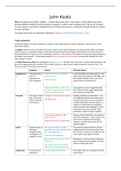
Definition Quotes What this tells us
Megalopsychi The ‘greatness of Stoop, Hermes, let me breathe Lamia is god-liked and supernatural – this
a spirit’ or upon thy brow. quote references Genesis in the Bible, and
importance of the creation of Adam. She is even more
High-thoughted
the protagonist. powerful than the god Hermes.
A descended Pleiad…/ Here, upon Lamia agrees to Lycius’ suggestion that
this floor of clay and pain, my steps she is from the stars, again showing that
upon these flowers rough. she is superior and god-like.
Hamartia The tragic or fatal Asking for her lost Basil amorously Isabella’s fatal flaw is materialism – she
flaw, a character can’t differentiate between material and
Her Basil sweet
defect that leads romantic love. Keats uses her worship of
to peripeteia. an object (fetishism) and later death as a
criticism of materialism and capitalism,
which romantics were opposed to. This is
furthered by his choice of basil, which
symbolises wealth in folklore tradition.
And she forgot the stars, the Because of this materialism, she begins to
moon, the sun reject life and nature – all she values is the
basil. Keats emphasises this through
Seldom did she go to chapel shrift
anaphora, and also shows that she has
rejected religion.
Hubris Excessive pride of Her eyes were wild… I made a The woman is natural and free, but the
the tragic garland for her head, and bracelets knight assumes he has more power than
protagonist that too, and fragrant zone her. He tries to control or shackle her. The
foreshadows the ‘zone’ (belt) could suggest chastity.
I shut her wild, wild eyes
tragedy to come.
What mortal hath a prize… let my Although he is not the tragic protagonist,
foes choke… Lycius is hubristic and arrogant. He wants
others to think well of him.
She could never win his foolish
heart from its mad pompousness
Anagnorisis The moment of I awoke and found me here The knight wakes up, breaking free of the
realisation/ enchantment.