TEST BANK
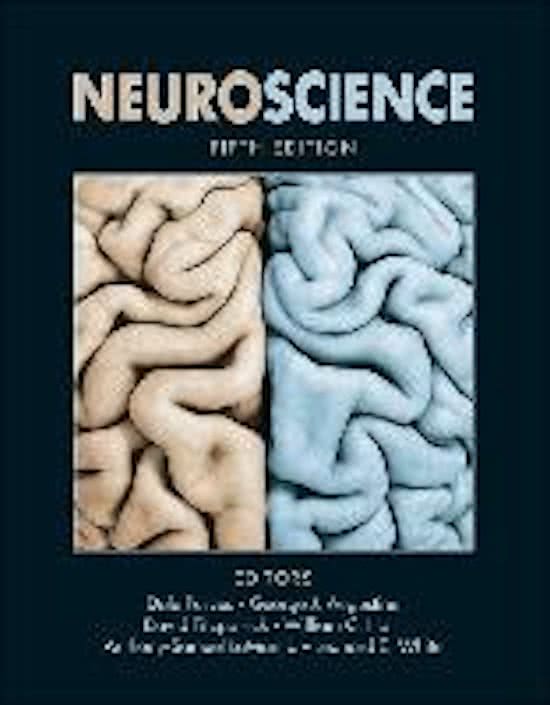
Neuroscience / Edition 6 by Dale Purves Test Bank
Table of Contents:
Chapter 1. Studying the Nervous System
Chapter 2. Electrical Signals of Nerve Cells
NEUROSCIENCE/6TH EDITION Chapter 3. Voltage-Dependent Membrane Permeability
Chapter 4. Ion Channels and Transporters
By: Dale Purves, George J. Augustine, David Fitzpatrick, William C. Hall, Anthony-Samuel LaMantia Chapter 5. Synaptic Transmission
Chapter 6. Neurotransmitters and Their Receptors
Chapter 7. Molecular Signaling within Neurons
Chapter 8. Synaptic Plasticity
Chapter 9. The Somatosensory System: Touch and Proprioception
Chapter 10. Pain
K
K
Chapter 11. Vision: The Eye
Chapter 12. Central Visual Pathways
Chapter 13. The Auditory System
N
N
Chapter 14. The Vestibular System
Chapter 15. The Chemical Senses
A
A
Chapter 16. Lower Motor Neuron Circuits and Motor Control
Chapter 17. Upper Motor Neuron Control of the Brainstem and Spinal Cord
Chapter 18. Modulation of Movement by the Basal Ganglia
R
R
Chapter 19. Modulation of Movement by the Cerebellum
Chapter 20. Eye Movements and Sensory Motor Integration
F
F
Chapter 21. The Visceral Motor System
Chapter 22. Early Brain Development
Chapter 23. Construction of Neural Circuits
Chapter 24. Circuit Differentiation: Intrinsic Factors and Sex Differences
Chapter 25. Experience-Dependent Plasticity in the Developing Brain
Chapter 26. Repair and Regeneration in the Nervous System
Chapter 27. Cognitive Functions and the Organization of the Cerebral Cortex
Chapter 28. Cortical States
Chapter 29. Attention
Chapter 30. Memory
Chapter 31. Emotion
Chapter 32. Thinking, Planning, and Deciding
Chapter 33. Speech and Language
Chapter 34. Development and Evolution of Cognitive Functions
TEST BANK
, Test Bank e. Camillo Golgi and Santiago Ramón y Cajal.
to accompany Answer: d
Neuroscience, Sixth Edition Textbook Reference: Cellular Components of the Nervous System
Purves • Augustine • Fitzpatrick • Hall • LaMantia • Mooney • Platt • White Bloom’s Level: 1. Remembering
5. Which function is a characteristic primarily of neurons only, and not glia?
Chapter 1: Studying the Nervous System
a. Transmits action potentials
b. Supports electrical signals
c. Repairs the nervous system
Multiple Choice
d. Prevents regeneration of the nervous system
e. Produces myelin
1. Which part of DNA is transcribed into messenger RNA?
Answer: a
a. Exon
Textbook Reference: Cellular Components of the Nervous System
b. Intron
Bloom’s Level: 1. Remembering
c. Promoter
d. Non-coding DNA
6. In which part of a neuron would most of the endoplasmic reticulum be concentrated?
e. Regulatory DNA
K
K
a. Postsynaptic terminal
Answer: a
b. Presynaptic terminal
Textbook Reference: Genetics and Genomics
c. Axon
Bloom’s Level: 2. Understanding
N
N
d. Cell body
e. Dendrite
2. Genomics is the analysis of
Answer: d
a. coding DNA sequences for a species.
Textbook Reference: Cellular Components of the Nervous System
A
A
b. regulatory DNA sequences for an individual organism and a species.
Bloom’s Level: 1. Remembering
c. coding and regulatory DNA sequences for a species.
d. coding and regulatory DNA sequences for an individual organism.
7. Which intracellular component facilitates the processes of endocytosis and exocytosis
R
R
e. coding and regulatory DNA of an individual organism or a species.
underlying synaptic communication?
Answer: e
a. Mitochondria
Textbook Reference: Genetics and Genomics
b. Endoplasmic reticulum
Bloom’s Level: 1. Remembering
F
F
c. Cytoskeleton
d. Golgi apparatus
3. Which of Camillo Golgi’s contributions enabled Santiago Ramón y Cajal to make
e. Nucleus
observations that suggested that nerve cells are discrete entities?
Answer: c
a. Articulation of the neuron doctrine
Textbook Reference: Cellular Components of the Nervous System
b. Identifying the organelle later called the Golgi apparatus
Bloom’s Level: 2. Understanding
c. Development of a staining method based on impregnation with silver salts
d. Improving the understanding of the pathophysiology of malaria
8. Most neurons have
e. Articulation of the reticular theory of nerve cell communication
a. one axon hillock (initial segment).
Answer: c
b. multiple axon hillocks (initial segments).
Textbook Reference: Cellular Components of the Nervous System
c. one dendrite.
Bloom’s Level: 2. Understanding
d. one axon hillock (initial segment) and one dendrite.
e. multiple axon hillocks (initial segments) and one dendrite.
4. The major proponent(s) of the neuron doctrine was(were)
Answer: a
a. Camillo Golgi.
Textbook Reference: Neurons
b. Santiago Ramón y Cajal.
Bloom’s Level: 1. Remembering
c. Charles Sherrington.
d. Santiago Ramón y Cajal and Charles Sherrington.
,9. Which statement best describes the function of a neuron with multiple, highly d. terminal bouton.
branched dendrites and one axon? e. receptor.
a. It passes information directly to multiple neurons. Answer: e
b. It cannot integrate information from multiple neurons. Textbook Reference: Neurons
c. It receives information from only one other neuron. Bloom’s Level: 1. Remembering
d. It integrates information from many neurons.
e. The information it receives will not be relayed. 14. Which cell produces myelin in the nerves of the peripheral nervous system?
Answer: d a. Astrocyte
Textbook Reference: Neurons b. Neuron
Bloom’s Level: 3. Applying c. Schwann cell
d. Microglia
10. Which statement best describes most neurons? e. Neural progenitor cell
a. They receive information via axons. Answer: c
b. They transmit information to other cells via dendrites. Textbook Reference: Glial Cells
c. They are polarized. Bloom’s Level: 1. Remembering
d. They conduct signals bidirectionally.
K
K
e. They transmit electrical signals via cytoplasmic continuity. 15. Which glial cell type serves as a resident immune cell in the central nervous system?
Answer: c a. Glial stem cell
Textbook Reference: Neurons b. Astrocyte
N
N
Bloom’s Level: 3. Applying c. Microglia
d. Oligodendrocyte
11. Compared with projection neurons, axons of local circuit neurons (interneurons) e. Schwann cell
a. are longer. Answer: c
A
A
b. are shorter. Textbook Reference: Glial Cells
c. have more synapses. Bloom’s Level: 1. Remembering
d. have more branches.
R
R
e. reach more postsynaptic neurons. 16. In the mature central nervous system, glial stem cells with the properties of astrocytes
Answer: b can give rise to
Textbook Reference: Neurons a. astrocytes.
F
F
Bloom’s Level: 2. Understanding b. neurons.
c. oligodendrocytes.
12. An action potential is a(n) change in the electrical potential across the nerve d. astrocytes and oligodendrocytes.
cell membrane. e. astrocytes, oligodendrocytes, and neurons.
a. single Answer: e
b. all-or-nothing Textbook Reference: Glial Cells
c. permanent Bloom’s Level: 1. Remembering
d. random
e. unidirectional 17. Refer to the figure.
Answer: b
Textbook Reference: Neurons
Bloom’s Level: 1. Remembering
13. The part of a synapse to which the contents of synaptic vesicles bind is called the
a. presynaptic terminal.
b. synaptic ending.
c. axon terminal.
, 20. What is the role of interneurons in the knee-jerk reflex?
a. Inhibition of motor neurons to all leg muscles
b. Amplification of the response
c. Dampen the pain of the hammer tap
d. Relaxation of flexor muscles
e. Transfer of signal from efferent to afferent neurons
Answer: d
Textbook Reference: Neural Circuits
Bloom’s Level: 2. Understanding
K 21. Refer to the figure.
K
Which method was used to visualize the retinal neurons shown?
a. Cresyl violet staining
b. Intracellular injection of a fluorescent dye
N
N
c. Intracellular injection of an enzyme
d. Silver impregnation (the Golgi method)
e. Nissl stain
A
A
Answer: b
Textbook Reference: Cellular Diversity in the Nervous System
Bloom’s Level: 3. Applying
R
R
18. The in situ hybridization method is based on
a. labeling specific neuronal components with antibodies.
The figure shows patterns of action potentials (vertical lines) in neurons that form the
b. using nucleic acid probes to detect mRNAs that encode specific genes.
F
F
neural circuits for the knee-jerk reflex. Which pattern represents the activity of a flexor
c. using nucleic acid probes to detect specific proteins.
motor neuron?
d. injecting a fluorescent dye into a neuron.
a. Top
e. formation of an insoluble colored product within cell bodies.
b. Second from the top
Answer: b
c. Third from the top
Textbook Reference: Cellular Diversity in the Nervous System
d. Bottom
Bloom’s Level: 1. Remembering
e. None of the above
Answer: d
19. In the knee-jerk reflex, the afferent neurons
Textbook Reference: Neural Circuits
a. innervate leg flexor muscles.
Bloom’s Level: 4. Analyzing
b. innervate leg flexor and extensor muscles.
c. innervate leg extensor muscles.
22. Which component represents the peripheral nervous system?
d. are sensory neurons.
e. are cranial nerves. a. Nucleus (i.e., group of neurons)
b. Spinal nerve
Answer: d
c. Tract
Textbook Reference: Neural Circuits
d. Column
Bloom’s Level: 2. Understanding
e. Commissure
Answer: b
Neuroscience / Edition 6 by Dale Purves Test Bank
Table of Contents:
Chapter 1. Studying the Nervous System
Chapter 2. Electrical Signals of Nerve Cells
NEUROSCIENCE/6TH EDITION Chapter 3. Voltage-Dependent Membrane Permeability
Chapter 4. Ion Channels and Transporters
By: Dale Purves, George J. Augustine, David Fitzpatrick, William C. Hall, Anthony-Samuel LaMantia Chapter 5. Synaptic Transmission
Chapter 6. Neurotransmitters and Their Receptors
Chapter 7. Molecular Signaling within Neurons
Chapter 8. Synaptic Plasticity
Chapter 9. The Somatosensory System: Touch and Proprioception
Chapter 10. Pain
K
K
Chapter 11. Vision: The Eye
Chapter 12. Central Visual Pathways
Chapter 13. The Auditory System
N
N
Chapter 14. The Vestibular System
Chapter 15. The Chemical Senses
A
A
Chapter 16. Lower Motor Neuron Circuits and Motor Control
Chapter 17. Upper Motor Neuron Control of the Brainstem and Spinal Cord
Chapter 18. Modulation of Movement by the Basal Ganglia
R
R
Chapter 19. Modulation of Movement by the Cerebellum
Chapter 20. Eye Movements and Sensory Motor Integration
F
F
Chapter 21. The Visceral Motor System
Chapter 22. Early Brain Development
Chapter 23. Construction of Neural Circuits
Chapter 24. Circuit Differentiation: Intrinsic Factors and Sex Differences
Chapter 25. Experience-Dependent Plasticity in the Developing Brain
Chapter 26. Repair and Regeneration in the Nervous System
Chapter 27. Cognitive Functions and the Organization of the Cerebral Cortex
Chapter 28. Cortical States
Chapter 29. Attention
Chapter 30. Memory
Chapter 31. Emotion
Chapter 32. Thinking, Planning, and Deciding
Chapter 33. Speech and Language
Chapter 34. Development and Evolution of Cognitive Functions
TEST BANK
, Test Bank e. Camillo Golgi and Santiago Ramón y Cajal.
to accompany Answer: d
Neuroscience, Sixth Edition Textbook Reference: Cellular Components of the Nervous System
Purves • Augustine • Fitzpatrick • Hall • LaMantia • Mooney • Platt • White Bloom’s Level: 1. Remembering
5. Which function is a characteristic primarily of neurons only, and not glia?
Chapter 1: Studying the Nervous System
a. Transmits action potentials
b. Supports electrical signals
c. Repairs the nervous system
Multiple Choice
d. Prevents regeneration of the nervous system
e. Produces myelin
1. Which part of DNA is transcribed into messenger RNA?
Answer: a
a. Exon
Textbook Reference: Cellular Components of the Nervous System
b. Intron
Bloom’s Level: 1. Remembering
c. Promoter
d. Non-coding DNA
6. In which part of a neuron would most of the endoplasmic reticulum be concentrated?
e. Regulatory DNA
K
K
a. Postsynaptic terminal
Answer: a
b. Presynaptic terminal
Textbook Reference: Genetics and Genomics
c. Axon
Bloom’s Level: 2. Understanding
N
N
d. Cell body
e. Dendrite
2. Genomics is the analysis of
Answer: d
a. coding DNA sequences for a species.
Textbook Reference: Cellular Components of the Nervous System
A
A
b. regulatory DNA sequences for an individual organism and a species.
Bloom’s Level: 1. Remembering
c. coding and regulatory DNA sequences for a species.
d. coding and regulatory DNA sequences for an individual organism.
7. Which intracellular component facilitates the processes of endocytosis and exocytosis
R
R
e. coding and regulatory DNA of an individual organism or a species.
underlying synaptic communication?
Answer: e
a. Mitochondria
Textbook Reference: Genetics and Genomics
b. Endoplasmic reticulum
Bloom’s Level: 1. Remembering
F
F
c. Cytoskeleton
d. Golgi apparatus
3. Which of Camillo Golgi’s contributions enabled Santiago Ramón y Cajal to make
e. Nucleus
observations that suggested that nerve cells are discrete entities?
Answer: c
a. Articulation of the neuron doctrine
Textbook Reference: Cellular Components of the Nervous System
b. Identifying the organelle later called the Golgi apparatus
Bloom’s Level: 2. Understanding
c. Development of a staining method based on impregnation with silver salts
d. Improving the understanding of the pathophysiology of malaria
8. Most neurons have
e. Articulation of the reticular theory of nerve cell communication
a. one axon hillock (initial segment).
Answer: c
b. multiple axon hillocks (initial segments).
Textbook Reference: Cellular Components of the Nervous System
c. one dendrite.
Bloom’s Level: 2. Understanding
d. one axon hillock (initial segment) and one dendrite.
e. multiple axon hillocks (initial segments) and one dendrite.
4. The major proponent(s) of the neuron doctrine was(were)
Answer: a
a. Camillo Golgi.
Textbook Reference: Neurons
b. Santiago Ramón y Cajal.
Bloom’s Level: 1. Remembering
c. Charles Sherrington.
d. Santiago Ramón y Cajal and Charles Sherrington.
,9. Which statement best describes the function of a neuron with multiple, highly d. terminal bouton.
branched dendrites and one axon? e. receptor.
a. It passes information directly to multiple neurons. Answer: e
b. It cannot integrate information from multiple neurons. Textbook Reference: Neurons
c. It receives information from only one other neuron. Bloom’s Level: 1. Remembering
d. It integrates information from many neurons.
e. The information it receives will not be relayed. 14. Which cell produces myelin in the nerves of the peripheral nervous system?
Answer: d a. Astrocyte
Textbook Reference: Neurons b. Neuron
Bloom’s Level: 3. Applying c. Schwann cell
d. Microglia
10. Which statement best describes most neurons? e. Neural progenitor cell
a. They receive information via axons. Answer: c
b. They transmit information to other cells via dendrites. Textbook Reference: Glial Cells
c. They are polarized. Bloom’s Level: 1. Remembering
d. They conduct signals bidirectionally.
K
K
e. They transmit electrical signals via cytoplasmic continuity. 15. Which glial cell type serves as a resident immune cell in the central nervous system?
Answer: c a. Glial stem cell
Textbook Reference: Neurons b. Astrocyte
N
N
Bloom’s Level: 3. Applying c. Microglia
d. Oligodendrocyte
11. Compared with projection neurons, axons of local circuit neurons (interneurons) e. Schwann cell
a. are longer. Answer: c
A
A
b. are shorter. Textbook Reference: Glial Cells
c. have more synapses. Bloom’s Level: 1. Remembering
d. have more branches.
R
R
e. reach more postsynaptic neurons. 16. In the mature central nervous system, glial stem cells with the properties of astrocytes
Answer: b can give rise to
Textbook Reference: Neurons a. astrocytes.
F
F
Bloom’s Level: 2. Understanding b. neurons.
c. oligodendrocytes.
12. An action potential is a(n) change in the electrical potential across the nerve d. astrocytes and oligodendrocytes.
cell membrane. e. astrocytes, oligodendrocytes, and neurons.
a. single Answer: e
b. all-or-nothing Textbook Reference: Glial Cells
c. permanent Bloom’s Level: 1. Remembering
d. random
e. unidirectional 17. Refer to the figure.
Answer: b
Textbook Reference: Neurons
Bloom’s Level: 1. Remembering
13. The part of a synapse to which the contents of synaptic vesicles bind is called the
a. presynaptic terminal.
b. synaptic ending.
c. axon terminal.
, 20. What is the role of interneurons in the knee-jerk reflex?
a. Inhibition of motor neurons to all leg muscles
b. Amplification of the response
c. Dampen the pain of the hammer tap
d. Relaxation of flexor muscles
e. Transfer of signal from efferent to afferent neurons
Answer: d
Textbook Reference: Neural Circuits
Bloom’s Level: 2. Understanding
K 21. Refer to the figure.
K
Which method was used to visualize the retinal neurons shown?
a. Cresyl violet staining
b. Intracellular injection of a fluorescent dye
N
N
c. Intracellular injection of an enzyme
d. Silver impregnation (the Golgi method)
e. Nissl stain
A
A
Answer: b
Textbook Reference: Cellular Diversity in the Nervous System
Bloom’s Level: 3. Applying
R
R
18. The in situ hybridization method is based on
a. labeling specific neuronal components with antibodies.
The figure shows patterns of action potentials (vertical lines) in neurons that form the
b. using nucleic acid probes to detect mRNAs that encode specific genes.
F
F
neural circuits for the knee-jerk reflex. Which pattern represents the activity of a flexor
c. using nucleic acid probes to detect specific proteins.
motor neuron?
d. injecting a fluorescent dye into a neuron.
a. Top
e. formation of an insoluble colored product within cell bodies.
b. Second from the top
Answer: b
c. Third from the top
Textbook Reference: Cellular Diversity in the Nervous System
d. Bottom
Bloom’s Level: 1. Remembering
e. None of the above
Answer: d
19. In the knee-jerk reflex, the afferent neurons
Textbook Reference: Neural Circuits
a. innervate leg flexor muscles.
Bloom’s Level: 4. Analyzing
b. innervate leg flexor and extensor muscles.
c. innervate leg extensor muscles.
22. Which component represents the peripheral nervous system?
d. are sensory neurons.
e. are cranial nerves. a. Nucleus (i.e., group of neurons)
b. Spinal nerve
Answer: d
c. Tract
Textbook Reference: Neural Circuits
d. Column
Bloom’s Level: 2. Understanding
e. Commissure
Answer: b