

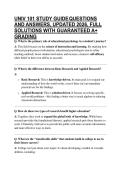
UNIV 101 STUDY GUIDE QUESTIONS
AND ANSWERS, UPDATED 2026, FULL
SOLUTIONS WITH GUARANTEED A+
GRADING
Q: What is the primary role of educational psychology in a student's journey?
A: This field focuses on the science of instruction and learning. By studying how
different people process information, educational psychologists aim to refine
teaching methods, boost student motivation, and increase a learner's self-efficacy
(their belief in their own ability to succeed).
Q: What is the difference between Basic Research and Applied Research?
A:
Basic Research: This is knowledge-driven. Its main goal is to expand our
understanding of how the world works, even if there isn't an immediate
practical use for the findings.
Applied Research: This is solution-driven. It focuses on solving specific,
real-world problems—like finding a better way to teach algebra or reducing
classroom distractions.
Q: How do these two types of research benefit higher education?
A: Together, they work to expand the global body of knowledge. While basic
research provides the foundational theories, applied research puts those theories to
work. Ultimately, both serve to provide the public with more accurate information
and more effective ways to learn.
Q: What are the "transferable skills" that students build in college to use in
their future careers?
A: College isn't just about your major; it's about developing a toolkit of versatile
abilities, including:
, Analysis: Inquiry and deep analytical thinking.
Innovation: Thinking both critically and creatively.
Expression: Mastering both written and verbal communication.
Literacy: Developing quantitative skills (math) and information literacy
(finding/evaluating data).
Collaboration: Excelling at teamwork and collective problem-solving.
Describe the four major categories usually included within a Liberal Arts
education. -ANSWER ✔✔Humanities, social sciences, natural science, and formal
sciences
"Why do humans continue behavior that is reinforced?" is an example of: -
ANSWER ✔✔Social Sciences- involves the scientific and empirical of human
behavior, culture, society, and relationships.
Describe the relationship between values, goals and goal commitment. -ANSWER
✔✔Make goals out of values.
They are all personal and different for everybody.
Stay committed and motivated.
Describe what it means to "own" your goals. -ANSWER ✔✔"Why you deserve it"
Make it personal
Making it realistic for yourself.
Describe the three characteristics of a useful goal. -ANSWER ✔✔Specific and
measurable, challenging, time frame
Values, commitment, and ownership
Self- Concordant Goals- goals that are personally useful.
AND ANSWERS, UPDATED 2026, FULL
SOLUTIONS WITH GUARANTEED A+
GRADING
Q: What is the primary role of educational psychology in a student's journey?
A: This field focuses on the science of instruction and learning. By studying how
different people process information, educational psychologists aim to refine
teaching methods, boost student motivation, and increase a learner's self-efficacy
(their belief in their own ability to succeed).
Q: What is the difference between Basic Research and Applied Research?
A:
Basic Research: This is knowledge-driven. Its main goal is to expand our
understanding of how the world works, even if there isn't an immediate
practical use for the findings.
Applied Research: This is solution-driven. It focuses on solving specific,
real-world problems—like finding a better way to teach algebra or reducing
classroom distractions.
Q: How do these two types of research benefit higher education?
A: Together, they work to expand the global body of knowledge. While basic
research provides the foundational theories, applied research puts those theories to
work. Ultimately, both serve to provide the public with more accurate information
and more effective ways to learn.
Q: What are the "transferable skills" that students build in college to use in
their future careers?
A: College isn't just about your major; it's about developing a toolkit of versatile
abilities, including:
, Analysis: Inquiry and deep analytical thinking.
Innovation: Thinking both critically and creatively.
Expression: Mastering both written and verbal communication.
Literacy: Developing quantitative skills (math) and information literacy
(finding/evaluating data).
Collaboration: Excelling at teamwork and collective problem-solving.
Describe the four major categories usually included within a Liberal Arts
education. -ANSWER ✔✔Humanities, social sciences, natural science, and formal
sciences
"Why do humans continue behavior that is reinforced?" is an example of: -
ANSWER ✔✔Social Sciences- involves the scientific and empirical of human
behavior, culture, society, and relationships.
Describe the relationship between values, goals and goal commitment. -ANSWER
✔✔Make goals out of values.
They are all personal and different for everybody.
Stay committed and motivated.
Describe what it means to "own" your goals. -ANSWER ✔✔"Why you deserve it"
Make it personal
Making it realistic for yourself.
Describe the three characteristics of a useful goal. -ANSWER ✔✔Specific and
measurable, challenging, time frame
Values, commitment, and ownership
Self- Concordant Goals- goals that are personally useful.


