
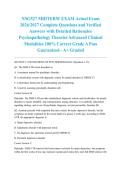
NSG527 MIDTERM EXAM Actual Exam
2026/2027 Complete Questions and Verified
Answers with Detailed Rationales
Psychopathology Theories Advanced Clinical
Modalities 100% Correct Grade A Pass
Guaranteed - A+ Graded
SECTION 1: FOUNDATIONS OF PSYCHOPATHOLOGY (Questions 1-15)
Q1: The DSM-5-TR is best described as:
A. A treatment manual for psychiatric disorders
B. A classification system with diagnostic criteria for mental disorders [CORRECT]
C. A theoretical framework for understanding psychopathology
D. A tool for assessing personality disorders only
Correct Answer: B
Rationale: The DSM-5-TR provides standardized diagnostic criteria and classification for mental
disorders to ensure reliability and communication among clinicians. It is explicitly atheoretical
regarding etiology and covers all psychiatric diagnoses, not just personality disorders (B).
Q2: A patient presents with symptoms that meet criteria for major depressive disorder, but the
symptoms are better explained by the recent death of a spouse 2 weeks ago. According to DSM-
5-TR, the appropriate diagnosis is:
A. Major depressive disorder
B. Adjustment disorder with depressed mood
C. No diagnosis; this represents normal grief [CORRECT]
D. Persistent depressive disorder
Correct Answer: C
Rationale: DSM-5-TR removed the bereavement exclusion for major depression, but symptoms
within the first weeks of loss may represent normal grief unless they meet full MDD criteria with
,severity (suicidal ideation, psychosis, psychomotor retardation) or functional impairment. This
scenario describes normal grief without specification of severe symptoms (C).
Q3: The ICD-11 differs from DSM-5-TR primarily in that:
A. It is only used in the United States
B. It is the international standard for health reporting and includes broader medical conditions
[CORRECT]
C. It focuses only on mental disorders
D. It uses only dimensional assessments
Correct Answer: B
Rationale: ICD-11 is the international classification system developed by WHO for all health
conditions, used globally for epidemiology, health management, and clinical purposes. DSM-5-
TR is primarily used in the U.S. for mental health diagnosis. ICD-11 has broader application
beyond mental health (B).
Q4: Cultural formulation in DSM-5-TR includes all EXCEPT:
A. Cultural identity of the individual
B. Cultural conceptualizations of distress
C. Psychosocial stressors and cultural features of vulnerability and resilience
D. Genetic testing results [CORRECT]
Correct Answer: D
Rationale: The cultural formulation interview covers cultural identity, cultural explanations of
illness, cultural factors related to psychosocial environment and functioning, and cultural
features of clinician-patient relationship. Genetic testing (D) is not part of cultural formulation
but rather biological assessment.
Q5: The prevalence of a disorder refers to:
A. The number of new cases in a population over a specific time period
B. The total number of existing cases in a population at a specific time [CORRECT]
C. The rate of recovery from the disorder
D. The genetic heritability of the disorder
Correct Answer: B
,Rationale: Prevalence is the proportion of a population found to have a condition at a specific
time (point prevalence) or over a period (period prevalence). Incidence (A) refers to new cases.
Prevalence provides information about disease burden (B).
Q6: Ataque de nervios is an example of:
A. A neurological disorder
B. A cultural syndrome or cultural concept of distress [CORRECT]
C. A genetic mutation
D. A medication side effect
Correct Answer: B
Rationale: Ataque de nervios is a cultural syndrome described in Latino cultures involving
symptoms of uncontrollable shouting, crying, trembling, verbal/physical aggression, and
dissociative experiences following stressful events. It is included in DSM-5-TR as a cultural
concept of distress (B).
Q7: Comorbidity in psychiatric disorders refers to:
A. The exclusive presence of one disorder
B. The co-occurrence of two or more disorders in the same individual [CORRECT]
C. The genetic relationship between disorders
D. The cure of one disorder by another
Correct Answer: B
Rationale: Comorbidity refers to the presence of two or more disorders in the same individual
simultaneously or sequentially. High comorbidity rates (e.g., depression and anxiety, substance
use and mood disorders) are common and have implications for etiology, prognosis, and
treatment (B).
Q8: The biopsychosocial model of mental illness emphasizes:
A. Biological factors only
B. The integration of biological, psychological, and social factors [CORRECT]
C. Social factors only
D. Psychological factors only
Correct Answer: B
, Rationale: The biopsychosocial model, developed by George Engel and applied to psychiatry,
integrates biological (genetics, neurochemistry), psychological (cognition, emotion, behavior),
and social (environment, culture, relationships) factors in understanding mental health and illness
(B).
Q9: Deinstitutionalization in the 1960s-1970s resulted in:
A. Improved care for all patients with mental illness
B. Shift from state hospitals to community care with mixed outcomes including homelessness
and incarceration [CORRECT]
C. Complete elimination of mental illness
D. Increased funding for psychiatric research only
Correct Answer: B
Rationale: Deinstitutionalization, driven by antipsychotic development and civil rights concerns,
shifted care from large state hospitals to community settings. Without adequate community
resources, this contributed to homelessness, incarceration ("transinstitutionalization"), and
inadequate care for many severely ill individuals (B).
Q10: The categorical approach of DSM-5-TR means that:
A. Disorders are viewed on a continuum with normal behavior
B. Disorders are present or absent based on meeting specific criteria [CORRECT]
C. Only biological factors are considered
D. Cultural factors are excluded
Correct Answer: B
Rationale: DSM-5-TR primarily uses a categorical approach where disorders are diagnosed if
specific criteria are met (present/absent). However, dimensional specifiers (severity, symptom
counts) provide some dimensional assessment within categories. Some sections (personality
disorders, autism) incorporate more dimensional elements (B).
Q11: A patient reports that their depression is caused by "bad karma from a past life" according
to their religious beliefs. This represents:
A. Delusional thinking
B. A cultural explanation of illness [CORRECT]
C. Psychotic disorder
D. Cognitive deficit
2026/2027 Complete Questions and Verified
Answers with Detailed Rationales
Psychopathology Theories Advanced Clinical
Modalities 100% Correct Grade A Pass
Guaranteed - A+ Graded
SECTION 1: FOUNDATIONS OF PSYCHOPATHOLOGY (Questions 1-15)
Q1: The DSM-5-TR is best described as:
A. A treatment manual for psychiatric disorders
B. A classification system with diagnostic criteria for mental disorders [CORRECT]
C. A theoretical framework for understanding psychopathology
D. A tool for assessing personality disorders only
Correct Answer: B
Rationale: The DSM-5-TR provides standardized diagnostic criteria and classification for mental
disorders to ensure reliability and communication among clinicians. It is explicitly atheoretical
regarding etiology and covers all psychiatric diagnoses, not just personality disorders (B).
Q2: A patient presents with symptoms that meet criteria for major depressive disorder, but the
symptoms are better explained by the recent death of a spouse 2 weeks ago. According to DSM-
5-TR, the appropriate diagnosis is:
A. Major depressive disorder
B. Adjustment disorder with depressed mood
C. No diagnosis; this represents normal grief [CORRECT]
D. Persistent depressive disorder
Correct Answer: C
Rationale: DSM-5-TR removed the bereavement exclusion for major depression, but symptoms
within the first weeks of loss may represent normal grief unless they meet full MDD criteria with
,severity (suicidal ideation, psychosis, psychomotor retardation) or functional impairment. This
scenario describes normal grief without specification of severe symptoms (C).
Q3: The ICD-11 differs from DSM-5-TR primarily in that:
A. It is only used in the United States
B. It is the international standard for health reporting and includes broader medical conditions
[CORRECT]
C. It focuses only on mental disorders
D. It uses only dimensional assessments
Correct Answer: B
Rationale: ICD-11 is the international classification system developed by WHO for all health
conditions, used globally for epidemiology, health management, and clinical purposes. DSM-5-
TR is primarily used in the U.S. for mental health diagnosis. ICD-11 has broader application
beyond mental health (B).
Q4: Cultural formulation in DSM-5-TR includes all EXCEPT:
A. Cultural identity of the individual
B. Cultural conceptualizations of distress
C. Psychosocial stressors and cultural features of vulnerability and resilience
D. Genetic testing results [CORRECT]
Correct Answer: D
Rationale: The cultural formulation interview covers cultural identity, cultural explanations of
illness, cultural factors related to psychosocial environment and functioning, and cultural
features of clinician-patient relationship. Genetic testing (D) is not part of cultural formulation
but rather biological assessment.
Q5: The prevalence of a disorder refers to:
A. The number of new cases in a population over a specific time period
B. The total number of existing cases in a population at a specific time [CORRECT]
C. The rate of recovery from the disorder
D. The genetic heritability of the disorder
Correct Answer: B
,Rationale: Prevalence is the proportion of a population found to have a condition at a specific
time (point prevalence) or over a period (period prevalence). Incidence (A) refers to new cases.
Prevalence provides information about disease burden (B).
Q6: Ataque de nervios is an example of:
A. A neurological disorder
B. A cultural syndrome or cultural concept of distress [CORRECT]
C. A genetic mutation
D. A medication side effect
Correct Answer: B
Rationale: Ataque de nervios is a cultural syndrome described in Latino cultures involving
symptoms of uncontrollable shouting, crying, trembling, verbal/physical aggression, and
dissociative experiences following stressful events. It is included in DSM-5-TR as a cultural
concept of distress (B).
Q7: Comorbidity in psychiatric disorders refers to:
A. The exclusive presence of one disorder
B. The co-occurrence of two or more disorders in the same individual [CORRECT]
C. The genetic relationship between disorders
D. The cure of one disorder by another
Correct Answer: B
Rationale: Comorbidity refers to the presence of two or more disorders in the same individual
simultaneously or sequentially. High comorbidity rates (e.g., depression and anxiety, substance
use and mood disorders) are common and have implications for etiology, prognosis, and
treatment (B).
Q8: The biopsychosocial model of mental illness emphasizes:
A. Biological factors only
B. The integration of biological, psychological, and social factors [CORRECT]
C. Social factors only
D. Psychological factors only
Correct Answer: B
, Rationale: The biopsychosocial model, developed by George Engel and applied to psychiatry,
integrates biological (genetics, neurochemistry), psychological (cognition, emotion, behavior),
and social (environment, culture, relationships) factors in understanding mental health and illness
(B).
Q9: Deinstitutionalization in the 1960s-1970s resulted in:
A. Improved care for all patients with mental illness
B. Shift from state hospitals to community care with mixed outcomes including homelessness
and incarceration [CORRECT]
C. Complete elimination of mental illness
D. Increased funding for psychiatric research only
Correct Answer: B
Rationale: Deinstitutionalization, driven by antipsychotic development and civil rights concerns,
shifted care from large state hospitals to community settings. Without adequate community
resources, this contributed to homelessness, incarceration ("transinstitutionalization"), and
inadequate care for many severely ill individuals (B).
Q10: The categorical approach of DSM-5-TR means that:
A. Disorders are viewed on a continuum with normal behavior
B. Disorders are present or absent based on meeting specific criteria [CORRECT]
C. Only biological factors are considered
D. Cultural factors are excluded
Correct Answer: B
Rationale: DSM-5-TR primarily uses a categorical approach where disorders are diagnosed if
specific criteria are met (present/absent). However, dimensional specifiers (severity, symptom
counts) provide some dimensional assessment within categories. Some sections (personality
disorders, autism) incorporate more dimensional elements (B).
Q11: A patient reports that their depression is caused by "bad karma from a past life" according
to their religious beliefs. This represents:
A. Delusional thinking
B. A cultural explanation of illness [CORRECT]
C. Psychotic disorder
D. Cognitive deficit


