Paleoclimatology summary
Earth’s Climate: Past and Future
William F. Ruddiman
2nd edition (C3 1st Edition)
Chapter 1: overview of climate science
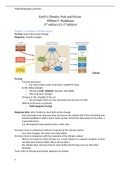
Forcing: factors that cause change
Response: climatic changes
Climate
Forcing:
- Tectonic processes
o E.g. long carbon cycle, mountains, seabed forming
- Earth orbital changes
o Influence solar radiation (seasons, day/night)
o Also long-term changes
- Changes in the strength of the sun
o The strength of the sun has increased over the last 4,55 Byr
- (Effects of humans on climate)
o Anthropogenic forcing
Response time: time it takes to react fully on the change
- Each step takes one response time and moves the system half of the remaining way
toward equilibrium (that’s why it heats up fast at first but slows down in the end) →
exponential form
- E.g. atmosphere long response time, water slow
Forcing is slow in comparison with the response of the climate system:
- very slow changes, the earth can easily adjust
Forcing is fast in comparison with the response of the climate system:
- little to no response to the forcing: e.g. a solar eclipse or a volcanic eruption. It does
not affect the climate (DOES affect the weather)
- the climate does not have time to react before the forcing occurs in the other
direction
Time scales of forcing and climate response are similar:
1
,Paleoclimatology summary
- then the climate (or the burner) will be peddling between two extremes without
reaching equilibrium
- cycles e.g. seasons
positive feedback: amplifies
negative feedback: suppresses
2
, Paleoclimatology summary
Chapter 2: climate archives, data and models
Types of archives:
- Sediments
o erosion and sedimentation cause layers to form
o useful because their deposition is uninterrupted especially in the deep
sea, the lower layers are hardly disturbed
o lake sediments that are left behind after glaciers have melted are important
o Moraines: the outer edges of the ice sheet where it has pushed up the soil
(stuwwal) → mix of old and new sediments
o Loess: sediments carried by the wind and deposited somewhere else
- Glacial ice:
o Over 700,000 years in Greenland
- Other climate archives:
o Caves
Limestone; stalactites
o Trees
Tree rings! Make a calendar with matching rings to date back
Only in mid latitudes with strong seasonal differences
o Coral
Kinda same as trees, they also develop growth rings → coral bands
o Historical archives
o Instrumental records
First weather reports, temperature readings, etc.
Dating climate records:
- Radiometric dating:
o measure the decay of radioactive isotopes in rocks.
- Radiometric dating and correlation:
o based on the radioactive decay of a parent isotope (unstable) to a daughter
isotope (stable). Occurs at a known rate, the decay constant.
The clock only starts ticking once the rock becomes a closed system
and the only thing that can further happen is internal radioactive
decay.
Half-life: rate at which the parent is half decayed to the daughter.
- Fossils: most useful if the species is short-lived and widespread
- Radiocarbon:
o Radiocarbon dating: date lake sediments and other carbon-bearing archives
- Counting annual layers:
o E.g. darker layers in ice sheets marking a windy year with a lot of dust
o Varves:
Deeper parts of lakes containing little/no oxygen
Results in layers signifying summer and winter
- Correlating records with orbital cycles
o Link orbital changes to climatic responses
- Internal chronometers
3
Earth’s Climate: Past and Future
William F. Ruddiman
2nd edition (C3 1st Edition)
Chapter 1: overview of climate science
Forcing: factors that cause change
Response: climatic changes
Climate
Forcing:
- Tectonic processes
o E.g. long carbon cycle, mountains, seabed forming
- Earth orbital changes
o Influence solar radiation (seasons, day/night)
o Also long-term changes
- Changes in the strength of the sun
o The strength of the sun has increased over the last 4,55 Byr
- (Effects of humans on climate)
o Anthropogenic forcing
Response time: time it takes to react fully on the change
- Each step takes one response time and moves the system half of the remaining way
toward equilibrium (that’s why it heats up fast at first but slows down in the end) →
exponential form
- E.g. atmosphere long response time, water slow
Forcing is slow in comparison with the response of the climate system:
- very slow changes, the earth can easily adjust
Forcing is fast in comparison with the response of the climate system:
- little to no response to the forcing: e.g. a solar eclipse or a volcanic eruption. It does
not affect the climate (DOES affect the weather)
- the climate does not have time to react before the forcing occurs in the other
direction
Time scales of forcing and climate response are similar:
1
,Paleoclimatology summary
- then the climate (or the burner) will be peddling between two extremes without
reaching equilibrium
- cycles e.g. seasons
positive feedback: amplifies
negative feedback: suppresses
2
, Paleoclimatology summary
Chapter 2: climate archives, data and models
Types of archives:
- Sediments
o erosion and sedimentation cause layers to form
o useful because their deposition is uninterrupted especially in the deep
sea, the lower layers are hardly disturbed
o lake sediments that are left behind after glaciers have melted are important
o Moraines: the outer edges of the ice sheet where it has pushed up the soil
(stuwwal) → mix of old and new sediments
o Loess: sediments carried by the wind and deposited somewhere else
- Glacial ice:
o Over 700,000 years in Greenland
- Other climate archives:
o Caves
Limestone; stalactites
o Trees
Tree rings! Make a calendar with matching rings to date back
Only in mid latitudes with strong seasonal differences
o Coral
Kinda same as trees, they also develop growth rings → coral bands
o Historical archives
o Instrumental records
First weather reports, temperature readings, etc.
Dating climate records:
- Radiometric dating:
o measure the decay of radioactive isotopes in rocks.
- Radiometric dating and correlation:
o based on the radioactive decay of a parent isotope (unstable) to a daughter
isotope (stable). Occurs at a known rate, the decay constant.
The clock only starts ticking once the rock becomes a closed system
and the only thing that can further happen is internal radioactive
decay.
Half-life: rate at which the parent is half decayed to the daughter.
- Fossils: most useful if the species is short-lived and widespread
- Radiocarbon:
o Radiocarbon dating: date lake sediments and other carbon-bearing archives
- Counting annual layers:
o E.g. darker layers in ice sheets marking a windy year with a lot of dust
o Varves:
Deeper parts of lakes containing little/no oxygen
Results in layers signifying summer and winter
- Correlating records with orbital cycles
o Link orbital changes to climatic responses
- Internal chronometers
3