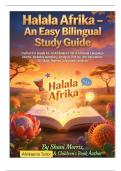
, Halala Afrika – An Easy Bilingual Study
Guide
By Shani Morris
Afrikaans Tutor & Children's Book Author
Perfect for Grade 10-12 Afrikaans First Additonal Language exams.
Includes summary, analysis, line-by-line translation, 30 Q&As, themes and poetic devices.
Poem Summary/Gedig opsomming
Afrikaans: Die gedig “Halala Afrika” begin met ’n beeld van Afrika toe dit nog vry, groen en
ongerep was,’n wêreld met wyd oop horisonne en natuurlike rykdom. Later kom skepe van die
weste en die land en sy mense ondergaan veranderings: die vryheid en uitgestrektheid word verruil
die natuurlike rykdom word ontgin en die mense word “slawe” in ’n sekere sin, werk vir iemand
anders se wins. Tog klink die refrein “Halala, ewig is ons Afrika” as ’n viering én ’n hoopvolle roep
na Afrika se krag, identiteit en toekoms.
English: The poem “Halala Afrika” begins with an image of Africa when it was still free, green
and untouched. A world with wide open horizons and natural abundance. Then ships arrive from
the West and the land and its people undergo change: freedom and vastness were traded away,
natural wealth is exploited and the people become “slaves” in a sense, working for someone else’s
profit. Yet the refrain “Rejoice, eternal is our Africa” stands as both a celebration and a hopeful
call to Africa’s strength, identity and future.
Belangrike Temas / Key Themes
Afrikaans:
• Die skoonheid en vryheid van voor koloniale Afrika.
• Die pyn en verlies wat kolonialisme veroorsaak.
• Daar is hoop en sterkte in die gees van Afrika.
English:
• The beauty and freedom of pre-colonial Africa.
• The pain and loss brought by colonialism.
• Enduring hope and strength of the African spirit.
Guide
By Shani Morris
Afrikaans Tutor & Children's Book Author
Perfect for Grade 10-12 Afrikaans First Additonal Language exams.
Includes summary, analysis, line-by-line translation, 30 Q&As, themes and poetic devices.
Poem Summary/Gedig opsomming
Afrikaans: Die gedig “Halala Afrika” begin met ’n beeld van Afrika toe dit nog vry, groen en
ongerep was,’n wêreld met wyd oop horisonne en natuurlike rykdom. Later kom skepe van die
weste en die land en sy mense ondergaan veranderings: die vryheid en uitgestrektheid word verruil
die natuurlike rykdom word ontgin en die mense word “slawe” in ’n sekere sin, werk vir iemand
anders se wins. Tog klink die refrein “Halala, ewig is ons Afrika” as ’n viering én ’n hoopvolle roep
na Afrika se krag, identiteit en toekoms.
English: The poem “Halala Afrika” begins with an image of Africa when it was still free, green
and untouched. A world with wide open horizons and natural abundance. Then ships arrive from
the West and the land and its people undergo change: freedom and vastness were traded away,
natural wealth is exploited and the people become “slaves” in a sense, working for someone else’s
profit. Yet the refrain “Rejoice, eternal is our Africa” stands as both a celebration and a hopeful
call to Africa’s strength, identity and future.
Belangrike Temas / Key Themes
Afrikaans:
• Die skoonheid en vryheid van voor koloniale Afrika.
• Die pyn en verlies wat kolonialisme veroorsaak.
• Daar is hoop en sterkte in die gees van Afrika.
English:
• The beauty and freedom of pre-colonial Africa.
• The pain and loss brought by colonialism.
• Enduring hope and strength of the African spirit.