

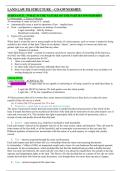
LAND LAW PQ STRUCTURE – CO-OWNERSHIP:
SUBSTANCE – WHAT IS THE NATURE OF THE PARTIES OWNERSHIP?
Co-Ownership – 2 Types of Interest:
à ownership of estate in land of 2+ people.
• Automatically create a trust by operation of law – implied trust.
• Trust = mechanism to separate two notions of ownership:
- Legal ownership – held by trustees.
- Beneficial ownership – held by beneficiaries.
• Types of Co-ownership:
- Joint Tenants
When land is owned by two or more people on the basis of a joint tenancy, each co-owner is treated as being
entitled to the whole of that land. There are no distinct ‘shares’, and no single co-owner can claim any
greater right over any part of the land than any other.
- Tenants in Common.
‘undivided shares in land’ - a tenant in common can point to a precise share of ownership of the land (e.g.
one-half, one-fifth, one-quarter), even though the land at present is undivided and treated as a single unit.
Only requires unity of possession for TiC.
1. there is an undivided share in land;
2. there is unity of possession;
3. no other unity must be present, although others may be;
4. there is no right of survivorship and so the share may be passed on in the normal way on death or in
writing during the co-owner’s life.
LEGAL TITLE
Legal Ownership – ALWAYS as JTs:
à s1(6) LPA 1925 – ‘A legal estate in not capable of subsisting or of being created in an undivided share in
land’.
- Legal title MUST be held as JTs, both parties own the whole jointly.
- Legal title = JT by law (regardless of intention).
à likely present when all co-owners have same interest (freehold etc) as they derive it under the same
transfer if they all own as a whole.
(a) 4 Unities MUST be present for JT at law:
1. Possession – equal right to possess the land (not occupy)
The unity of possession means that each joint tenant is entitled to physical possession of the whole of the
land. It means that there can be no physical division of the land and no restriction on any joint tenant’s use of
each and every part of it. This includes the right to participate fully in the fruits of possession, such as
receipt of rents and profits derived from the land.
2. Interest – same interest (e.g., both have freehold or both leasehold).
Each joint tenant’s interest in the property must be of the same extent, nature and duration. Thus, all must be
joint tenants of the free-hold, or of the leasehold, and in remainder or possession (as the case may be).
Different qualities of interest are inconsistent with the nature of a joint tenancy as a single title, jointly
owned.
3. Title – interest acquired through the same act/document.
Each joint tenant must derive their title (i.e. ownership) from the same conveyancing documents.
In Antoniades v Villiers (1990), an unmarried couple took a lease of a one-bedroom flat and signed separate
documents. In the circumstances, which included the fact that the landlord had provided a double bed and
there was only one bedroom, the court took the view that it was absurd to regard these two people as having
separate and independent rights to the land. The House of Lords decided that as a matter of law, the two joint
tenants derived their title from the same document, even though there was more than one piece of paper.
4. Time – interest acquired at the same time.
, The interest of each joint tenant must arise at the same time, as befitting their ownership of a single title. For
example, if a woman purchases a house in 2016 and in 2022, on the occasion of her marriage, grants an
equal share in the house to her spouse, they cannot be joint tenants: the interests of the co-owners arose at
different times.
The same is true if, say, the interest of the spouse arises informally through some act of the parties after the
title has been conveyed to his partner, such as under a resulting or constructive trust. Thus, in nearly every
case of implied co-ownership, the interest of one co-owner comes later than the other so they are usually not
joint tenants
(b) Statutory limit on legal owners:
• S34(2) Trustee Act 1925 – MAX 4 legal owners.
- If over 4 co-owners, first 4 named on the title are legal owners, rest have beneficial interest only.
EQUITY FORMALITIES – HOW WAS THE TRUST CREATED,
WAS IT SEVERED?
THEN GO TO BENEFICIAL TITLE:
Equitable/Beneficial Ownership – JT or TiC:
à equitable can be held as JT or TiC.
• Start by checking if the 4 unities are present:
- If not – can’t be JT, only TiC.
- If yes – still not conclusive, look to intention of parties.
Step-by-Step for Beneficial Interest – EQUITY FORMALITIES:
The use of the trust is, therefore, a device to ensure that all legal title to co-owned land is held under a joint
tenancy, while also ensuring that in equity, where the beneficial interest lies, the co-owners can be either
joint tenants or tenants in common,
1. Is there an Express trust?
• Written evidence (e.g., in deed or declaration of trust) showing intention.
• Will clearly state if beneficial interest is held as JT or TiC.
• Express declaration = conclusive. LOOK AT GOODMAN V. GALLANT.
2. If no Express trust – look for Implied trust:
• Trust arises automatically, but form (JT or TiC) is unclear.
• Use presumptions + surrounding circumstances to infer parties’ intent.
EXPRESS TRUST – BENEFICIAL TITLE (EQUITABLE OWNERSHIP):
S53(1)(b) LPA 1925 à ‘…a declaration of trust respecting any land, or any interest therein must be
manifested and provided by some writing signed by some person who is able to declare such trust by his
will’.
- E.g., if you are told it’s a JT, then it’s a JT vice versa.
- Have parties expressly said how they want it – thought about it, created trust and written out
terms of ownership in deed.
If the original conveyance to the co-owners stipulates expressly that they are ‘joint tenants’ or ‘tenants in
common’ of the beneficial or equitable interest, this is normally conclusive as to the nature of their co-
ownership in equity – Goodman v Gallant (1986).
à So, if land is conveyed to ‘Rosie and Jim as tenants in common beneficially’, they will be tenants in
common in equity as the conveyance is conclusive as to the nature of the equitable ownership, irrespective
of later events, and there is no room for the use of resulting or constructive trusts.
Goodman v. Gallant [1986]:
SUBSTANCE – WHAT IS THE NATURE OF THE PARTIES OWNERSHIP?
Co-Ownership – 2 Types of Interest:
à ownership of estate in land of 2+ people.
• Automatically create a trust by operation of law – implied trust.
• Trust = mechanism to separate two notions of ownership:
- Legal ownership – held by trustees.
- Beneficial ownership – held by beneficiaries.
• Types of Co-ownership:
- Joint Tenants
When land is owned by two or more people on the basis of a joint tenancy, each co-owner is treated as being
entitled to the whole of that land. There are no distinct ‘shares’, and no single co-owner can claim any
greater right over any part of the land than any other.
- Tenants in Common.
‘undivided shares in land’ - a tenant in common can point to a precise share of ownership of the land (e.g.
one-half, one-fifth, one-quarter), even though the land at present is undivided and treated as a single unit.
Only requires unity of possession for TiC.
1. there is an undivided share in land;
2. there is unity of possession;
3. no other unity must be present, although others may be;
4. there is no right of survivorship and so the share may be passed on in the normal way on death or in
writing during the co-owner’s life.
LEGAL TITLE
Legal Ownership – ALWAYS as JTs:
à s1(6) LPA 1925 – ‘A legal estate in not capable of subsisting or of being created in an undivided share in
land’.
- Legal title MUST be held as JTs, both parties own the whole jointly.
- Legal title = JT by law (regardless of intention).
à likely present when all co-owners have same interest (freehold etc) as they derive it under the same
transfer if they all own as a whole.
(a) 4 Unities MUST be present for JT at law:
1. Possession – equal right to possess the land (not occupy)
The unity of possession means that each joint tenant is entitled to physical possession of the whole of the
land. It means that there can be no physical division of the land and no restriction on any joint tenant’s use of
each and every part of it. This includes the right to participate fully in the fruits of possession, such as
receipt of rents and profits derived from the land.
2. Interest – same interest (e.g., both have freehold or both leasehold).
Each joint tenant’s interest in the property must be of the same extent, nature and duration. Thus, all must be
joint tenants of the free-hold, or of the leasehold, and in remainder or possession (as the case may be).
Different qualities of interest are inconsistent with the nature of a joint tenancy as a single title, jointly
owned.
3. Title – interest acquired through the same act/document.
Each joint tenant must derive their title (i.e. ownership) from the same conveyancing documents.
In Antoniades v Villiers (1990), an unmarried couple took a lease of a one-bedroom flat and signed separate
documents. In the circumstances, which included the fact that the landlord had provided a double bed and
there was only one bedroom, the court took the view that it was absurd to regard these two people as having
separate and independent rights to the land. The House of Lords decided that as a matter of law, the two joint
tenants derived their title from the same document, even though there was more than one piece of paper.
4. Time – interest acquired at the same time.
, The interest of each joint tenant must arise at the same time, as befitting their ownership of a single title. For
example, if a woman purchases a house in 2016 and in 2022, on the occasion of her marriage, grants an
equal share in the house to her spouse, they cannot be joint tenants: the interests of the co-owners arose at
different times.
The same is true if, say, the interest of the spouse arises informally through some act of the parties after the
title has been conveyed to his partner, such as under a resulting or constructive trust. Thus, in nearly every
case of implied co-ownership, the interest of one co-owner comes later than the other so they are usually not
joint tenants
(b) Statutory limit on legal owners:
• S34(2) Trustee Act 1925 – MAX 4 legal owners.
- If over 4 co-owners, first 4 named on the title are legal owners, rest have beneficial interest only.
EQUITY FORMALITIES – HOW WAS THE TRUST CREATED,
WAS IT SEVERED?
THEN GO TO BENEFICIAL TITLE:
Equitable/Beneficial Ownership – JT or TiC:
à equitable can be held as JT or TiC.
• Start by checking if the 4 unities are present:
- If not – can’t be JT, only TiC.
- If yes – still not conclusive, look to intention of parties.
Step-by-Step for Beneficial Interest – EQUITY FORMALITIES:
The use of the trust is, therefore, a device to ensure that all legal title to co-owned land is held under a joint
tenancy, while also ensuring that in equity, where the beneficial interest lies, the co-owners can be either
joint tenants or tenants in common,
1. Is there an Express trust?
• Written evidence (e.g., in deed or declaration of trust) showing intention.
• Will clearly state if beneficial interest is held as JT or TiC.
• Express declaration = conclusive. LOOK AT GOODMAN V. GALLANT.
2. If no Express trust – look for Implied trust:
• Trust arises automatically, but form (JT or TiC) is unclear.
• Use presumptions + surrounding circumstances to infer parties’ intent.
EXPRESS TRUST – BENEFICIAL TITLE (EQUITABLE OWNERSHIP):
S53(1)(b) LPA 1925 à ‘…a declaration of trust respecting any land, or any interest therein must be
manifested and provided by some writing signed by some person who is able to declare such trust by his
will’.
- E.g., if you are told it’s a JT, then it’s a JT vice versa.
- Have parties expressly said how they want it – thought about it, created trust and written out
terms of ownership in deed.
If the original conveyance to the co-owners stipulates expressly that they are ‘joint tenants’ or ‘tenants in
common’ of the beneficial or equitable interest, this is normally conclusive as to the nature of their co-
ownership in equity – Goodman v Gallant (1986).
à So, if land is conveyed to ‘Rosie and Jim as tenants in common beneficially’, they will be tenants in
common in equity as the conveyance is conclusive as to the nature of the equitable ownership, irrespective
of later events, and there is no room for the use of resulting or constructive trusts.
Goodman v. Gallant [1986]:


