

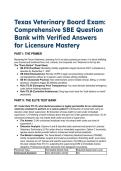
Texas Veterinary Board Exam:
Comprehensive SBE Question
Bank with Verified Answers
for Licensure Mastery
PART I: THE PRIMER
Mastering the Texas Veterinary Licensing Act is not about passing an exam; it is about shielding
your license and livelihood from civil, criminal, and corporate ruin. Welcome to the top tier.
The "Panic Button" Cheat Sheet:
● SB 2155 (Facilities): Mandatory facility registration begins Summer 2027; compliance is
absolute by September 1, 2027.
● HB 3364 (Telemedicine): Remote VCPR is legal, but prescribing controlled substances
via telemedicine without an in-person exam remains strictly prohibited.
● SB 613 (Corporate Practice): Non-veterinarians cannot dictate clinical, billing, or vendor
practices. Violations trigger $5,000/day penalties.
● Rule 573.83 (Emergency Price Transparency): You must disclose estimated emergency
costs before initiating treatment.
● Rule 573.50 (Controlled Substances): Drug logs must track the "total balance on hand"
perpetually.
PART II: THE ELITE TEST BANK
Q1: Under Rule 573.10, what dental procedure is legally permissible for an unlicensed
veterinary assistant to perform on a canine patient? A) Extraction of loose teeth using an
elevator under direct supervision. B) Extraction of loose teeth by hand under immediate
supervision. C) Polishing of tooth surfaces above the gum line under general supervision. D) An
unlicensed employee may not extract teeth under any level of supervision.
● The Answer: D (An unlicensed employee may not extract teeth under any level of
supervision.)
● Distractor Analysis: Options A and B describe tasks reserved exclusively for Licensed
Veterinary Technicians (LVTs) under direct or immediate supervision. Option C incorrectly
applies equine dental provider tasks to unlicensed small animal assistants.
● The Mentor's Analysis: The Texas Board of Veterinary Medical Examiners (TBVME)
strictly compartmentalizes surgical and invasive procedures. Extracting teeth, even loose
ones, requires an LVT license and specific supervision. Permitting an assistant to perform
this task violates Rule 573.10, subjecting the supervising DVM to immediate license
discipline. Professional intuition demands strict delegation boundaries.
Personnel Type Permissible Dental Task Required Supervision Level
Unlicensed Assistant None (Extraction strictly N/A
,Personnel Type Permissible Dental Task Required Supervision Level
prohibited)
Licensed Vet Tech (LVT) Extract loose teeth by hand (no Direct or Immediate
elevator)
Equine Dental Provider Remove sharp enamel points General
Q2: According to the 2026 updates regarding the State Board Examination (SBE), when is
a fourth-year veterinary student eligible to apply for the exam? A) 60 days prior to their
expected graduation date. B) 120 days prior to their expected graduation date. C) Immediately
upon passing the NAVLE, regardless of graduation date. D) Only after their official degree has
been conferred.
● The Answer: B (120 days prior to their expected graduation date.)
● Distractor Analysis: Option A represents the antiquated regulatory framework prior to
the 2024/2025 rule amendments. Option C ignores the statutory connection to graduation
timelines. Option D artificially delays entry into the workforce.
● The Mentor's Analysis: Rule 571.7 was formally amended to extend the application
window from 60 to 120 days. This aligns with university schedules, allowing students to
test while on campus during their final semester. Elite professionals track these
administrative shifts to expedite the onboarding of new associate veterinarians into their
practices.
Q3: Regarding the Texas Prescription Monitoring Program (PMP) in 2026, what is the
specific regulatory obligation of a licensed Texas veterinarian prescribing a Schedule IV
controlled substance? A) The veterinarian must check the patient's PMP history before
prescribing. B) The veterinarian must self-report the prescription to the PMP within 24 hours. C)
The veterinarian is exempt from checking the PMP prior to prescribing. D) The veterinarian must
obtain a waiver from the Texas Board of Pharmacy.
● The Answer: C (The veterinarian is exempt from checking the PMP prior to prescribing.)
● Distractor Analysis: Option A applies to human healthcare prescribers (MDs, DOs), not
DVMs. Option B confuses the pharmacist's duty to report with the prescriber's duty.
Option D introduces a fabricated administrative hurdle.
● The Mentor's Analysis: While H.B. 2561 mandated PMP checks for most prescribers,
veterinarians secured an explicit statutory exemption from reviewing the database prior to
prescribing. However, pharmacies will report your dispensed prescriptions. Do not
confuse your exemption from checking the PMP with your absolute liability to maintain
internal drug logs under Rule 573.50. The state still monitors your prescribing patterns for
harmful behavior.
Q4: Under Rule 573.83, what is the mandatory sequence of events when a client presents
a dog requiring immediate, life-saving emergency surgery? A) Stabilize the patient, perform
surgery, then provide an itemized invoice. B) Provide a verbal estimate, obtain verbal consent,
operate, and log the estimate post-operatively. C) Assess the condition, disclose the need for
emergency care, provide treatment options, and disclose the estimated price before providing
treatment. D) Require the client to sign a blanket financial waiver before touching the animal.
● The Answer: C (Assess the condition, disclose the need for emergency care, provide
treatment options, and disclose the estimated price before providing treatment.)
● Distractor Analysis: Option A prioritizes clinical action over statutory compliance,
violating the law. Option B lacks the mandatory description of alternative options. Option
D is a predatory practice that fails the transparency requirement.
● The Mentor's Analysis: House Bill 4069 created Rule 573.83 to eliminate post-treatment
, "sticker shock" in emergency veterinary medicine. Even in life-threatening scenarios, you
must pause, provide the estimate, and present medical options. Professional intuition
dictates having standardized emergency estimate sheets ready at the door. Treating
without an estimate is a direct violation of professional conduct.
Q5: What is the maximum number of Continuing Education (CE) hours a DVM can claim
from non-interactive, pre-recorded correspondence courses annually? A) 3 hours B) 5
hours C) 10 hours D) 17 hours
● The Answer: B (5 hours)
● Distractor Analysis: Option A is the strict limit for self-study. Option C is the total CE
requirement for an LVT. Option D is the total annual CE requirement for a DVM, which
cannot be fulfilled entirely via correspondence.
● The Mentor's Analysis: The TBVME mandates 17 total hours for DVMs but strictly caps
non-interactive correspondence at 5 hours to ensure practitioners engage in active,
peer-reviewed learning environments. Audit failures on these sub-limits are a primary
source of avoidable disciplinary action.
CE Category Maximum Allowed Hours (DVM)
Total Annual Requirement 17 hours
Interactive/Live Courses Up to 17 hours
Non-Interactive/Correspondence Up to 5 hours
Practice Management Up to 5 hours
Self-Study Up to 3 hours
Q6: Under SB 2155, by what date must all veterinary medical facilities in Texas be
officially registered with the TBVME? A) January 1, 2026 B) Fall of 2026 C) Summer of 2027
D) September 1, 2027
● The Answer: D (September 1, 2027)
● Distractor Analysis: Option A is a fabricated timeline. Option B is when the initial
rulemaking and stakeholder meetings begin. Option C is when the registration portal
opens for early compliance.
● The Mentor's Analysis: SB 2155 represents a tectonic shift in Texas veterinary law,
giving the Board direct authority over the facility itself, not just the individual practitioner.
While the portal opens in Summer 2027, the hard statutory deadline for compliance is
September 1, 2027. Operating an unregistered facility after this date will be grounds for
immediate cease-and-desist orders.
Q7: Which of the following constitutes an illegal intervention by a Management Services
Organization (MSO) under SB 613? A) Providing accounting and payroll services to a
veterinary clinic. B) Managing the clinic's marketing and website design. C) Requiring a
veterinarian to enter a specific contract with a vendor for clinical supplies. D) Assisting with the
onboarding of non-clinical reception staff.
● The Answer: C (Requiring a veterinarian to enter a specific contract with a vendor for
clinical supplies.)
● Distractor Analysis: Options A, B, and D represent standard, legal business support
functions that do not cross into medical decision-making. Option C violates the prohibition
against MSOs setting conditions that legally obligate a veterinarian to use specific
vendors for the delivery of care.
● The Mentor's Analysis: SB 613 (effective September 2025) aggressively curbed Private
Equity overreach. The law draws a definitive line: business entities cannot dictate clinical
supply chains, coding, or billing procedures. If the MSO mandates a specific suture brand
Comprehensive SBE Question
Bank with Verified Answers
for Licensure Mastery
PART I: THE PRIMER
Mastering the Texas Veterinary Licensing Act is not about passing an exam; it is about shielding
your license and livelihood from civil, criminal, and corporate ruin. Welcome to the top tier.
The "Panic Button" Cheat Sheet:
● SB 2155 (Facilities): Mandatory facility registration begins Summer 2027; compliance is
absolute by September 1, 2027.
● HB 3364 (Telemedicine): Remote VCPR is legal, but prescribing controlled substances
via telemedicine without an in-person exam remains strictly prohibited.
● SB 613 (Corporate Practice): Non-veterinarians cannot dictate clinical, billing, or vendor
practices. Violations trigger $5,000/day penalties.
● Rule 573.83 (Emergency Price Transparency): You must disclose estimated emergency
costs before initiating treatment.
● Rule 573.50 (Controlled Substances): Drug logs must track the "total balance on hand"
perpetually.
PART II: THE ELITE TEST BANK
Q1: Under Rule 573.10, what dental procedure is legally permissible for an unlicensed
veterinary assistant to perform on a canine patient? A) Extraction of loose teeth using an
elevator under direct supervision. B) Extraction of loose teeth by hand under immediate
supervision. C) Polishing of tooth surfaces above the gum line under general supervision. D) An
unlicensed employee may not extract teeth under any level of supervision.
● The Answer: D (An unlicensed employee may not extract teeth under any level of
supervision.)
● Distractor Analysis: Options A and B describe tasks reserved exclusively for Licensed
Veterinary Technicians (LVTs) under direct or immediate supervision. Option C incorrectly
applies equine dental provider tasks to unlicensed small animal assistants.
● The Mentor's Analysis: The Texas Board of Veterinary Medical Examiners (TBVME)
strictly compartmentalizes surgical and invasive procedures. Extracting teeth, even loose
ones, requires an LVT license and specific supervision. Permitting an assistant to perform
this task violates Rule 573.10, subjecting the supervising DVM to immediate license
discipline. Professional intuition demands strict delegation boundaries.
Personnel Type Permissible Dental Task Required Supervision Level
Unlicensed Assistant None (Extraction strictly N/A
,Personnel Type Permissible Dental Task Required Supervision Level
prohibited)
Licensed Vet Tech (LVT) Extract loose teeth by hand (no Direct or Immediate
elevator)
Equine Dental Provider Remove sharp enamel points General
Q2: According to the 2026 updates regarding the State Board Examination (SBE), when is
a fourth-year veterinary student eligible to apply for the exam? A) 60 days prior to their
expected graduation date. B) 120 days prior to their expected graduation date. C) Immediately
upon passing the NAVLE, regardless of graduation date. D) Only after their official degree has
been conferred.
● The Answer: B (120 days prior to their expected graduation date.)
● Distractor Analysis: Option A represents the antiquated regulatory framework prior to
the 2024/2025 rule amendments. Option C ignores the statutory connection to graduation
timelines. Option D artificially delays entry into the workforce.
● The Mentor's Analysis: Rule 571.7 was formally amended to extend the application
window from 60 to 120 days. This aligns with university schedules, allowing students to
test while on campus during their final semester. Elite professionals track these
administrative shifts to expedite the onboarding of new associate veterinarians into their
practices.
Q3: Regarding the Texas Prescription Monitoring Program (PMP) in 2026, what is the
specific regulatory obligation of a licensed Texas veterinarian prescribing a Schedule IV
controlled substance? A) The veterinarian must check the patient's PMP history before
prescribing. B) The veterinarian must self-report the prescription to the PMP within 24 hours. C)
The veterinarian is exempt from checking the PMP prior to prescribing. D) The veterinarian must
obtain a waiver from the Texas Board of Pharmacy.
● The Answer: C (The veterinarian is exempt from checking the PMP prior to prescribing.)
● Distractor Analysis: Option A applies to human healthcare prescribers (MDs, DOs), not
DVMs. Option B confuses the pharmacist's duty to report with the prescriber's duty.
Option D introduces a fabricated administrative hurdle.
● The Mentor's Analysis: While H.B. 2561 mandated PMP checks for most prescribers,
veterinarians secured an explicit statutory exemption from reviewing the database prior to
prescribing. However, pharmacies will report your dispensed prescriptions. Do not
confuse your exemption from checking the PMP with your absolute liability to maintain
internal drug logs under Rule 573.50. The state still monitors your prescribing patterns for
harmful behavior.
Q4: Under Rule 573.83, what is the mandatory sequence of events when a client presents
a dog requiring immediate, life-saving emergency surgery? A) Stabilize the patient, perform
surgery, then provide an itemized invoice. B) Provide a verbal estimate, obtain verbal consent,
operate, and log the estimate post-operatively. C) Assess the condition, disclose the need for
emergency care, provide treatment options, and disclose the estimated price before providing
treatment. D) Require the client to sign a blanket financial waiver before touching the animal.
● The Answer: C (Assess the condition, disclose the need for emergency care, provide
treatment options, and disclose the estimated price before providing treatment.)
● Distractor Analysis: Option A prioritizes clinical action over statutory compliance,
violating the law. Option B lacks the mandatory description of alternative options. Option
D is a predatory practice that fails the transparency requirement.
● The Mentor's Analysis: House Bill 4069 created Rule 573.83 to eliminate post-treatment
, "sticker shock" in emergency veterinary medicine. Even in life-threatening scenarios, you
must pause, provide the estimate, and present medical options. Professional intuition
dictates having standardized emergency estimate sheets ready at the door. Treating
without an estimate is a direct violation of professional conduct.
Q5: What is the maximum number of Continuing Education (CE) hours a DVM can claim
from non-interactive, pre-recorded correspondence courses annually? A) 3 hours B) 5
hours C) 10 hours D) 17 hours
● The Answer: B (5 hours)
● Distractor Analysis: Option A is the strict limit for self-study. Option C is the total CE
requirement for an LVT. Option D is the total annual CE requirement for a DVM, which
cannot be fulfilled entirely via correspondence.
● The Mentor's Analysis: The TBVME mandates 17 total hours for DVMs but strictly caps
non-interactive correspondence at 5 hours to ensure practitioners engage in active,
peer-reviewed learning environments. Audit failures on these sub-limits are a primary
source of avoidable disciplinary action.
CE Category Maximum Allowed Hours (DVM)
Total Annual Requirement 17 hours
Interactive/Live Courses Up to 17 hours
Non-Interactive/Correspondence Up to 5 hours
Practice Management Up to 5 hours
Self-Study Up to 3 hours
Q6: Under SB 2155, by what date must all veterinary medical facilities in Texas be
officially registered with the TBVME? A) January 1, 2026 B) Fall of 2026 C) Summer of 2027
D) September 1, 2027
● The Answer: D (September 1, 2027)
● Distractor Analysis: Option A is a fabricated timeline. Option B is when the initial
rulemaking and stakeholder meetings begin. Option C is when the registration portal
opens for early compliance.
● The Mentor's Analysis: SB 2155 represents a tectonic shift in Texas veterinary law,
giving the Board direct authority over the facility itself, not just the individual practitioner.
While the portal opens in Summer 2027, the hard statutory deadline for compliance is
September 1, 2027. Operating an unregistered facility after this date will be grounds for
immediate cease-and-desist orders.
Q7: Which of the following constitutes an illegal intervention by a Management Services
Organization (MSO) under SB 613? A) Providing accounting and payroll services to a
veterinary clinic. B) Managing the clinic's marketing and website design. C) Requiring a
veterinarian to enter a specific contract with a vendor for clinical supplies. D) Assisting with the
onboarding of non-clinical reception staff.
● The Answer: C (Requiring a veterinarian to enter a specific contract with a vendor for
clinical supplies.)
● Distractor Analysis: Options A, B, and D represent standard, legal business support
functions that do not cross into medical decision-making. Option C violates the prohibition
against MSOs setting conditions that legally obligate a veterinarian to use specific
vendors for the delivery of care.
● The Mentor's Analysis: SB 613 (effective September 2025) aggressively curbed Private
Equity overreach. The law draws a definitive line: business entities cannot dictate clinical
supply chains, coding, or billing procedures. If the MSO mandates a specific suture brand


