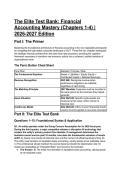
The Elite Test Bank: Financial
Accounting Mastery (Chapters 1-4) |
2026-2027 Edition
Part I: The Primer
Mastering the foundational architecture of financial accounting is the non-negotiable prerequisite
for navigating the high-stakes corporate landscape of 2027. These first four chapters distinguish
the strategic financial architect from the entry-level data processor, providing the cognitive
framework necessary to transform raw economic activity into a coherent, audited narrative of
organizational value.
The Panic Button Cheat Sheet
Core Pillar Standard / Formula / Rule
The Fundamental Equation Assets = Liabilities + Equity (Equity =
Contributed Capital + Retained Earnings)
Revenue Recognition ASC 606: Recognize revenue when
performance obligations are satisfied,
regardless of cash timing
The Matching Principle 2027 Mandate: Expenses must be recorded in
the same period as the revenues they helped
generate
Asset Valuation ASU 2023-08: Specific crypto-assets are
measured at fair value; others remain at
historical cost
Credit Loss Model ASU 2025-05: CECL (Current Expected Credit
Losses) must be applied to accounts receivable
Part II: The Elite Test Bank
Questions 1–15: Foundational Syntax & Application
Q1: An entity operates under the Going Concern Assumption for its 2026 fiscal year.
During the third quarter, a major competitor releases a disruptive AI technology that
renders the entity's primary product line obsolete. If management determines the
business cannot survive past 10 months, how does the fundamental valuation of assets
shift? A) Assets must remain at historical cost until the moment of official bankruptcy filing. B)
The entity must transition to liquidation-basis accounting, valuing assets at net realizable value.
C) The professional should maintain the accrual basis but double the depreciation rate. D)
Assets are reclassified as "Intangible Risks" and moved to the footnotes.
● The Answer: B) The entity must transition to liquidation-basis accounting, valuing assets
at net realizable value.
, ● Distractor Analysis: Option A represents a common amateur trap of delaying reporting
reality until legal insolvency; however, accounting standards require proactive reporting
once the assumption of continuity is violated. Option C is a pseudo-adjustment that fails to
address the underlying valuation principle. Option D is a fabrication of nomenclature that
ignores established GAAP procedures.
● The Mentor's Analysis: The Going Concern Assumption is the silent engine of the
historical cost principle. It allows a firm to record assets based on what was paid,
assuming those costs will be recovered through years of use. When the "foreseeable
future"—typically defined as one year—is threatened, the "Historical Cost" model
becomes irrelevant to stakeholders. In the 2027 regulatory environment, transparency
regarding viability is paramount. The professional recognizes that if the entity is effectively
"dead," the Balance Sheet must reflect "fire-sale" or liquidation values to protect creditors
and investors.
Q2: Which qualitative characteristic of financial information is directly compromised if a
junior accountant intentionally omits a $5 million environmental remediation liability on
the 2026 Balance Sheet because the exact payment date is "uncertain"? A) Comparability
B) Faithful Representation C) Verifiability D) Understandability
● The Answer: B) Faithful Representation
● Distractor Analysis: Comparability (A) refers to consistency across periods or firms.
Verifiability (C) concerns whether independent observers would reach the same
conclusion. Understandability (D) is about the clarity of the presentation. None of these
address the core issue of omitting a known economic obligation.
● The Mentor's Analysis: Faithful Representation requires that financial reports accurately
depict the economic phenomena they purport to represent. To achieve this, information
must be complete, neutral, and free from error. Omitting a material liability—even one with
timing uncertainty—violates the "completeness" requirement. In the 2027 audit climate,
where ESG (Environmental, Social, and Governance) liabilities are under heavy scrutiny,
such omissions are often categorized as fraudulent reporting rather than mere error.
Q3: A multinational corporation receives a $250,000 cryptocurrency payment in
November 2026 for a two-year service contract. According to the 2026/2027 standards for
digital assets (ASC 350-60), how should the entity record the initial transaction? A) Debit
Cash; Credit Service Revenue B) Debit Digital Assets; Credit Unearned Revenue C) Debit
Digital Assets; Credit Contributed Capital D) Debit Investment; Credit Sales Revenue
● The Answer: B) Debit Digital Assets; Credit Unearned Revenue
● Distractor Analysis: Option A incorrectly classifies crypto as "Cash," which is reserved
for fiat and cash equivalents. Option C suggests the payment is an owner investment
rather than a customer transaction. Option D violates the revenue recognition principle, as
the service has not yet been performed.
● The Mentor's Analysis: This scenario tests the intersection of new measurement
standards and classic revenue logic. While ASC 350-60 mandates that certain
crypto-assets be measured at fair value, it does not override the fundamental "Unearned
Revenue" concept. Because the service contract spans two years, the entity has a
performance obligation. The professional must recognize that the "form" of the asset
(Digital Asset) does not change the "nature" of the liability (Unearned Revenue). Success
in 2027 requires this fluid understanding of multi-layered standards.
Q4: In the 2026 ledger, "Accumulated Depreciation" is classified as a contra-asset. What
is the professional logic behind maintaining this account separately from the
"Equipment" account? A) To hide the actual value of the equipment from competitors. B) To
, comply with the "Island Rule" of physical asset tracking. C) To preserve the historical cost data
while simultaneously showing the asset's consumed utility. D) To ensure the Trial Balance
always has more credits than debits.
● The Answer: C) To preserve the historical cost data while simultaneously showing the
asset's consumed utility.
● Distractor Analysis: Option A is ethically flawed and logically incorrect; both accounts
are reported. Option B uses the prompt's internal terminology incorrectly. Option D
describes a balanced trial balance, not a credit-heavy one.
● The Mentor's Analysis: The "Historical Cost Principle" is a cornerstone of reliability.
Investors need to know what the company originally paid for its infrastructure
(transparency). However, they also need to know how much of that life has been used up
(relevance). By using a contra-asset account, the professional provides both data points.
This "Book Value" calculation (Cost - Accumulated Depreciation) provides a window into
the age and remaining productivity of the firm's physical capital.
Q5: A firm discovers a material error in January 2027: a $15,000 insurance premium paid
in early 2026 was never adjusted at year-end, leaving the entire amount in "Prepaid
Insurance." If the 2026 books are closed, how is this corrected? A) Record a $15,000
Insurance Expense in the 2027 Income Statement. B) Debit Retained Earnings; Credit Prepaid
Insurance. C) Debit Prepaid Insurance; Credit Cash. D) No correction is needed, as it will
self-correct in 2027.
● The Answer: B) Debit Retained Earnings; Credit Prepaid Insurance.
● Distractor Analysis: Option A distorts the 2027 results by including 2026 costs. Option C
is a new transaction entry, not a correction. Option D represents the "counterbalancing"
fallacy; while it may "wash out" eventually, the 2026 financial statements remain
unacceptably incorrect for audit purposes.
● The Mentor's Analysis: This is a "Prior Period Adjustment." Because the 2026
"Insurance Expense" account was closed into Retained Earnings, it no longer exists for
direct correction. The professional must bypass the temporary accounts and adjust the
permanent equity account (Retained Earnings) to reflect what the profit should have been.
This integrity of historical data is what separates elite practitioners from casual
bookkeepers.
Q6: A technology startup acquires an AI-processing server for $80,000 on account in late
2026. What is the immediate effect on the expanded accounting equation? A) Assets
increase; Equity increases. B) Assets increase; Liabilities increase.
● C) Assets decrease; Liabilities decrease. D) No effect until the cash is paid in 2027.
● The Answer: B) Assets increase; Liabilities increase.
● Distractor Analysis: Option A is incorrect because equity only increases through owner
investment or profit, not by incurring debt. Option C is the mathematical inverse of reality.
Option D is the "Cash-Basis" trap, which is a disqualifying error in professional accrual
accounting.
● The Mentor's Analysis: The accounting equation (A = L + E) is a tautology that must
always hold. "On account" signifies a legal obligation to pay in the future (Accounts
Payable), which is a liability. The server is a resource (Asset). Professional intuition
should immediately see the "Dual Effect": the company has more resources but also more
claims against those resources. The "When" of the cash payment is secondary to the
"When" of the economic transfer.
Q7: Which document serves as the primary "Book of Original Entry" where transactions
are first analyzed and recorded chronologically? A) The General Ledger B) The Adjusted
Accounting Mastery (Chapters 1-4) |
2026-2027 Edition
Part I: The Primer
Mastering the foundational architecture of financial accounting is the non-negotiable prerequisite
for navigating the high-stakes corporate landscape of 2027. These first four chapters distinguish
the strategic financial architect from the entry-level data processor, providing the cognitive
framework necessary to transform raw economic activity into a coherent, audited narrative of
organizational value.
The Panic Button Cheat Sheet
Core Pillar Standard / Formula / Rule
The Fundamental Equation Assets = Liabilities + Equity (Equity =
Contributed Capital + Retained Earnings)
Revenue Recognition ASC 606: Recognize revenue when
performance obligations are satisfied,
regardless of cash timing
The Matching Principle 2027 Mandate: Expenses must be recorded in
the same period as the revenues they helped
generate
Asset Valuation ASU 2023-08: Specific crypto-assets are
measured at fair value; others remain at
historical cost
Credit Loss Model ASU 2025-05: CECL (Current Expected Credit
Losses) must be applied to accounts receivable
Part II: The Elite Test Bank
Questions 1–15: Foundational Syntax & Application
Q1: An entity operates under the Going Concern Assumption for its 2026 fiscal year.
During the third quarter, a major competitor releases a disruptive AI technology that
renders the entity's primary product line obsolete. If management determines the
business cannot survive past 10 months, how does the fundamental valuation of assets
shift? A) Assets must remain at historical cost until the moment of official bankruptcy filing. B)
The entity must transition to liquidation-basis accounting, valuing assets at net realizable value.
C) The professional should maintain the accrual basis but double the depreciation rate. D)
Assets are reclassified as "Intangible Risks" and moved to the footnotes.
● The Answer: B) The entity must transition to liquidation-basis accounting, valuing assets
at net realizable value.
, ● Distractor Analysis: Option A represents a common amateur trap of delaying reporting
reality until legal insolvency; however, accounting standards require proactive reporting
once the assumption of continuity is violated. Option C is a pseudo-adjustment that fails to
address the underlying valuation principle. Option D is a fabrication of nomenclature that
ignores established GAAP procedures.
● The Mentor's Analysis: The Going Concern Assumption is the silent engine of the
historical cost principle. It allows a firm to record assets based on what was paid,
assuming those costs will be recovered through years of use. When the "foreseeable
future"—typically defined as one year—is threatened, the "Historical Cost" model
becomes irrelevant to stakeholders. In the 2027 regulatory environment, transparency
regarding viability is paramount. The professional recognizes that if the entity is effectively
"dead," the Balance Sheet must reflect "fire-sale" or liquidation values to protect creditors
and investors.
Q2: Which qualitative characteristic of financial information is directly compromised if a
junior accountant intentionally omits a $5 million environmental remediation liability on
the 2026 Balance Sheet because the exact payment date is "uncertain"? A) Comparability
B) Faithful Representation C) Verifiability D) Understandability
● The Answer: B) Faithful Representation
● Distractor Analysis: Comparability (A) refers to consistency across periods or firms.
Verifiability (C) concerns whether independent observers would reach the same
conclusion. Understandability (D) is about the clarity of the presentation. None of these
address the core issue of omitting a known economic obligation.
● The Mentor's Analysis: Faithful Representation requires that financial reports accurately
depict the economic phenomena they purport to represent. To achieve this, information
must be complete, neutral, and free from error. Omitting a material liability—even one with
timing uncertainty—violates the "completeness" requirement. In the 2027 audit climate,
where ESG (Environmental, Social, and Governance) liabilities are under heavy scrutiny,
such omissions are often categorized as fraudulent reporting rather than mere error.
Q3: A multinational corporation receives a $250,000 cryptocurrency payment in
November 2026 for a two-year service contract. According to the 2026/2027 standards for
digital assets (ASC 350-60), how should the entity record the initial transaction? A) Debit
Cash; Credit Service Revenue B) Debit Digital Assets; Credit Unearned Revenue C) Debit
Digital Assets; Credit Contributed Capital D) Debit Investment; Credit Sales Revenue
● The Answer: B) Debit Digital Assets; Credit Unearned Revenue
● Distractor Analysis: Option A incorrectly classifies crypto as "Cash," which is reserved
for fiat and cash equivalents. Option C suggests the payment is an owner investment
rather than a customer transaction. Option D violates the revenue recognition principle, as
the service has not yet been performed.
● The Mentor's Analysis: This scenario tests the intersection of new measurement
standards and classic revenue logic. While ASC 350-60 mandates that certain
crypto-assets be measured at fair value, it does not override the fundamental "Unearned
Revenue" concept. Because the service contract spans two years, the entity has a
performance obligation. The professional must recognize that the "form" of the asset
(Digital Asset) does not change the "nature" of the liability (Unearned Revenue). Success
in 2027 requires this fluid understanding of multi-layered standards.
Q4: In the 2026 ledger, "Accumulated Depreciation" is classified as a contra-asset. What
is the professional logic behind maintaining this account separately from the
"Equipment" account? A) To hide the actual value of the equipment from competitors. B) To
, comply with the "Island Rule" of physical asset tracking. C) To preserve the historical cost data
while simultaneously showing the asset's consumed utility. D) To ensure the Trial Balance
always has more credits than debits.
● The Answer: C) To preserve the historical cost data while simultaneously showing the
asset's consumed utility.
● Distractor Analysis: Option A is ethically flawed and logically incorrect; both accounts
are reported. Option B uses the prompt's internal terminology incorrectly. Option D
describes a balanced trial balance, not a credit-heavy one.
● The Mentor's Analysis: The "Historical Cost Principle" is a cornerstone of reliability.
Investors need to know what the company originally paid for its infrastructure
(transparency). However, they also need to know how much of that life has been used up
(relevance). By using a contra-asset account, the professional provides both data points.
This "Book Value" calculation (Cost - Accumulated Depreciation) provides a window into
the age and remaining productivity of the firm's physical capital.
Q5: A firm discovers a material error in January 2027: a $15,000 insurance premium paid
in early 2026 was never adjusted at year-end, leaving the entire amount in "Prepaid
Insurance." If the 2026 books are closed, how is this corrected? A) Record a $15,000
Insurance Expense in the 2027 Income Statement. B) Debit Retained Earnings; Credit Prepaid
Insurance. C) Debit Prepaid Insurance; Credit Cash. D) No correction is needed, as it will
self-correct in 2027.
● The Answer: B) Debit Retained Earnings; Credit Prepaid Insurance.
● Distractor Analysis: Option A distorts the 2027 results by including 2026 costs. Option C
is a new transaction entry, not a correction. Option D represents the "counterbalancing"
fallacy; while it may "wash out" eventually, the 2026 financial statements remain
unacceptably incorrect for audit purposes.
● The Mentor's Analysis: This is a "Prior Period Adjustment." Because the 2026
"Insurance Expense" account was closed into Retained Earnings, it no longer exists for
direct correction. The professional must bypass the temporary accounts and adjust the
permanent equity account (Retained Earnings) to reflect what the profit should have been.
This integrity of historical data is what separates elite practitioners from casual
bookkeepers.
Q6: A technology startup acquires an AI-processing server for $80,000 on account in late
2026. What is the immediate effect on the expanded accounting equation? A) Assets
increase; Equity increases. B) Assets increase; Liabilities increase.
● C) Assets decrease; Liabilities decrease. D) No effect until the cash is paid in 2027.
● The Answer: B) Assets increase; Liabilities increase.
● Distractor Analysis: Option A is incorrect because equity only increases through owner
investment or profit, not by incurring debt. Option C is the mathematical inverse of reality.
Option D is the "Cash-Basis" trap, which is a disqualifying error in professional accrual
accounting.
● The Mentor's Analysis: The accounting equation (A = L + E) is a tautology that must
always hold. "On account" signifies a legal obligation to pay in the future (Accounts
Payable), which is a liability. The server is a resource (Asset). Professional intuition
should immediately see the "Dual Effect": the company has more resources but also more
claims against those resources. The "When" of the cash payment is secondary to the
"When" of the economic transfer.
Q7: Which document serves as the primary "Book of Original Entry" where transactions
are first analyzed and recorded chronologically? A) The General Ledger B) The Adjusted