

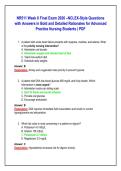
NR511 Week 8 Final Exam 2026 –NCLEX-Style Questions
with Answers in Bold and Detailed Rationales for Advanced
Practice Nursing Students | PDF
1. A patient with acute heart failure presents with dyspnea, crackles, and edema. What
is the priority nursing intervention?
A. Administer oral diuretic
B. Administer oxygen and elevate head of bed
C. Teach low-sodium diet
D. Schedule daily weights
Answer: B
Explanation: Airway and oxygenation take priority to prevent hypoxia.
2. A patient with DKA has blood glucose 480 mg/dL and fruity breath. Which
intervention is most urgent?
A. Administer insulin per sliding scale
B. Start IV fluids and insulin infusion
C. Provide oral glucose
D. Encourage ambulation
Answer: B
Explanation: DKA requires immediate fluid resuscitation and insulin to correct
hyperglycemia and dehydration.
3. Which lab value is most concerning in a patient on digoxin?
A. Potassium 4.0 mEq/L
B. Sodium 138 mEq/L
C. Potassium 2.7 mEq/L
D. Magnesium 2.0 mg/dL
Answer: C
Explanation: Hypokalemia increases risk for digoxin toxicity.
, 4. A nurse is delegating tasks to an LPN. Which task is appropriate?
A. Performing initial admission assessment
B. Administering IV push medications
C. Changing a stable wound dressing
D. Developing care plan
Answer: C
Explanation: LPNs can perform routine care on stable patients; assessment and planning
remain RN responsibilities.
5. A patient with COPD becomes restless and confused. SpO₂ is 85%. What should
the nurse do first?
A. Call family
B. Document findings
C. Apply oxygen and assess airway
D. Give bronchodilator
Answer: C
Explanation: Hypoxia is life-threatening; oxygenation is the priority.
6. A patient reports chest pain radiating to the left arm. Which action is priority?
A. Administer antacid
B. Obtain ECG
C. Call rapid response / activate STEMI protocol
D. Document symptoms
Answer: C
Explanation: Chest pain with radiation suggests myocardial infarction; rapid reperfusion is
critical.
7. Which intervention best prevents pressure injuries?
A. Massage reddened areas
B. Reposition every 2 hours
C. Reduce fluid intake
D. Apply heat
, Answer: B
Explanation: Frequent repositioning relieves pressure and prevents skin breakdown.
8. A patient with CKD has potassium 6.5 mEq/L. Which action is priority?
A. Encourage high-potassium foods
B. Notify provider immediately
C. Administer potassium supplement
D. Monitor BP
Answer: B
Explanation: Hyperkalemia can cause lethal cardiac arrhythmias.
9. Which patient is appropriate for discharge?
A. O₂ saturation 88% on room air
B. Pain 8/10
C. Stable vitals and symptom control
D. New medication started today
Answer: C
Explanation: Discharge requires stability and controlled symptoms.
10. A nurse is teaching a patient about warfarin. Which statement indicates
understanding?
A. “I can take ibuprofen freely.”
B. “I will avoid all green vegetables.”
C. “I will have my INR checked regularly.”
D. “Bleeding gums are normal.”
Answer: C
Explanation: INR monitoring ensures therapeutic anticoagulation.
11. Which assessment finding indicates fluid overload?
A. Dry mucous membranes
B. Crackles in lungs
with Answers in Bold and Detailed Rationales for Advanced
Practice Nursing Students | PDF
1. A patient with acute heart failure presents with dyspnea, crackles, and edema. What
is the priority nursing intervention?
A. Administer oral diuretic
B. Administer oxygen and elevate head of bed
C. Teach low-sodium diet
D. Schedule daily weights
Answer: B
Explanation: Airway and oxygenation take priority to prevent hypoxia.
2. A patient with DKA has blood glucose 480 mg/dL and fruity breath. Which
intervention is most urgent?
A. Administer insulin per sliding scale
B. Start IV fluids and insulin infusion
C. Provide oral glucose
D. Encourage ambulation
Answer: B
Explanation: DKA requires immediate fluid resuscitation and insulin to correct
hyperglycemia and dehydration.
3. Which lab value is most concerning in a patient on digoxin?
A. Potassium 4.0 mEq/L
B. Sodium 138 mEq/L
C. Potassium 2.7 mEq/L
D. Magnesium 2.0 mg/dL
Answer: C
Explanation: Hypokalemia increases risk for digoxin toxicity.
, 4. A nurse is delegating tasks to an LPN. Which task is appropriate?
A. Performing initial admission assessment
B. Administering IV push medications
C. Changing a stable wound dressing
D. Developing care plan
Answer: C
Explanation: LPNs can perform routine care on stable patients; assessment and planning
remain RN responsibilities.
5. A patient with COPD becomes restless and confused. SpO₂ is 85%. What should
the nurse do first?
A. Call family
B. Document findings
C. Apply oxygen and assess airway
D. Give bronchodilator
Answer: C
Explanation: Hypoxia is life-threatening; oxygenation is the priority.
6. A patient reports chest pain radiating to the left arm. Which action is priority?
A. Administer antacid
B. Obtain ECG
C. Call rapid response / activate STEMI protocol
D. Document symptoms
Answer: C
Explanation: Chest pain with radiation suggests myocardial infarction; rapid reperfusion is
critical.
7. Which intervention best prevents pressure injuries?
A. Massage reddened areas
B. Reposition every 2 hours
C. Reduce fluid intake
D. Apply heat
, Answer: B
Explanation: Frequent repositioning relieves pressure and prevents skin breakdown.
8. A patient with CKD has potassium 6.5 mEq/L. Which action is priority?
A. Encourage high-potassium foods
B. Notify provider immediately
C. Administer potassium supplement
D. Monitor BP
Answer: B
Explanation: Hyperkalemia can cause lethal cardiac arrhythmias.
9. Which patient is appropriate for discharge?
A. O₂ saturation 88% on room air
B. Pain 8/10
C. Stable vitals and symptom control
D. New medication started today
Answer: C
Explanation: Discharge requires stability and controlled symptoms.
10. A nurse is teaching a patient about warfarin. Which statement indicates
understanding?
A. “I can take ibuprofen freely.”
B. “I will avoid all green vegetables.”
C. “I will have my INR checked regularly.”
D. “Bleeding gums are normal.”
Answer: C
Explanation: INR monitoring ensures therapeutic anticoagulation.
11. Which assessment finding indicates fluid overload?
A. Dry mucous membranes
B. Crackles in lungs


