

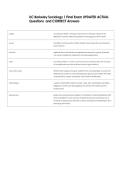
UC Berkeley Sociology 1 Final Exam UPDATED ACTUAL
Questions and CORRECT Answers
politics according to Weber, "striving to share power or striving to influence the
distribution of power, either among states or among groups within a state"
power the ability to achieve ends or further interests; also includes the use of physical
force/violence
authority legitimate forms of domination recognized and obeyed by a group of people;
can come in traditional, charismatic, and rational-legal forms
state according to Weber, a "human community that (successfully) claims the monopoly
of the legitimate use of physical force within a given territory"
class, status, party Weber's idea of groups that gain wealth/money, honor/prestige, or power; the
distribution of power in a society through status groups (communities with similar
characteristics), classes, and parties, which leads to stratification
rational-legal a system of domination based on reason, order, laws, and thinking; rules define
obligations and they are discharged by the "servant of the state" (aka the
bureaucracy)
bureaucracy public rules and procedures codified in an institution; includes administrative staff
which is obedient to those in power; material reward and social honor act as
incentives to keep power with those in office and keeps the administration from
exercising domination
, executive committee of the bourgeoisie Marx's idea of a tool used by the bourgeoisie to enforce its dominance in all
realms, not neutral; the state represents this, as it is a tool to enforce conflict
theory/stratification and support the interests of the bourgeoisie over the
proletariat
stratification the arrangement or classification of something into different groups; Weber
believes that this is caused by differences in class, status, and party; affected by
education, race, economics, and a variety of other factors that affect overall life
outcomes
life chances the opportunities available to an individual to improve their quality of life, usually
tied to socioeconomic status
mobility the ability to move up or down in a society
superstructure a system- institutions and organizations- which helps to support the oppression of
lower classes
means of production the facilities and resources for producing goods
class in itself part of Marx's conflict theory, when the proletariat reaches class consciousness
and realizes that they have a shared struggle
class for itself part of Marx's conflict theory, where the proletariat realizes that their class
struggle is a reflection/part of a larger historical process
bourgeoisie the dominant group in society which owns the means of production
proletariat the group in society which does not own the means of production but will rise up
and overthrow the ruling class
socialism a theory that the means of production are owned by the community as a whole
communism the result of class warfare, where the means of production are publicly owned
and people are paid according to their means
self-fulfilling prophecy an idea that, in reality, is false but becomes true when the belief that it is true
determines behavior
discrimination different treatment of groups based on membership in that group
cultural capital the assets of an individual that promote social mobility; Bourdieu says that this is a
resource that allows individuals to succeed in society, defined by a dominant
group deciding the rules of a game within a field
total institution a form of an institution in which there is no separation between the different
spheres of life, a bureaucratic organization of power; usually used to control
behavior and separate an individual from larger society
Questions and CORRECT Answers
politics according to Weber, "striving to share power or striving to influence the
distribution of power, either among states or among groups within a state"
power the ability to achieve ends or further interests; also includes the use of physical
force/violence
authority legitimate forms of domination recognized and obeyed by a group of people;
can come in traditional, charismatic, and rational-legal forms
state according to Weber, a "human community that (successfully) claims the monopoly
of the legitimate use of physical force within a given territory"
class, status, party Weber's idea of groups that gain wealth/money, honor/prestige, or power; the
distribution of power in a society through status groups (communities with similar
characteristics), classes, and parties, which leads to stratification
rational-legal a system of domination based on reason, order, laws, and thinking; rules define
obligations and they are discharged by the "servant of the state" (aka the
bureaucracy)
bureaucracy public rules and procedures codified in an institution; includes administrative staff
which is obedient to those in power; material reward and social honor act as
incentives to keep power with those in office and keeps the administration from
exercising domination
, executive committee of the bourgeoisie Marx's idea of a tool used by the bourgeoisie to enforce its dominance in all
realms, not neutral; the state represents this, as it is a tool to enforce conflict
theory/stratification and support the interests of the bourgeoisie over the
proletariat
stratification the arrangement or classification of something into different groups; Weber
believes that this is caused by differences in class, status, and party; affected by
education, race, economics, and a variety of other factors that affect overall life
outcomes
life chances the opportunities available to an individual to improve their quality of life, usually
tied to socioeconomic status
mobility the ability to move up or down in a society
superstructure a system- institutions and organizations- which helps to support the oppression of
lower classes
means of production the facilities and resources for producing goods
class in itself part of Marx's conflict theory, when the proletariat reaches class consciousness
and realizes that they have a shared struggle
class for itself part of Marx's conflict theory, where the proletariat realizes that their class
struggle is a reflection/part of a larger historical process
bourgeoisie the dominant group in society which owns the means of production
proletariat the group in society which does not own the means of production but will rise up
and overthrow the ruling class
socialism a theory that the means of production are owned by the community as a whole
communism the result of class warfare, where the means of production are publicly owned
and people are paid according to their means
self-fulfilling prophecy an idea that, in reality, is false but becomes true when the belief that it is true
determines behavior
discrimination different treatment of groups based on membership in that group
cultural capital the assets of an individual that promote social mobility; Bourdieu says that this is a
resource that allows individuals to succeed in society, defined by a dominant
group deciding the rules of a game within a field
total institution a form of an institution in which there is no separation between the different
spheres of life, a bureaucratic organization of power; usually used to control
behavior and separate an individual from larger society


