
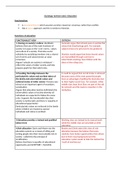
Sociology revision notes: Education
Functionalism
A structural theory which assumes society is based on consensus rather than conflict.
Has a macro approach and this is similar to Marxism.
Functions of education
FUNCTIONALIST VIEW CRITICSM
1 .Passing on society’s culture -Durkheim Feminists argue that schools pass on patriarchal
believes that one of the main functions of values that disadvantage girls .For example ,
society is to pass on the ‘core’ norms , values subject choices for girls tend to be gendered.
and culture of a society. Promotes social
solidarity by socialising members into a shared Marxists would argue that these shared values
set of norms and values known as value are transmitted through coercion to
consensus. indoctrinate working class children with the
Argued ‘schools are society in miniature’ – ideas of the ruling class.
reflect the values of wider society and help
prepare pupils for their adult roles.
2.Providing the bridge between the It could be argued that not all status is achieved
particularistic values and ascribed status of because many of the most powerful people
the family and universalistic values and have an advantage of getting the best jobs due
achieved status of wider society- Parsons sees to their higher social class. For example, white
school as an important agent of secondary middle class boys from Eton are part of the old
socialisation. tie network and this leads to nepotism in the
Argues that education teaches individuals the workplace.
universalistic values of society whereby all
individuals are expected to follow the same
rules. Supports the functionalist idea that
society is meritocratic and there is ‘equality of
educational opportunity’.
Particularistic values are enforced in the family
where children are treated as special
individuals and status is ascribed.
3.Education provides a trained and qualified Working class are trained to do manual work
labour force while the middle class are provided an elite
education.
4.Role allocation- Davis and Moore see the Bowles and Gintis reject this view of role
education system as a means of sifting and allocation because the believe that some
sorting people into their most suitable role in students have better opportunities than others
society ; called this the principal of due to their class background and the
stratification. education system seeks to hide this behind the
Believe that there is equality of educational ‘myth of meritocracy’.
opportunity and IQ+EFFORT = SUCCESS.
, New Right
Both Functionalism and the New Right believe that the education system should be
run on meritocratic principles of open competition ,one that serves the needs of the
economy by preparing young people for work.
Both believe that education should socialise pupils into shared values and instil a
sense of national identity.
Differences
The New Right does not agree that schools have reached the goal of meeting the goals of
the economy. Their solution to this is the marketisation of schools which will increase
competition and standards.
Chubb and Moe : Parents should be given a voucher to ‘spend’ at a school of their choice.
Forces schools to respond to the needs of parents and students and schools act as private
businesses by competing to attract ‘customers’.
Marxism
Althusser: Education is an ideological state apparatus that functions to maintain , legitimise
and reproduce class inequalities by transmitting capitalist values disguised as common
values.
- As the ruling class cannot control through force , they control through ideology. This is
called hegemony which is to win people’s hearts and minds.
Education transmits ruling class ideology in two ways:
Formal curriculum: formally taught subjects e.g. classical books are taught in English. This is
part of middle class habitus.
Hidden curriculum: implicit and hidden messages are passed on through the way schools are
organised. The informal way of encouraging obedience , conformity and acceptance of failure.
Bourdieu: Symbolic violence: students are ‘duped’ into accepting their failure ; if you fail ,you
only have yourself to blame and this is a form of symbolic violence.
Cultural capital : middle class culture is the one most valued by the education system .
Parents can take their children on educational trips and help them with their
homework.
Bowles and Gintis: the correspondence theory states that the norms and values pupils learn at
school corresponds to the norms and values which make it easy for future
capitalist employers to exploit them at work. Schools operate in the ‘long
shadow of work’.
Hierarchy Schools teach acceptance of hierarchy -pupils
are expected to obey the authority of teachers
and later on at work , workers are expected to
obey the authority of managers.
Power Pupils’ lack power and autonomy – they have
, little say over what they learn. This is linked to
alienation in the workplace and lack of
autonomy.
Organisation Both schools and the workplace are fragmented
to make it difficult for students to
understand .This fragmentation makes workers
easier to control because they are divided.
More difficult for them to unite and challenge
their exploitative conditions.
Motivation Pupils are motivated by the external rewards
of exam success rather than the joy of learning
itself just as workers are motivated by the
wages rather than the joy of working.
A03 Evaluation
Support for Bowles and Gintis Criticisms of Bowles and Gintis
Vocational education was introduced in the Brown argues Marxism is outdated because
1980s.This refers to teaching individuals the employers do not want docile workers who
specific skills and knowledge required for a can only conform .Instead, they seek to
particular career. For example, students can employ individuals who are creative and can
take apprenticeships or courses such as think for themselves.
BTEC health and social care which focus on a Willis argues that education does not always
particular career. succeed in socialising people into dominant
values. These ‘lads’ consciously turn away
from school and seek unskilled work rather
than being ‘forced into it’.
Reynolds – some subjects such as
humanities and sociology teach students to
be critical and question what is happening
around them.
Feminism
Marxist Feminism: the education system has encouraged girls to take the more expressive subjects
which may lead them into the role of carer. This means that they will become
‘slaves of the wage slaves’ and suffer a double exploitation.
Radical Feminism: argue that subject choices for female students tend to be gendered. Argue that
girls are encouraged to take more expressive subjects which are held in lower
esteem while boys take STEM subjects that can lead them into more highly paid
jobs. This upholds patriarchy and allows men to keep control in society because
of their high status.
Liberal feminism: boys outperformed girls in school in the past but due to changes in the law and
attitudes ,girls have been encouraged to be more ambitious.Policy changes such as
the 1988 ERA which introduced coursework and core subjects at GCSE have helped
girls overtake boys in terms of achievement.
Sue Sharpe: girls priorities have changed from love and marriage in the 1970s to careers and
financial independence in the 1990s.
Functionalism
A structural theory which assumes society is based on consensus rather than conflict.
Has a macro approach and this is similar to Marxism.
Functions of education
FUNCTIONALIST VIEW CRITICSM
1 .Passing on society’s culture -Durkheim Feminists argue that schools pass on patriarchal
believes that one of the main functions of values that disadvantage girls .For example ,
society is to pass on the ‘core’ norms , values subject choices for girls tend to be gendered.
and culture of a society. Promotes social
solidarity by socialising members into a shared Marxists would argue that these shared values
set of norms and values known as value are transmitted through coercion to
consensus. indoctrinate working class children with the
Argued ‘schools are society in miniature’ – ideas of the ruling class.
reflect the values of wider society and help
prepare pupils for their adult roles.
2.Providing the bridge between the It could be argued that not all status is achieved
particularistic values and ascribed status of because many of the most powerful people
the family and universalistic values and have an advantage of getting the best jobs due
achieved status of wider society- Parsons sees to their higher social class. For example, white
school as an important agent of secondary middle class boys from Eton are part of the old
socialisation. tie network and this leads to nepotism in the
Argues that education teaches individuals the workplace.
universalistic values of society whereby all
individuals are expected to follow the same
rules. Supports the functionalist idea that
society is meritocratic and there is ‘equality of
educational opportunity’.
Particularistic values are enforced in the family
where children are treated as special
individuals and status is ascribed.
3.Education provides a trained and qualified Working class are trained to do manual work
labour force while the middle class are provided an elite
education.
4.Role allocation- Davis and Moore see the Bowles and Gintis reject this view of role
education system as a means of sifting and allocation because the believe that some
sorting people into their most suitable role in students have better opportunities than others
society ; called this the principal of due to their class background and the
stratification. education system seeks to hide this behind the
Believe that there is equality of educational ‘myth of meritocracy’.
opportunity and IQ+EFFORT = SUCCESS.
, New Right
Both Functionalism and the New Right believe that the education system should be
run on meritocratic principles of open competition ,one that serves the needs of the
economy by preparing young people for work.
Both believe that education should socialise pupils into shared values and instil a
sense of national identity.
Differences
The New Right does not agree that schools have reached the goal of meeting the goals of
the economy. Their solution to this is the marketisation of schools which will increase
competition and standards.
Chubb and Moe : Parents should be given a voucher to ‘spend’ at a school of their choice.
Forces schools to respond to the needs of parents and students and schools act as private
businesses by competing to attract ‘customers’.
Marxism
Althusser: Education is an ideological state apparatus that functions to maintain , legitimise
and reproduce class inequalities by transmitting capitalist values disguised as common
values.
- As the ruling class cannot control through force , they control through ideology. This is
called hegemony which is to win people’s hearts and minds.
Education transmits ruling class ideology in two ways:
Formal curriculum: formally taught subjects e.g. classical books are taught in English. This is
part of middle class habitus.
Hidden curriculum: implicit and hidden messages are passed on through the way schools are
organised. The informal way of encouraging obedience , conformity and acceptance of failure.
Bourdieu: Symbolic violence: students are ‘duped’ into accepting their failure ; if you fail ,you
only have yourself to blame and this is a form of symbolic violence.
Cultural capital : middle class culture is the one most valued by the education system .
Parents can take their children on educational trips and help them with their
homework.
Bowles and Gintis: the correspondence theory states that the norms and values pupils learn at
school corresponds to the norms and values which make it easy for future
capitalist employers to exploit them at work. Schools operate in the ‘long
shadow of work’.
Hierarchy Schools teach acceptance of hierarchy -pupils
are expected to obey the authority of teachers
and later on at work , workers are expected to
obey the authority of managers.
Power Pupils’ lack power and autonomy – they have
, little say over what they learn. This is linked to
alienation in the workplace and lack of
autonomy.
Organisation Both schools and the workplace are fragmented
to make it difficult for students to
understand .This fragmentation makes workers
easier to control because they are divided.
More difficult for them to unite and challenge
their exploitative conditions.
Motivation Pupils are motivated by the external rewards
of exam success rather than the joy of learning
itself just as workers are motivated by the
wages rather than the joy of working.
A03 Evaluation
Support for Bowles and Gintis Criticisms of Bowles and Gintis
Vocational education was introduced in the Brown argues Marxism is outdated because
1980s.This refers to teaching individuals the employers do not want docile workers who
specific skills and knowledge required for a can only conform .Instead, they seek to
particular career. For example, students can employ individuals who are creative and can
take apprenticeships or courses such as think for themselves.
BTEC health and social care which focus on a Willis argues that education does not always
particular career. succeed in socialising people into dominant
values. These ‘lads’ consciously turn away
from school and seek unskilled work rather
than being ‘forced into it’.
Reynolds – some subjects such as
humanities and sociology teach students to
be critical and question what is happening
around them.
Feminism
Marxist Feminism: the education system has encouraged girls to take the more expressive subjects
which may lead them into the role of carer. This means that they will become
‘slaves of the wage slaves’ and suffer a double exploitation.
Radical Feminism: argue that subject choices for female students tend to be gendered. Argue that
girls are encouraged to take more expressive subjects which are held in lower
esteem while boys take STEM subjects that can lead them into more highly paid
jobs. This upholds patriarchy and allows men to keep control in society because
of their high status.
Liberal feminism: boys outperformed girls in school in the past but due to changes in the law and
attitudes ,girls have been encouraged to be more ambitious.Policy changes such as
the 1988 ERA which introduced coursework and core subjects at GCSE have helped
girls overtake boys in terms of achievement.
Sue Sharpe: girls priorities have changed from love and marriage in the 1970s to careers and
financial independence in the 1990s.


