
BSC 2085 Anatomy and Physiology Lab UPDATED ACTUAL
Questions and CORRECT Answers
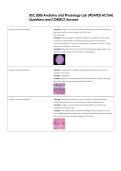
simple squamous epithelium *structure*: single row of thin cells; looks like dark purple circles and red thread
like back round colored in; single row of thin cells
(thin, scaly cells)
*Function*:Allows passage of materials by diffusion and filtration in sites where
protection is not important; secretes lubricating substances in serosae. ;
Permits rapid diffusion or transport of substances • Secretes serous fluid • Alveoli,
glomeruli, endothelium, and serosa
*Location*:Kidney glomeruli, air sacs of lungs, lining of heart, blood vessels, and
lymphatic vessels; lining of ventral body cavity(serosae)
simple cuboidal epithelium *structure*: single layer of cube-like cells with large, spherical central nuclei
square or round cells
*function*: absorption
*location*: glands and ducts (bile duct); kidney tubules; Liver, thyroid, mammary
and salivary glands, bronchioles, and kidney tubules
simple columnar epithelium *Function*: Absorption; secretion of mucus, enzymes, and other substances;
ciliated type propels mucus (or reproductive cells) by ciliated action.
*structure*: single row of thin cells; permits rapid diffusion or transport of
substances tall narrow cells
*Location*: Non-ciliated type lines most of the digestive tract (stomach to anal
canal), gallbladder and excretory ducts of some glands; ciliated variety lines small
bronchi, uterine tubes, and some regions of the uterus.
,pseudostratified columnar epithelium *structure*:tissue that consists of a single layer of irregularly shaped and sized
cells that give the appearance of multiple layers; found in ducts of certain glands
and the upper respiratory tract; • Not all cells reach the free surface • Shorter
cells are covered over by taller ones • Looks stratified • Every cell reaches the
basement membrane
*location*: trachea; vas deferens and epididymis.
* function*: secrete mucous; protects lungs from pollutants
from ppt: Looks multilayered; some not reaching free surface; all touch basement
membrane o Nuclei at several layers o With cilia and goblet cells o Secretes and
propels mucus o Respiratory tract and portions of male urethra
midsagittal plane divides the body into equal right and left sides or organ
Axial region: head, neck, & trunk
anterior closer to the front
ventral surface of human - front of chest & abdomen
ex: The trachea is anterior to the esophagus.
thoracic region trunk above diaphragm
abdominal region trunk below diaphragm
• divided into quadrants
• divided into nine regions by tic-tac-toe grid
Appendicular region: upper & lower limbs
upper limb •arm (brachial region), forearm (antebrachial region), wrist (carpal region), hand
(manual region), fingers (digits)
lower limb •thigh (femoral region), leg (crural region),ankle (tarsal region), foot (pedal region),
toes (digits)
major body cavities cranial cavity
vertebral canal
• meninges
thoracic cavity
abdominopelvic cavity
• abdominal cavity
• pelvic cavity
*lined by serous membranes and filled with viscera*
, cranial cavity contains the brain and lined with meninges
vertebral canal contains the spinal cord, lined with meninges
stratified squamous epithelium *Function*:protects underlying tissues in areas subject to abrasion
*structure*: multiple cell layers with cells becoming flat and scaly toward surface
*Location*: nonkeratinized type forms the moist lining of the esophagus, mouth,
and vagina; keratinized type forms the epidermis of the skin, a dry membrane.
from ppt: Multiple cell layers with cells becoming flat and scaly toward surface o
Epidermis; palms and soles heavily keratinized o Resists abrasion; retards water
loss through skin; resists penetration by pathogenic organisms
nonkeratinized stratified squamous epithelium Same as keratinized epithelium without the surface layer of dead cells o Tongue,
oral mucosa, esophagus, and vagina o Resists abrasion and penetration of
pathogens


