

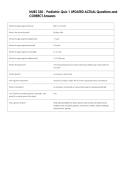
NURS 330 - Pediatric Quiz 1 UPDATED ACTUAL Questions and
CORRECT Answers
What is the age range for infancy? Birth to 12 months
When is the neonatal period? 28 days of life
What is the age range for toddlerhood? 1-2 years
What is the age range for preschool? 3-5 years
What is the age range for school age? 6-11/12 years
What is the age range for adolescence? 11/13-18/20 years
What is development? "is the sequential process by which infants and children gain various skills and
functions"
What is growth? an increase in physical size
how is growth measured? measured by height, weight, BMI and when appropriate head circumference
What is maturation? an increase in functionality of various body systems or developmental skills
T or F: Growth is an orderly process, systematic, and True
specific to certain parts of the body.
Why is growth diverse? Wide individual differences exist in growth rates and they are influenced by
multiple factors. d/t SDOH, genetics, environment, nutrition, health challenges,
temperament, gender
, How does development proceed? -simple to complex
-general to specific
-in a cephalocaudal and proximodistal progression
What is cephalocaudal? Control of head before everything below the head
What is proximodistal? Inside to outwards i.e., gain control of arms before hands before fingers
Why is growth and development important? Experiences in childhood and adolescents affect lifelong health, and the earlier
we invest in children's health, the greater return.
T or F: Understanding and caring for children is a True
fundament right and a nursing obligation
In Canada, what rights do children have? -Respect as full members of society
-Affection, care and support
-A healthy environment
-Access to adequate nutrition, housing, and essential services
-Access to appropriate health care services
Why is assessment important in pediatrics? It is a right and an obligation of nurses, establishes a baseline with the
patient/client working with and identify trends and issues to intervene for/with
What do we need to assess in pediatric patients? Growth (height, weight, head circumference, BMI) and development (gross motor
function (i.e., large muscle groups), fine motor function (i.e., hand-eye
coordination and small muscle movement, language, drawing), cognitive abilities
(learning, understanding, problem solving, and reasoning and remembering) and
psychosocial (i.e., how are they connecting with others)
What is Bowlby's theory? The Attachment theory
What is Erikson's Theory? Psychosocial development theory
What is Piaget's Theory? Theory of cognitive development
What is Freud's Theory? Theory of Psychosexual development
What is Kohlberg's theory? Theory of Moral Development
What is the attachment theory? -Attachment is a motivational-behavioral control system
-BOWLBY identified that infants need one special relationship for internal
development i.e., someone connected to and trustworthy to the person and act
as a role model
-Successful early attachment to one person facilitates the child to learn to cue her
behavior to the subtle social cues of many
-This experience allows the child to develop the ability to engage in social
relationships, to make friends, and, to eventually attain physical intimacy.
-Psychosocial connectedness with others
-A child's experience with caregivers gives a sense of worth, a belief in the
helpfulness of others, and a favorable model on which to build a future
relationship
CORRECT Answers
What is the age range for infancy? Birth to 12 months
When is the neonatal period? 28 days of life
What is the age range for toddlerhood? 1-2 years
What is the age range for preschool? 3-5 years
What is the age range for school age? 6-11/12 years
What is the age range for adolescence? 11/13-18/20 years
What is development? "is the sequential process by which infants and children gain various skills and
functions"
What is growth? an increase in physical size
how is growth measured? measured by height, weight, BMI and when appropriate head circumference
What is maturation? an increase in functionality of various body systems or developmental skills
T or F: Growth is an orderly process, systematic, and True
specific to certain parts of the body.
Why is growth diverse? Wide individual differences exist in growth rates and they are influenced by
multiple factors. d/t SDOH, genetics, environment, nutrition, health challenges,
temperament, gender
, How does development proceed? -simple to complex
-general to specific
-in a cephalocaudal and proximodistal progression
What is cephalocaudal? Control of head before everything below the head
What is proximodistal? Inside to outwards i.e., gain control of arms before hands before fingers
Why is growth and development important? Experiences in childhood and adolescents affect lifelong health, and the earlier
we invest in children's health, the greater return.
T or F: Understanding and caring for children is a True
fundament right and a nursing obligation
In Canada, what rights do children have? -Respect as full members of society
-Affection, care and support
-A healthy environment
-Access to adequate nutrition, housing, and essential services
-Access to appropriate health care services
Why is assessment important in pediatrics? It is a right and an obligation of nurses, establishes a baseline with the
patient/client working with and identify trends and issues to intervene for/with
What do we need to assess in pediatric patients? Growth (height, weight, head circumference, BMI) and development (gross motor
function (i.e., large muscle groups), fine motor function (i.e., hand-eye
coordination and small muscle movement, language, drawing), cognitive abilities
(learning, understanding, problem solving, and reasoning and remembering) and
psychosocial (i.e., how are they connecting with others)
What is Bowlby's theory? The Attachment theory
What is Erikson's Theory? Psychosocial development theory
What is Piaget's Theory? Theory of cognitive development
What is Freud's Theory? Theory of Psychosexual development
What is Kohlberg's theory? Theory of Moral Development
What is the attachment theory? -Attachment is a motivational-behavioral control system
-BOWLBY identified that infants need one special relationship for internal
development i.e., someone connected to and trustworthy to the person and act
as a role model
-Successful early attachment to one person facilitates the child to learn to cue her
behavior to the subtle social cues of many
-This experience allows the child to develop the ability to engage in social
relationships, to make friends, and, to eventually attain physical intimacy.
-Psychosocial connectedness with others
-A child's experience with caregivers gives a sense of worth, a belief in the
helpfulness of others, and a favorable model on which to build a future
relationship


