

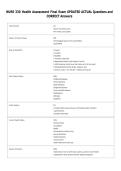
NURS 330 Health Assessment Final Exam UPDATED ACTUAL Questions and
CORRECT Answers
Chief Concern CC
Reason for seeking care
Pt's words, use quotes
History of Present Illness HPI
Chronological account of cc and history
OLDCARTS
What is OLDCARTS? O onset
L location
D duration
C character (describe)
A aggravating factors (what makes it worse)
R relief measures (what have they tried even if did not work)
T temporal factors (time of day, seasons, etc)
S severity (scale 1-10, describe if stabbing aching etc)
Past Medical History PMH
Childhood illnesses
Immunizations
Adult Illnesses
Surgeries/injuries
Communicable diseases
Medications
Allergies
Disabilities
Family History FH
includes health status and age of immediate family members
2 generations
hereditary disorders
Current Health Status CHS
personal status
occupation
habits
characteristics of daily living
sexual practices
hobbies/interests
recent travel
health habits and check-ups
Review of Systems ROS
relationship of CC to other body systems, general overall health
complaints in each system and the related symptoms
, Physical examination order Inspection
Palpation
Percussion
Auscultation
ABDOMINAL / GI :
inspection
auscultation
percussion
palpation
Aspects of inspection use all senses to observe throughout exam
provide privacy and dignity when able to
Aspects of palpation touch, keep fingers together
light = up to 1 cm
deep = 1-4 cm
examine areas of pain last
palmar and finger pads= determine position, texture, size, consistency, fluid,
crepitus, forms of masses or structures
ulnar surface = evaluate vibrations
dorsal surface = assess temperature
Aspects of percussion striking one object against another that produces vibrations and then sound
waves
helps determine density in torso and trunk
Direct vs indirect percussion Direct= striking hand or finger directly on surface
Indirect= finger of one hand acts as the hammer and the finger of the other hand
acts as the striking surface
Tympanic drumlike (gastric bubble)
Hyperresonance booming sound (lungs of someone with emphysema)
Resonance hollow, normal healthy lungs
Dull thud (over liver and dense areas)
Flat soft dull (over muscles)
Aspects of auscultation listening for sounds produced by the body
listen for symmetry
place on bare skin
Bell vs Diaphragm Diaphragm: high-pitched sounds (lung, bowel, heart)
Bell: soft, low-pitched sounds (heart murmurs)
CORRECT Answers
Chief Concern CC
Reason for seeking care
Pt's words, use quotes
History of Present Illness HPI
Chronological account of cc and history
OLDCARTS
What is OLDCARTS? O onset
L location
D duration
C character (describe)
A aggravating factors (what makes it worse)
R relief measures (what have they tried even if did not work)
T temporal factors (time of day, seasons, etc)
S severity (scale 1-10, describe if stabbing aching etc)
Past Medical History PMH
Childhood illnesses
Immunizations
Adult Illnesses
Surgeries/injuries
Communicable diseases
Medications
Allergies
Disabilities
Family History FH
includes health status and age of immediate family members
2 generations
hereditary disorders
Current Health Status CHS
personal status
occupation
habits
characteristics of daily living
sexual practices
hobbies/interests
recent travel
health habits and check-ups
Review of Systems ROS
relationship of CC to other body systems, general overall health
complaints in each system and the related symptoms
, Physical examination order Inspection
Palpation
Percussion
Auscultation
ABDOMINAL / GI :
inspection
auscultation
percussion
palpation
Aspects of inspection use all senses to observe throughout exam
provide privacy and dignity when able to
Aspects of palpation touch, keep fingers together
light = up to 1 cm
deep = 1-4 cm
examine areas of pain last
palmar and finger pads= determine position, texture, size, consistency, fluid,
crepitus, forms of masses or structures
ulnar surface = evaluate vibrations
dorsal surface = assess temperature
Aspects of percussion striking one object against another that produces vibrations and then sound
waves
helps determine density in torso and trunk
Direct vs indirect percussion Direct= striking hand or finger directly on surface
Indirect= finger of one hand acts as the hammer and the finger of the other hand
acts as the striking surface
Tympanic drumlike (gastric bubble)
Hyperresonance booming sound (lungs of someone with emphysema)
Resonance hollow, normal healthy lungs
Dull thud (over liver and dense areas)
Flat soft dull (over muscles)
Aspects of auscultation listening for sounds produced by the body
listen for symmetry
place on bare skin
Bell vs Diaphragm Diaphragm: high-pitched sounds (lung, bowel, heart)
Bell: soft, low-pitched sounds (heart murmurs)


