

Written by students who passed Immediately available after payment Read online or as PDF Wrong document? Swap it for free 4.6 TrustPilot
logo-home
Exam (elaborations)

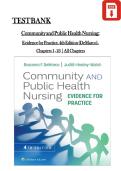
COMMUNITY & PUBLIC HEALTH NURSING: EVIDENCE FOR PRACTICE 4TH EDITION DEMARCO WALSH TEST BANK – NUR 420 COMPLETE CHAPTERS 1-25 WITH ANSWERS

Rating
-
Sold
-
Pages
460
Grade
A+
Uploaded on
25-02-2026
Written in
2025/2026

PREMIUM COMMUNITY & PUBLIC HEALTH NURSING TEST BANK – YOUR COMPLETE STUDY SOLUTION FOR NUR 420, NUR 480 & MORE! Master community and public health nursing with this comprehensive test bank for the 4th Edition of DeMarco and Walsh's evidence-based textbook. Perfect for exam preparation, clinical practice, and mastering population health concepts! What This Test Bank Includes: All 25 Chapters Fully Covered – Complete test bank from Ch. 1 through Ch. 25 Hundreds of Questions – Extensive practice with multiple formats Verified Answers Included – All answers clearly marked (A, B, C, D, E) for self-assessment Question Formats: Multiple Choice, Select All That Apply – As shown in document Page References – Every question cross-referenced to specific textbook pages Bloom's Taxonomy – Questions categorized (Remember, Understand, Apply, Analyze, Evaluate) Answer Rationales Provided – Detailed explanations for every answer Case-Based Questions – Real-world scenarios testing clinical application Searchable PDF – Find specific topics instantly Mobile-Ready – Study anywhere, anytime Chapter Highlights: Ch. 1 (Public Health Nursing – Present, Past, and Future): Patient-centered care, personal responsibility for health, public health interventions, public health nursing principles, historical nursing figures (Lillian Wald, Clara Barton, Dorothea Dix, Lemuel Shattuck), Healthy People 2020 goals, social determinants of health, domains of public health nursing practice, telehealth, health information technology, nursing education requirements, public health achievements Ch. 2 (Public Health Systems): Global health organizations (WHO, ICN), bilateral and multilateral agencies, nongovernmental organizations (NGOs), philanthropic organizations (Bill and Melinda Gates Foundation), international healthcare systems (France, Canada, Germany, Netherlands), U.S. healthcare system, Medicare, Medicaid, TRICARE, CHIP, health disparities, National Health Expenditure Accounts Ch. 3 (Health Policy, Politics, and Reform): Politics vs. policy, policy-making process (agenda setting, formulation, adoption, implementation, assessment, modification), political skills, cost-benefit analysis, Patient Protection and Affordable Care Act (ACA), quality of care, Institute of Medicine dimensions, Community Transformation Grant program, ethical decision-making, ANA Code of Ethics Ch. 4 (Global Health – A Community Perspective): WHO definition of health, health indicators (HALE, DALY, life expectancy), Millennium Development Goals, risk factors in low- and middle-income countries, epidemiologic and demographic transitions, poverty levels (extreme, moderate, relative), health models (clinical, role performance, adaptive, eudaimonistic), determinants of health, brain drain/gain Ch. 5 (Frameworks for Health Promotion, Disease Prevention, and Risk Reduction): Healthy People 2020 focal areas, levels of prevention (primary, secondary, tertiary, quaternary), motivational interviewing, health behavior models (Health Belief Model, Transtheoretical Model, Theory of Reasoned Action, Social Learning Theory, Relapse Prevention Model), screening types (mass, selective, multiphasic), silencing the self, positive prevention, ecological model Ch. 6 (Epidemiology – The Science of Prevention): Historical epidemiologists (Hippocrates, Aretaeus, Galen, Susruta, Graunt, Farr, Nightingale, Snow), epidemiologic process vs. nursing process, epidemiologic triad, wheel of causation, web of causation, natural history of disease, epidemic, endemic, pandemic, risk factors, outbreak investigation Ch. 7 (Describing Health Conditions – Understanding and Using Rates): Rates (crude, adjusted, specific), incidence vs. prevalence, mortality rates (infant, neonatal, perinatal, fetal, maternal, case fatality), sensitivity and specificity, relative risk, attributable risk, epidemic curves, incidence density Ch. 8 (Gathering Evidence for Public Health Practice): Research designs (cohort, case-control, cross-sectional, experimental, quasi-experimental, preventive, therapeutic), internal and external validity threats (history, maturation, testing, selection, instrumentation, mortality, reactivity, novelty), relative risk calculation, type I and type II errors, p-values Ch. 9 (Planning for Community Change): Logic models, health inequities vs. disparities, Lewin's change theory (unfreezing, moving, refreezing), force field analysis, upstream, mainstream, and downstream interventions, social marketing, community health workers, coalition building, sustainability, program replication, accountability, systems theory Ch. 10 (Cultural Competence – Awareness, Sensitivity, and Respect): Culture, cultural competence, cultural safety, ethnocentrism, cross-cultural nursing, cultural humility, subculture, interpreters vs. translators, personal space, fatalism, time orientation, cultural brokerage, folk healers Ch. 11 (Community Assessment): Geopolitical community, community of solution, windshield surveys, triangulation, data sources (primary and secondary), epidemiologic approach, asset-based assessment, functional health patterns, developmental model, collaborative model, geographic information systems (GIS) Ch. 12 (Care Management, Case Management, and Home Healthcare): Care management vs. case management, disease management, advocacy, interdisciplinary collaboration, home healthcare types (private/voluntary, proprietary, hospital-based, official), Medicare criteria for home health services, telehealth, parish nursing, motivational interviewing phases, home visit phases Ch. 13 (Family Assessment): Grand nursing theories (Science of Unitary Beings, Health as Expanding Consciousness, Roy Adaptation Model, Self-care Agency), family assessment approaches (Life Span Development, Rituals and Routines, Functional Health Patterns, Family Systems), 15-minute family interview, genograms, ecomaps, nuclear vs. extended families, blended families, caregiver burden, cultural diversity, generation X/Y Ch. 14 (Risk of Infectious and Communicable Diseases): Chain of infection (agent, host, environment), communicable vs. infectious diseases, modes of transmission (direct, indirect, airborne, droplet, vector, vehicle), incubation period, carriers, colonization, endemic vs. epidemic vs. pandemic, outbreak types (common source, propagated), public health surveillance, norovirus, foodborne illnesses (Campylobacter, Listeria, Salmonella, E. coli), STIs, syphilis stages Ch. 15 (Emerging Infectious Diseases): Antigenic drift vs. shift, herd immunity, microbial adaptation stages, emerging diseases (SARS, MERS-CoV, H5N1, West Nile virus, Lyme disease, E. coli O157:H7), tuberculosis (latent vs. active, PPD testing, directly observed therapy), Ebola virus disease, Institute of Medicine convergence model Ch. 16 (Violence and Abuse): Gender-based violence, intimate partner violence (IPV), femicide, risk factors (individual, relationship, community, societal), lethality assessment, levels of prevention for IPV, child abuse and neglect definitions (CAPTA), screening strategies, safety planning, gun violence, adolescent violence effects Ch. 17 (Substance Use): Tolerance vs. withdrawal, substance dependence, comorbidity with mental illness, college drinking, inhalant use, Native American substance use, motivational interviewing for substance abuse, opioid substitution treatment, syringe exchange programs, HIV and substance use, screening tools (AUDIT-C, CAGE, T-ACE, SMAST-G), pharmacologic treatments (naltrexone, acamprosate, disulfiram, naloxone) Ch. 18 (Underserved Populations): Medically underserved areas (MUAs) and populations (MUPs), health professional shortage areas (HPSAs), rural health challenges (Seven A's: Availability, Accessibility, Affordability, Awareness, Adequacy, Acceptability, Assessment), rural health priorities, Children's Defense Fund, incarcerated populations, genomics in underserved populations, urbanized area definition Ch. 19 (Environmental Health): Exposure pathway, exposure history, environmental media, contaminants (chemical, biological, radiological), risk assessment (Risk = Hazard × Exposure), bioavailability, biomonitoring, environmental epidemiology, Superfund, Clean Air Act, Clean Water Act, environmental justice, children's vulnerability, climate change and health Ch. 20 (Community Preparedness – Disaster and Terrorism): Disaster phases (preimpact, impact, postimpact), hazard identification, disaster management roles, triage systems (START, JumpSTART, Start/Save), point of distribution (POD), personal protective equipment (PPE), disaster documentation, chemical and radiological disasters, risk communication, critical incident stress debriefing, biological agents (anthrax, plague, botulism), Ebola response Ch. 21 (Community Mental Health): Levels of prevention for mental health, culture-bound syndromes, untreated mental illness demographics, antipsychotic medications (first- vs. second-generation), tardive dyskinesia, metabolic syndrome, deinstitutionalization, suicide risk factors, means restriction, ADHD vs. bipolar disorder in children, autism screening, comorbid conditions in schizophrenia, antidepressants (SSRIs, TCAs) Ch. 22 (School Health): Components of comprehensive school health programs, Medicaid-reimbursable school services, Youth Risk Behavior Surveillance Survey (YRBSS), school nurse roles (clinician, advocate, educator), community school model, cyberbullying, Education for All Handicapped Children Act, school nursing competencies, adolescent pregnancy prevention, HIV testing recommendations, CDC school health guidelines Ch. 23 (Faith-Oriented Communities and Health Ministries in Faith Communities): Faith community nursing models (congregation-based, institution-based, parish nursing), congregation characteristics, advisory boards, levels of prevention in faith communities, parish nurse functions (health educator, personal health counselor, referral agent, coordinator of volunteers, developer of supportive groups, integrator of faith and health, health advocate), ethical principles (autonomy, confidentiality, beneficence, nonmaleficence) Ch. 24 (Palliative and End-of-Life Care): Hospice care vs. palliative care, leading causes of death, comfort measures only (CMO), advance directives (living will, healthcare proxy), grief phases (numb shock, emotional turmoil, reorganization), signs of imminent death, postmortem care, pain types (somatic, visceral, neuropathic), pain management ladder (nonopioids, opioids, adjuvants), routes of pain medication administration, cultural considerations at end of life Ch. 25 (Occupational Health Nursing): Benner's stages of competency (novice, advanced beginner, competent, proficient, expert), workplace hazards (physical, biological, chemical, psychosocial), epidemiologic triad in occupational health, OSHA logs, workplace walk-throughs, occupational health history, root cause analysis, health promotion in the workplace, emergency planning, shelter-in-place, surveillance in occupational health Key Topics Covered: Public health nursing history, roles, and core functions Epidemiology: rates, study designs, outbreak investigation Health promotion theories and behavior change models Community assessment methods and tools Cultural competence and working with diverse populations Family assessment and nursing theories Infectious and communicable disease prevention Emerging infectious diseases and bioterrorism preparedness Violence, abuse, and trauma-informed care Substance use disorders and treatment approaches Working with underserved and vulnerable populations Environmental health hazards and risk assessment Disaster preparedness and emergency management Community mental health and psychiatric nursing School health nursing and adolescent health Faith community nursing and parish nursing Palliative care, hospice, and end-of-life nursing Occupational health nursing and workplace safety Health policy, advocacy, and healthcare reform Global health and international nursing Home healthcare and case management Care of older adults and chronic disease management Maternal-child health and family nursing Ethical and legal issues in community health Sample Questions Preview: Chapter 1, Question 1: A nurse is striving to practice patient-centered care at a hospital. Which action best exemplifies providing patient-centered care? (Answer: A – Having a client complete a self-reported functional status indicator and then reviewing it with the client) Chapter 6, Question 1: Which was the leading cause of death in the United States in 1900? (Answer: A – Major cardiovascular-renal disease) Chapter 11, Question 1: Community assessment is a critical process for the future because it can: (Answer: B – Identify a method to improve the health of at-risk clients) Chapter 16, Question 1: Which most accurately defines gender-based violence? (Answer: B – Violence that targets people or groups of people on the basis of their gender) Chapter 20, Question 1: The public health nurse works in New England during the winter months. An ice storm cripples the city, and electrical outages affect the power grid. Trees and frozen power lines are down throughout the city, and the timeline for restoration of power is 7 to 10 days. The management team should classify this occurrence as: (Answer: B – A natural disaster) Perfect For: NUR 420, NUR 480, PH 410, PUBH 330, NURS 350, COMMUNITY 450, and any undergraduate or graduate-level Community Health Nursing, Public Health Nursing, or Population Health courses ⏳ DOWNLOAD INSTANTLY ON STUVIA AND MASTER COMMUNITY & PUBLIC HEALTH NURSING WITH CONFIDENCE!

Show more Read less
Institution
Public Health Nursing
Course
Public Health Nursing

Content preview

TEST BANK
= =


Community and Public Health Nursing:
= = = = =


Evidence for Practice, 4th Edition (DeMarco),
= = = = = =


Chapters 1 - 25 | All Chapters
= = = = = =

,TABLE OF CONTENTS
= =

,Chapter 1: Public Health Nursing
= = = =


1. A=nurse=is=striving=to=practice=patient-
centered=care=at=a=hospital.=Which=action=best=exemplifies=providing=patient-
centered=care?
A) Having=a=client=complete=a=self-
reported=functional=status=indicator=and=then=reviewing=it= with=the=client
B) Explaining=to=a=client=the=benefits=of=computer-
assisted=robotic=surgical=techniques,=which=the=hospital=recently=implemen
ted
C) Recording=a=client's=signs=and=symptoms=in=an=electronic=health=record
D) Performing=continuous=glucose=monitoring=of=a=client=while=the=client=is=in=the=ho
spital
ANSWER:= A
Feedback:
Patient-
centered=care=considers=cultural=traditions,=personal=preferences,=values,=families,=and=lifest
yles.=Clients=become=active=participants=in=their=own=care,=and=monitoring=health=becomes=t
he=client's=responsibility.=To=help=clients=and=their=healthcare=providers=make=better=decisi
ons,=the=Agency=for=Healthcare=Research=and=Quality=(AHRQ)=has=developed=a=series=of=t
ools=that=empower=clients=and=assist=providers=in=achieving=desired=outcomes,=including=cli
ent-reported=functional=status=indicators.=Computer-
assisted=robotic=surgical=techniques,=electronic=health=records,=and=continuous=glucose=moni
toring=in=the=hospital=are=all=technological=advances=in=healthcare,=but=they=do=not=help=the=
client=become=a=more=active=participant=in=his=or=her=care,=and=thus=are=not=good=examples=
of=patient-centered=care.


Origin:= Chapter=1-=Public=Health=Nursing,=2
2. A=nurse=is=caring=for=an=older=client=who=is=struggling=to=manage=her=type=2=diabetes=mellit
us.=The=nurse=should=recognize=which=social=determinants=of=this=client's=health?=(Select= a
ll=that= apply.)

, A) Household=income=of=$23,000=per=year
B) Reading=level=of=a=third=grader
C) Medication=ineffective=due=to=error=in=prescription
D) Originally=from=Sudan
E) No=family=in=the=area=
ANSWER:= A,=B,=D,=E=Fee
dback:
The=social=conditions=in=which=people=live,=their=income,=social=status,=education,=literacy,=
home=and=work=environment,=support=networks,=gender,=culture,=and=availability=of=health=
services=are=the=social=determinants=of=health.=These=conditions=have=an=impact=on=the=exte
nt=to=which=a=person=or=community=possesses=the=physical,=social,=and=personal=resources=n
ecessary=to=attain=and=maintain=health.=A=medical=error=on=the=part=of=the=client's=primary=ca
re=provider=or=nurse=would=not=constitute=a=social=determinant=of=the=client's=health.


Written for

Institution
Public Health Nursing
Course
Public Health Nursing

Document information

Uploaded on
February 25, 2026
Number of pages
460
Written in
2025/2026
Type
Exam (elaborations)
Contains
Questions & answers

Subjects

$21.99
Get access to the full document:

Wrong document? Swap it for free Within 14 days of purchase and before downloading, you can choose a different document. You can simply spend the amount again.
Written by students who passed
Immediately available after payment
Read online or as PDF

Get to know the seller

Seller avatar
Reputation scores are based on the amount of documents a seller has sold for a fee and the reviews they have received for those documents. There are three levels: Bronze, Silver and Gold. The better the reputation, the more your can rely on the quality of the sellers work.
ProfReginaMSNRN Teachme2-tutor
View profile
Follow You need to be logged in order to follow users or courses
Sold
12
Member since
1 year
Number of followers
1
Documents
224
Last sold
1 week ago
Prof. Regina MSN,RN

Welcome to Regina Callion's Study Hub! Hi, I'm Regina Callion, MSN, RN — a nursing professional with real clinical and academic experience. I created this store to give nursing and science students access to high-quality, accurate, and well-structured study materials that actually work. Here you'll find notes, summaries, test banks, and exam guides covering Nursing, Biology, Anatomy & Physiology, Microbiology, and more — all built around real coursework and exam standards. Every file is current, verified, and easy to follow — whether you're just starting out or pushing through finals. Study smarter, not harder. You've got this!

Read more Read less
4.7

3 reviews

5
2
4
1
3
0
2
0
1
0

Recently viewed by you

Why students choose Stuvia

Created by fellow students, verified by reviews

Quality you can trust: written by students who passed their tests and reviewed by others who've used these notes.

Didn't get what you expected? Choose another document

No worries! You can instantly pick a different document that better fits what you're looking for.

Pay as you like, start learning right away

No subscription, no commitments. Pay the way you're used to via credit card and download your PDF document instantly.

Student with book image

“Bought, downloaded, and aced it. It really can be that simple.”

Alisha Student

Working on your references?

Create accurate citations in APA, MLA and Harvard with our free citation generator.

Working on your references?

Frequently asked questions
