
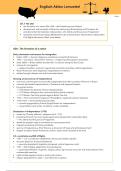
Englisch Abitur Lernzettel
FFBA53
Q1.1 The USA
• the formation of a nation (Die USA – die Entstehung einer Nation)
• development and principles of American democracy (Entwicklung und Prinzipien der
amerikanischen Demokratie), insbesondere „life, liberty and the pursuit of happiness“
• landmarks of American history (Meilensteine der amerikanischen Geschichte): insbesondere
Civil Rights Movement, Black Lives Matter
USA - The formation of a nation
Early colonization and reasons for immigration
• before 1492 -> diverse indigenous civilizations across North America
• 1492 -> Columbus “discovered” America -> beginning of European colonization
• early 1600s -> British settlers founded the 13 colonies along the East Coast
• motives for immigration
-> religious freedom, economic opportunity and land ownership, political oppression,...
• Native Americans were displaced, marginalized or enslaved
• settlers brought disease, war and forced assimilation
Growing unrest and war of independence
• over time, colonies grew economically independent but had no political influence in Britain
• colonists demanded representation in Parliament and opposed taxation
• key protest events
-> 1765 Stamp Act (taxation without representation)
-> 1770 Boston Massacre (five colonists killed by British soldiers)
-> 1773 Boston Tea Party (protest against British Tea Act)
• 1774 -> First Continental Congress in Philadelphia: organized colonial resistance
• 1775–1783 -> American Revolutionary War
-> colonies (supported by France) fought Britain for independence
-> many battles, harsh winter conditions, civilian hardships
Declaration of Independence (1776)
• written by Thomas Jefferson, adopted July 4, 1776
• proclaimed that all men are created equal and endowed with unalienable rights
-> life, liberty and the pursuit of happiness
• stated the people’s right to overthrow an unjust government
• inspired revolutionary thinking worldwide
• seen by immigrants (e.g. Khizr Khan) as a document of hope and self-empowerment
• despite its ideals, Native Americans, women, slaves were excluded at the time
U.S. constitution and Bill of Rights
• 1787 -> U.S. Constitution established a democratic federal republic
• structure based on checks and balances:
-> executive (president), legislative (congress), judicial (supreme court)
• 1791 -> Bill of Rights added (first 10 amendments)
-> guaranteed freedom of speech, religion, press; right to bear arms; fair trial and protection from
unreasonable searches
• rights initially applied mainly to white male citizens
• religion separated from state -> still influential in politics
,Expansion, slavery and Civil War
• expansion westward ("manifest destiny") led to land grabs and Native displacement
• slavery became central to the economy in the South
• enslaved Africans -> worked on plantations, treated as property
• slave trade -> lucrative business involving European goods and forced transport to America
• illegal activities for slaves (house and field slaves)
-> owning property, learning to read and write, marriage, running away, voting,...
• 1808 -> Congress banned international slave trade
• Civil War (1861–1865)
-> southern states (Confederacy) wanted to secede to preserve slavery
-> northern states (Union) opposed expansion of slavery
-> deadly war, North won
• 1863 -> Abraham Lincoln signed Emancipation Proclamation
• 1865 -> 13th Amendment abolished slavery nationwide
Post-war segregation and Jim Crow
• although slavery was abolished, racial inequality continued
• Black Codes -> controlled lives of freed slaves
• Jim Crow laws (starting 1865)
-> legalized segregation of schools, transport, public places
-> black people treated as second-class citizens
-> interracial marriage illegal
-> segregated cemeteries, jails, asylums, public parks, phone booths
• public facilities were "separate but equal" -> in reality unequal
The Civil Rights Movement (1950s–1960s)
• African Americans and allies protested racial discrimination and voter suppression
• key figures
-> Rosa Parks: refused to give up her seat -> Montgomery Bus Boycott
-> Martin Luther King Jr.: peaceful protest, "I have a dream", arrested 30+ times
-> Malcolm X: self-defense, member of Nation of Islam, more radical
• key events
-> 1954: Brown vs. Board of Education -> segregation in schools unconstitutional
-> 1955: Emmet Till murdered
-> 1955: Montgomery Bus Boycott (successful)
-> 1957: Little Rock Nine -> desegregation of school in Arkansas
-> 1960s: sit-ins (e.g. Greensboro Four)
-> 1961: Freedom Riders -> challenged segregated interstate buses, met with violence
-> 1963: March on Washington -> 200,000+ people protested for civil rights
-> 1965: Selma March (Bloody Sunday)
-> 1968: assassination of MLK Jr.
• results of the movement
-> Civil Rights Act (1964): banned discrimination in public places and employment
-> Voting Rights Act (1965): protected black voting rights
-> Fair Housing Act (1968): outlawed housing discrimination
• resistance (e.g.)
-> Ku Klux Klan: terror, violence, "white racial power"
-> George Wallace: openly segregationist governor of Alabama
Black Lives Matter (from 2013)
• started after death of Trayvon Martin
• gained global attention after death of George Floyd in 2020
• goals
-> end police brutality
-> racial justice and accountability
-> awareness of systemic racism in education, housing, justice system
• mass protests, especially after high-profile killings
• sparked national debate about racism, justice, and historical memory
• part of a broader continuation of civil rights activism
,Development and principles of American democracy
Founding ideals and structure
• American democracy based on Enlightenment principles
-> natural rights (life, liberty, happiness)
-> rule of law
-> equality and individualism
• Declaration of Independence (1776)
-> right to resist tyranny
-> importance of freedom and justice
• Constitution (1787)
-> created checks and balances
-> prevents abuse of power
-> divides power between federal and state governments
Bill of Rights (1791)
• protects personal freedoms and civil rights
• key amendments
-> 1st: freedom of speech, press, religion, assembly
-> 2nd: right to bear arms
-> 4th: protection from searches and seizures
-> 5th: no self-incrimination, due process
• inspired global democratic movements
• not originally applied equally to all citizens
Gettysburg address (1863)
• delivered by Abraham Lincoln during the Civil War
• emphasized unity, sacrifice, democratic renewal
• quote: "government of the people, by the people, for the people"
• rebirth of democracy through sacrifice
• used inclusive language (we/us) to strengthen national identity
Democracy and its contradictions
• democratic ideals often not realized for minorities
• discrimination and exclusion persisted after independence
• Civil Rights Movement -> necessary to fulfill democratic promises
• Black Lives Matter continues democratic activism today
• democracy is an evolving project requiring continuous participation and reform
Life, liberty and the pursuit of happiness
• phrase from the Declaration of Independence: "We hold these truths to be self-evident, that all men are
created equal, that they are endowed... with certain unalienable Rights, that among these are Life, Liberty
and the pursuit of Happiness”
• -> life -> right to safety, existence and dignity
-> liberty -> freedom of thought, expression, religion and political participation
-> pursuit of happiness -> right to seek fulfillment, personal goals and well-being
• represents American belief in freedom, ambition, and opportunity
• forms the ideological foundation of the American Dream
-> belief that anyone can succeed through hard work and freedom of choice
-> linked to ideas of social mobility, self-determination and individual success
• symbol of hope for immigrants and marginalized communities
• interpreted differently
-> for some: individual success and personal freedom
-> for others: justice, equality, protection from oppression
• originally excluded women, enslaved people, Native Americans and other minorities
• despite contradictions, remains a powerful and influential ideal
-> cited in civil rights movements, political speeches, and social activism
-> continues to inspire debates about equality, justice and the American identity
, Movements, Events and Figures in the Civil Rights Movement - chronological overview
Ku Klux Klan (KKK)
emerged after the Civil War (1860s)
• secret group, used violence and intimidation against Black individuals
• spread terror through activities like lynching
• aimed to suppress the civil rights of African Americans
Brown vs. Board of Education
1954
• landmark court case declaring racial segregation in public schools unconstitutional
• significantly impacted the fight against racial discrimination in education
• set the stage for further legal challenges
Montgomery Bus Boycott
1955-1956
• protest against segregated seating on buses
• sparked by Rosa Parks' refusal to give up her seat
• led by Martin Luther King Jr., highlighting nonviolent resistance
Little Rock Nine
1957 (consequence of the Brown vs. Board of Education movement)
• nine Black students integrated into an all-white high school in Little Rock, Arkansas
• faced hostility and opposition, including the National Guard
• symbolic of the struggle for desegregation in education
Greensboro Four
1960
• four African American college students staged a sit-in at a segregated lunch counter
• demonstrated nonviolent protest against racial segregation
• inspired similar acts of civil disobedience
Freedom Riders
1961
• activists who rode interstate buses to challenge segregation in the Southern United States
• faced violence and arrest for their actions
• contributed to the desegregation of interstate transportation
Martin Luther King Jr.
1929-1968
• leader of the Civil Rights Movement, known for his advocacy of nonviolent protest
• delivered the iconic "I Have a Dream" speech during the March on Washington
• assassinated in 1968, leaving a lasting legacy
March on Washington
1963
• massive rally for civil and economic rights, where Martin Luther King Jr. delivered his famous speech
• demonstrated the unity of the Civil Rights Movement
• contributed to the passing of the Civil Rights Act of 1964
Loving vs. Virginia
1967
• Supreme Court case that declared laws banning interracial marriage unconstitutional
• involved the marriage of Richard and Mildred Loving
• significantly impacted anti-miscegenation laws nationwide
FFBA53
Q1.1 The USA
• the formation of a nation (Die USA – die Entstehung einer Nation)
• development and principles of American democracy (Entwicklung und Prinzipien der
amerikanischen Demokratie), insbesondere „life, liberty and the pursuit of happiness“
• landmarks of American history (Meilensteine der amerikanischen Geschichte): insbesondere
Civil Rights Movement, Black Lives Matter
USA - The formation of a nation
Early colonization and reasons for immigration
• before 1492 -> diverse indigenous civilizations across North America
• 1492 -> Columbus “discovered” America -> beginning of European colonization
• early 1600s -> British settlers founded the 13 colonies along the East Coast
• motives for immigration
-> religious freedom, economic opportunity and land ownership, political oppression,...
• Native Americans were displaced, marginalized or enslaved
• settlers brought disease, war and forced assimilation
Growing unrest and war of independence
• over time, colonies grew economically independent but had no political influence in Britain
• colonists demanded representation in Parliament and opposed taxation
• key protest events
-> 1765 Stamp Act (taxation without representation)
-> 1770 Boston Massacre (five colonists killed by British soldiers)
-> 1773 Boston Tea Party (protest against British Tea Act)
• 1774 -> First Continental Congress in Philadelphia: organized colonial resistance
• 1775–1783 -> American Revolutionary War
-> colonies (supported by France) fought Britain for independence
-> many battles, harsh winter conditions, civilian hardships
Declaration of Independence (1776)
• written by Thomas Jefferson, adopted July 4, 1776
• proclaimed that all men are created equal and endowed with unalienable rights
-> life, liberty and the pursuit of happiness
• stated the people’s right to overthrow an unjust government
• inspired revolutionary thinking worldwide
• seen by immigrants (e.g. Khizr Khan) as a document of hope and self-empowerment
• despite its ideals, Native Americans, women, slaves were excluded at the time
U.S. constitution and Bill of Rights
• 1787 -> U.S. Constitution established a democratic federal republic
• structure based on checks and balances:
-> executive (president), legislative (congress), judicial (supreme court)
• 1791 -> Bill of Rights added (first 10 amendments)
-> guaranteed freedom of speech, religion, press; right to bear arms; fair trial and protection from
unreasonable searches
• rights initially applied mainly to white male citizens
• religion separated from state -> still influential in politics
,Expansion, slavery and Civil War
• expansion westward ("manifest destiny") led to land grabs and Native displacement
• slavery became central to the economy in the South
• enslaved Africans -> worked on plantations, treated as property
• slave trade -> lucrative business involving European goods and forced transport to America
• illegal activities for slaves (house and field slaves)
-> owning property, learning to read and write, marriage, running away, voting,...
• 1808 -> Congress banned international slave trade
• Civil War (1861–1865)
-> southern states (Confederacy) wanted to secede to preserve slavery
-> northern states (Union) opposed expansion of slavery
-> deadly war, North won
• 1863 -> Abraham Lincoln signed Emancipation Proclamation
• 1865 -> 13th Amendment abolished slavery nationwide
Post-war segregation and Jim Crow
• although slavery was abolished, racial inequality continued
• Black Codes -> controlled lives of freed slaves
• Jim Crow laws (starting 1865)
-> legalized segregation of schools, transport, public places
-> black people treated as second-class citizens
-> interracial marriage illegal
-> segregated cemeteries, jails, asylums, public parks, phone booths
• public facilities were "separate but equal" -> in reality unequal
The Civil Rights Movement (1950s–1960s)
• African Americans and allies protested racial discrimination and voter suppression
• key figures
-> Rosa Parks: refused to give up her seat -> Montgomery Bus Boycott
-> Martin Luther King Jr.: peaceful protest, "I have a dream", arrested 30+ times
-> Malcolm X: self-defense, member of Nation of Islam, more radical
• key events
-> 1954: Brown vs. Board of Education -> segregation in schools unconstitutional
-> 1955: Emmet Till murdered
-> 1955: Montgomery Bus Boycott (successful)
-> 1957: Little Rock Nine -> desegregation of school in Arkansas
-> 1960s: sit-ins (e.g. Greensboro Four)
-> 1961: Freedom Riders -> challenged segregated interstate buses, met with violence
-> 1963: March on Washington -> 200,000+ people protested for civil rights
-> 1965: Selma March (Bloody Sunday)
-> 1968: assassination of MLK Jr.
• results of the movement
-> Civil Rights Act (1964): banned discrimination in public places and employment
-> Voting Rights Act (1965): protected black voting rights
-> Fair Housing Act (1968): outlawed housing discrimination
• resistance (e.g.)
-> Ku Klux Klan: terror, violence, "white racial power"
-> George Wallace: openly segregationist governor of Alabama
Black Lives Matter (from 2013)
• started after death of Trayvon Martin
• gained global attention after death of George Floyd in 2020
• goals
-> end police brutality
-> racial justice and accountability
-> awareness of systemic racism in education, housing, justice system
• mass protests, especially after high-profile killings
• sparked national debate about racism, justice, and historical memory
• part of a broader continuation of civil rights activism
,Development and principles of American democracy
Founding ideals and structure
• American democracy based on Enlightenment principles
-> natural rights (life, liberty, happiness)
-> rule of law
-> equality and individualism
• Declaration of Independence (1776)
-> right to resist tyranny
-> importance of freedom and justice
• Constitution (1787)
-> created checks and balances
-> prevents abuse of power
-> divides power between federal and state governments
Bill of Rights (1791)
• protects personal freedoms and civil rights
• key amendments
-> 1st: freedom of speech, press, religion, assembly
-> 2nd: right to bear arms
-> 4th: protection from searches and seizures
-> 5th: no self-incrimination, due process
• inspired global democratic movements
• not originally applied equally to all citizens
Gettysburg address (1863)
• delivered by Abraham Lincoln during the Civil War
• emphasized unity, sacrifice, democratic renewal
• quote: "government of the people, by the people, for the people"
• rebirth of democracy through sacrifice
• used inclusive language (we/us) to strengthen national identity
Democracy and its contradictions
• democratic ideals often not realized for minorities
• discrimination and exclusion persisted after independence
• Civil Rights Movement -> necessary to fulfill democratic promises
• Black Lives Matter continues democratic activism today
• democracy is an evolving project requiring continuous participation and reform
Life, liberty and the pursuit of happiness
• phrase from the Declaration of Independence: "We hold these truths to be self-evident, that all men are
created equal, that they are endowed... with certain unalienable Rights, that among these are Life, Liberty
and the pursuit of Happiness”
• -> life -> right to safety, existence and dignity
-> liberty -> freedom of thought, expression, religion and political participation
-> pursuit of happiness -> right to seek fulfillment, personal goals and well-being
• represents American belief in freedom, ambition, and opportunity
• forms the ideological foundation of the American Dream
-> belief that anyone can succeed through hard work and freedom of choice
-> linked to ideas of social mobility, self-determination and individual success
• symbol of hope for immigrants and marginalized communities
• interpreted differently
-> for some: individual success and personal freedom
-> for others: justice, equality, protection from oppression
• originally excluded women, enslaved people, Native Americans and other minorities
• despite contradictions, remains a powerful and influential ideal
-> cited in civil rights movements, political speeches, and social activism
-> continues to inspire debates about equality, justice and the American identity
, Movements, Events and Figures in the Civil Rights Movement - chronological overview
Ku Klux Klan (KKK)
emerged after the Civil War (1860s)
• secret group, used violence and intimidation against Black individuals
• spread terror through activities like lynching
• aimed to suppress the civil rights of African Americans
Brown vs. Board of Education
1954
• landmark court case declaring racial segregation in public schools unconstitutional
• significantly impacted the fight against racial discrimination in education
• set the stage for further legal challenges
Montgomery Bus Boycott
1955-1956
• protest against segregated seating on buses
• sparked by Rosa Parks' refusal to give up her seat
• led by Martin Luther King Jr., highlighting nonviolent resistance
Little Rock Nine
1957 (consequence of the Brown vs. Board of Education movement)
• nine Black students integrated into an all-white high school in Little Rock, Arkansas
• faced hostility and opposition, including the National Guard
• symbolic of the struggle for desegregation in education
Greensboro Four
1960
• four African American college students staged a sit-in at a segregated lunch counter
• demonstrated nonviolent protest against racial segregation
• inspired similar acts of civil disobedience
Freedom Riders
1961
• activists who rode interstate buses to challenge segregation in the Southern United States
• faced violence and arrest for their actions
• contributed to the desegregation of interstate transportation
Martin Luther King Jr.
1929-1968
• leader of the Civil Rights Movement, known for his advocacy of nonviolent protest
• delivered the iconic "I Have a Dream" speech during the March on Washington
• assassinated in 1968, leaving a lasting legacy
March on Washington
1963
• massive rally for civil and economic rights, where Martin Luther King Jr. delivered his famous speech
• demonstrated the unity of the Civil Rights Movement
• contributed to the passing of the Civil Rights Act of 1964
Loving vs. Virginia
1967
• Supreme Court case that declared laws banning interracial marriage unconstitutional
• involved the marriage of Richard and Mildred Loving
• significantly impacted anti-miscegenation laws nationwide


